Amazon just rolled out a new Kindle feature called Ask This Book. It lets readers ask questions about whatever they’re reading and get AI-generated answers on the spot.
Right now, it’s available in the Kindle iOS app for U.S. customers, with plans to expand to Kindle devices and Android later in 2026.
Forget who a character is? Want a reminder of what happened earlier? Confused about a scene? You can now ask, and the system will tell you.
What makes this different from most reading tools is that it doesn’t send you back to the page. It offers its own explanations.
And it does it without the author’s involvement, permission, or ability to intervene.
That’s the problem.
What ‘Ask This Book' actually does
Amazon describes Ask This Book as a way for readers to get quick answers without breaking their reading flow. You can see how they frame it in their official announcement.
And that’s part of what it’s doing.
You can highlight a name, a scene, or a moment you don’t quite remember, type in a question, and the system will answer it for you right there inside the book.
But it doesn’t just send you back to the page.
It explains.
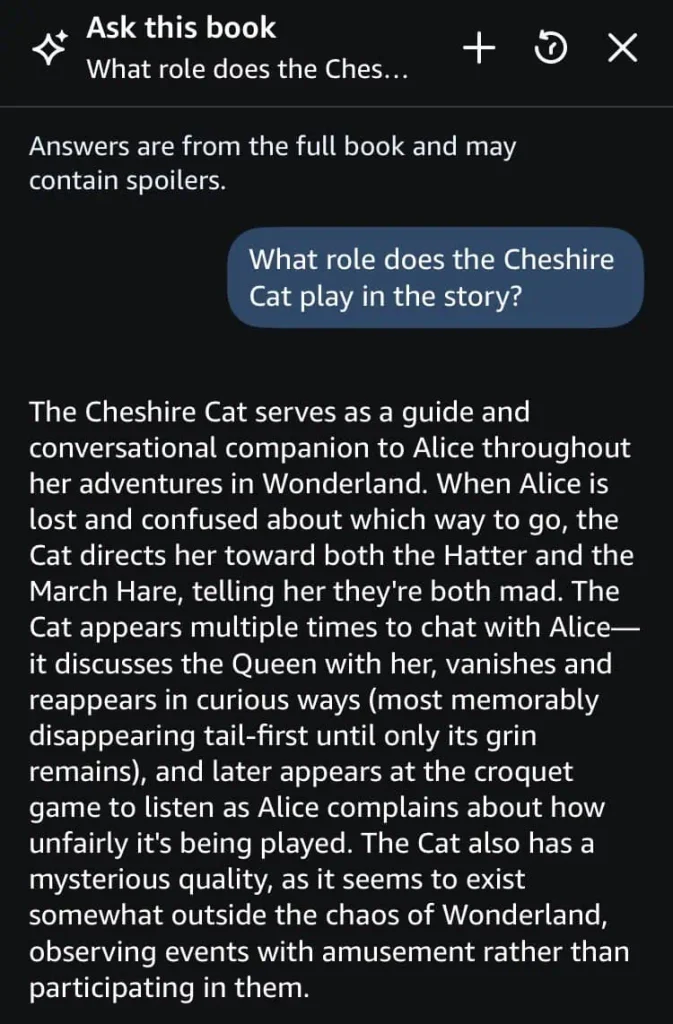
For example, I asked Ask This Book a simple question about Alice's Adventures in Wonderland: “What role does the Cheshire Cat play in the story?”
Rather than pointing me to a chapter or quoting a line, the system gave me a full paragraph describing who the character is, what he’s like, and how he behaves, all in its own words.
I then asked it a very different kind of question:
“Why does the logic in the story feel broken?”
This wasn’t a lookup question. It wasn’t about remembering a detail.
And the answer reflected that.
The system responded with a confident, multi-paragraph explanation about dream logic, absurdity, and how Wonderland is meant to operate outside normal cause-and-effect rules. It stitched together examples, explained the theme, and told me how to understand what I was reading.
That might sound fine. Helpful, even.
But notice what’s happening.
Instead of helping you look something up, the system is giving you its version of what that thing means. It decides what matters, what doesn’t, what’s central, and what can be glossed over.
Those judgments usually come from the reader, or from the way the author built the story.
Here, they’re coming from somewhere else.
And because these answers show up right inside the book, they don’t feel like a separate tool. They feel like part of the experience. Most readers probably won’t stop to think about where the explanation came from. They’ll just absorb it and keep going.
When something’s confusing, you don’t really have to sit with it anymore. You can just ask and move on.
You still get the story and you can still enjoy it.
But it’s a different kind of experience.
Why authors are pushing back
Authors didn’t opt into this.
There’s no toggle for it. No setting. No way to say, “I don’t want this layered on top of my book.” It’s just there.
If your book is on Kindle, Ask This Book can explain it, summarize it, and interpret it. You don’t get to review what it says. You don’t get to correct it. And you don’t get to decide how your characters or scenes are framed.
That’s what’s bothering a lot of authors.
The Authors Guild has pushed back on this for exactly that reason. When Amazon adds a layer like this, it starts treating the book as a different kind of product. And normally, that’s the sort of thing authors get a say in.
In their statement, they describe Ask This Book as turning books into “searchable, interactive products,” similar to enhanced ebooks or annotated editions. They point out that formats like that usually come with new rights, new terms, and new negotiations.
Put simply, this changes the deal. And nobody asked the authors.
Why this crosses a line
The Authors Guild isn’t the only one worried about this. Writer Beware, which mostly exists to warn authors about bad actors and sketchy practices, has also raised concerns.
With Ask This Book, Amazon is going beyond just selling books and getting involved in how people understand what they’re reading.
That’s a big shift.
Writer Beware points out that once an AI starts generating explanations and commentary about a copyrighted work, you’re no longer dealing only with the original text. You’re also dealing with a second version of the text that's filtered and framed by a machine.
The problem is… when this stuff lives inside the book, people don’t really second-guess it. Instead, they treat it like it belongs there.
When I asked Dave Chesson, Kindlepreneur’s founder, what he thought about it, he was pretty blunt: “this should be illegal.”
When you step back and look at it, you can see what he’s getting at. Copyright is supposed to give creators some control over how their work gets reused, transformed, and repackaged. Ask This Book generates a new explanatory layer on top of the text that interprets, summarizes, and reframes what the reader sees.
And it does it by default.
Once something like this becomes normal, it probably doesn’t stop here. Explanations turn into summaries. Summaries turn into condensation. Condensation turns into rewrites. Personalization comes next.
And every step puts a little more distance between the reader and the original work.
Does it actually work?
When Ask This Book first rolled out, a lot of the early reactions focused on fears about spoilers, hallucinations, and bad answers.
But about a month in, there actually aren’t many publicly documented examples of Ask This Book doing those things in a widespread, repeatable way.
So we decided to run our own tests.
We tried it on a mix of fiction and nonfiction. We asked straightforward questions. We asked interpretive ones. We tried to push it toward spoilers. We tried to get it to go beyond what we had actually read.
Here's a small sampling from Around the World in Eighty Days:
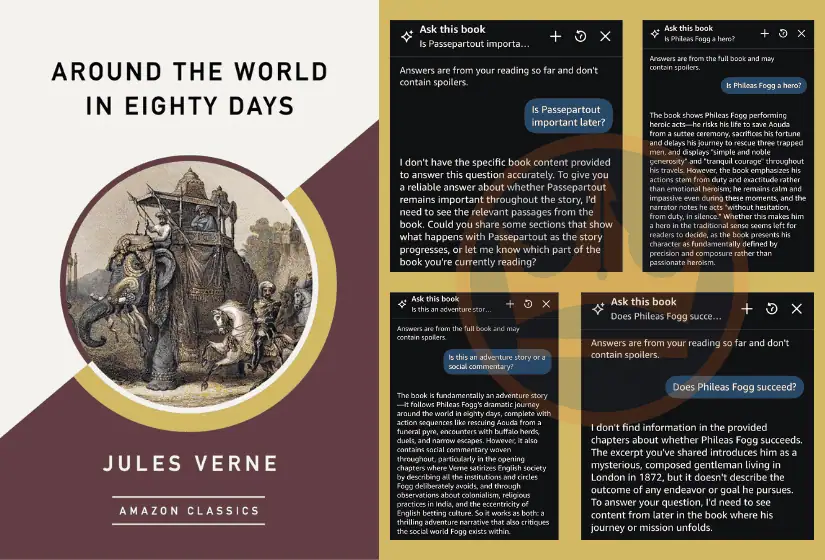
What surprised me is how restrained it was.
It didn’t jump ahead or wander outside the book.
This is a small sample size, of course. Your mileage may vary.
Based on what we’ve seen, Ask This Book appears to be doing what Amazon says it does.
But just because it's working as intended doesn't mean there isn't a problem.
Common questions you might have
Just in case you missed anything or something isn't clear, here's a roundup of the high points…
Ask This Book is a new Kindle feature that lets readers ask questions about the book they’re currently reading and receive AI-generated answers inside the reading experience. Instead of flipping back through pages or searching manually, readers can type something like, “Who is this character?” or “What just happened?” and get a response on the spot.
Right now, it’s available in the Kindle iOS app for U.S. customers. Amazon has said it plans to expand the feature to Kindle devices and Android later in 2026.
Based on our testing, it mostly avoids spoilers. We tried asking it questions that could have revealed future events, and it generally stayed within what had already happened in the book. That said, this is a small sample size. Your mileage may vary.
We haven’t seen strong evidence of widespread hallucination so far. In our tests, it stayed anchored to the text, didn’t wander into outside material, and didn’t invent details. It also didn’t try to be clever. That doesn’t mean it will never make mistakes (it’s still an AI system), but right now, accuracy doesn’t appear to be the main issue.
No. If your book is on Kindle, Ask This Book can be applied to it automatically. There is no opt-out, no review process, and no way to control how your work is explained or summarized.
No. Authors don’t get to review the answers, suggest changes, or flag problems. The system operates independently of the author.
That’s exactly what’s being debated. The Authors Guild and other advocacy groups argue that Ask This Book effectively creates a new, AI-generated layer on top of copyrighted works (something more like an annotated or enhanced edition), and that this kind of transformation usually requires new rights agreements. Amazon hasn’t publicly addressed those concerns in detail.
Right now, there’s no evidence that Ask This Book directly changes royalty structures. But that doesn’t mean it’s harmless. Once platforms start adding AI-generated layers to books, it raises questions about what future versions of these features might look like, and whether those could eventually affect how books are packaged, marketed, or monetized.
At the moment, not much. The pushback is happening at the organizational and policy level, not the individual one. Groups like the Authors Guild are the ones applying pressure.
What this means for authors
From what we’ve seen, Ask This Book mostly does what Amazon claims.
It stays inside the text. It avoids spoilers. It doesn’t seem to wander.
So the issue isn’t that the tool is broken, but that authors never agreed to this layer being added in the first place.
That's our concern. That and the reality of…
Well, once features like this become normal, they don’t usually roll back.
Instead, they continue to evolve. One “helpful” feature at a time.