Whether it’s to free themselves of the shackles of Amazon or simply to diversify (and not put all their eggs in one basket), more and more authors are skipping the middlemen and selling their books directly to readers.
And for every author who’s doing it, there are many more thinking about it. Complexity is usually what keeps them from pulling the trigger, though. Depending on your setup, you might need a website, a payment processor, a digital delivery system, a print fulfillment system, a way to handle taxes and customer service, and more.
It’s a lot, which is why many authors don’t even bother. Well, that or they just go with Shopify, which certainly has its pros (and can do basically everything), but can get expensive and is usually overkill for what most authors need.
The need is clearly there, so the market has done what markets do: try to fill it. Over the last several years, an assortment of different direct sales options have popped up for authors. Some good, some not so good, and some that make you want to bang your head against your desk.
It’s through this lens that Dave (Kindlepreneur’s CEO) asked me to research the myriad of possibilities so that we could know which ones to recommend to our readers. Curios, a digital sales platform for creators that was founded in Texas back in 2020, was one of the first I looked into.
For the last several months, I’ve put Curios through its paces. I even jumped on a Zoom call with their senior vice president so I could ask direct questions and fill in any gaps. I now have a good feel for what they do well and which authors should consider them.
Spoiler: I like them a lot. And in this review, I’ll try to explain to you why.
Note: The various Curios links you’ll see are affiliate ones, which means we’ll get a small commission if you click them and decide to sign up. However, using our links won't cost you anything extra, and us being an affiliate didn't influence my thoughts at all – in fact, when I started writing this review, Curios didn’t even have an affiliate program to join.
What I like about Curios
It’s a recurring theme you’ll see below, but I appreciate how much Curios takes off your plate. For someone like me, a creator who already has a website but doesn’t have any ecommerce options at the moment, Curios handles everything I need to sell directly, including things I didn't know I’d need when I started my research project.
Here’s what jumped out to me.
I like that I can sell ebooks, audiobooks, and print books in one place
I mentioned “complexity” as being a big reason why authors hit a roadblock when they start looking into direct sales. Here’s one of the things I meant…
If you have an ebook, a paperback, a hardcover, and an audiobook version of something, depending on the tech stack you choose you might have to use one service for the ebook, another for your audiobook, and another for your printed books.
No one wants that. Even if you’re an author with a side hustle as a professional juggler for birthday parties and bar mitzvahs, you don't want to juggle that many tools.
Curios lets you sell each of those formats in a single platform. You can do ebooks, audiobooks, paperbacks, hardcovers, and even special editions. You can even create combo packs, if you’d like to sell two+ items together.
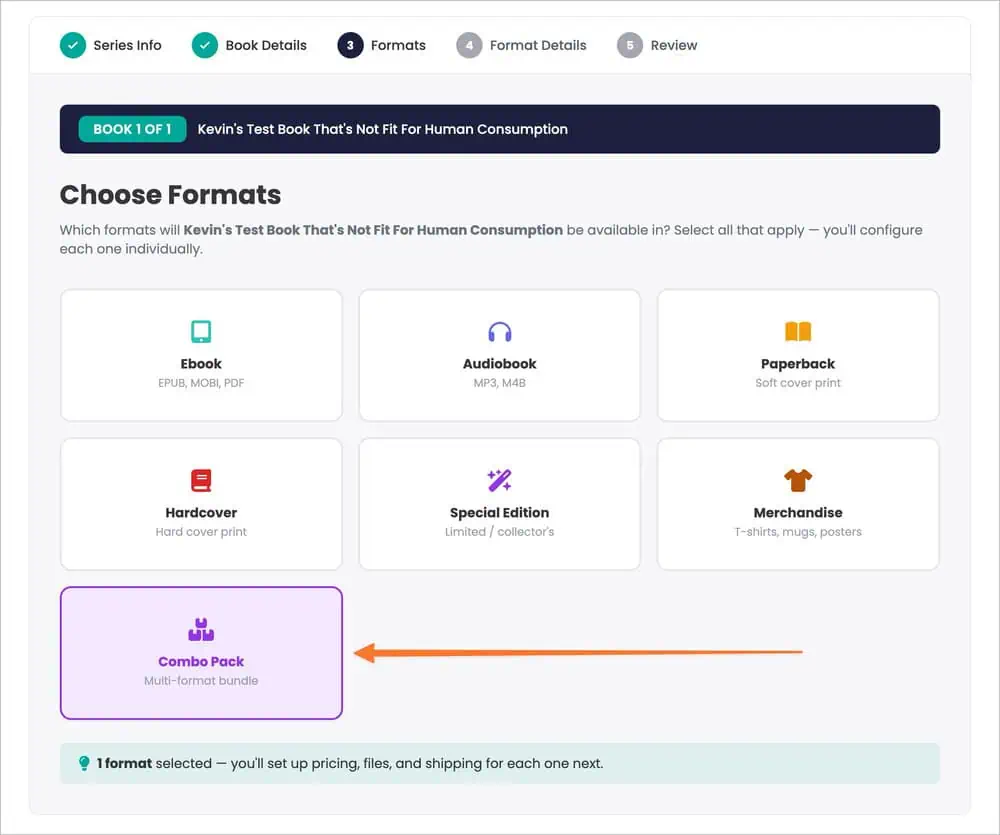
Besides the added convenience (of having everything in one place), being able to offer multiple formats for your readers gives them more opportunities to buy from you. I know that sounds obvious, but in our last author survey on direct sales, we found “a positive correlation between offering a greater variety of product types and generating higher revenues.”
Of course, that doesn’t mean offering an audio or paperback version of your ebook will magically increase your revenue, but it does suggest there’s value in giving your readers more ways to purchase your titles.
And that’s something Curios makes very straightforward for you.
I like that Curios handles the stuff no one wants to deal with
It’s something Dave undoubtedly knew right away, but something I didn’t realize heading into this direct sales research project was how “delivery” and “collecting money” were only small parts of the process.
You also have to worry about a veritable smorgasbord of administrative headaches like sales tax, fraud, customer support, and refunds. And if you sell books to people who live in different states or countries as you, taxes can become especially complicated.
With many platforms, YOU are what’s known as the merchant of record, which means you’re responsible for processing the sale and handling applicable sales tax collection and filing.
And yes, that’s just as much “fun” as it sounds.
But with Curios, IT is the merchant of record. It handles all that stuff for you.
Now, could you put together your own combo of services and tools to handle those things? Sure, plenty of authors do. But… why? Why juggle all of that if you don’t have to?
I like that it integrates with Bookvault for print fulfillment
Selling ebooks directly is pretty simple. It’s a digital product after all, so even the worst ecommerce tool should (hopefully) be able to handle it because there’s no inventory to stock, no shipping, and no trips to UPS or the post office to worry about.
But print books… that’s a different story.
Someone has to print the book first. Then someone has to package it and send it to the customer. Do you want to handle that yourself? I definitely don’t. It would mean either keeping copies in stock (stored in my garage), or I’d have to make arrangements with a printing service to produce them each time an order came in.
Neither option is appealing, but with many direct sales platforms, it’s the only one you’re given. Tertulia, for example, another direct sales platform, supports selling physical books, but you have to handle printing, stocking, and shipping yourself. “Self-fulfillment,” they call it.
Curios solves this headache by integrating with the popular Bookvault, a print-on-demand service that produces, packages, and ships the books for you as they’re ordered within Curios.
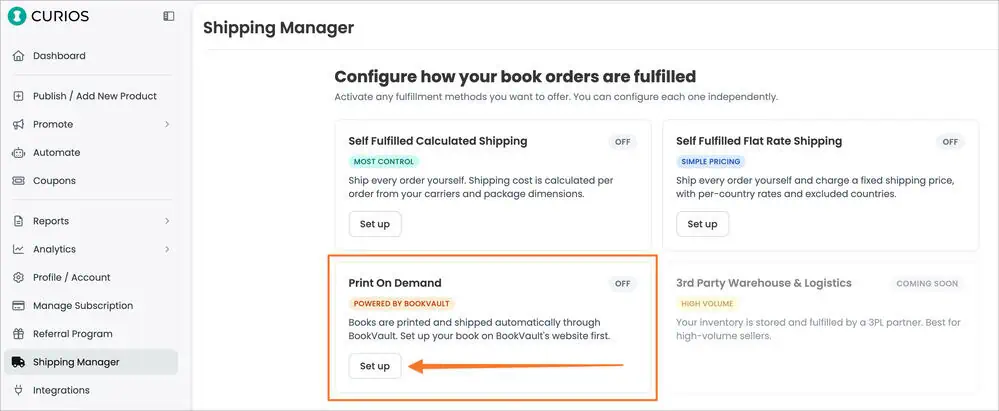
That means you don’t have to purchase hundreds of copies of your book in advance, store them in nooks and crannies throughout your home, and then spend your afternoons and weekends stuffing books in boxes and shipping them.
There are still expenses involved, of course. Bookvault isn’t free, so there will be charges for printing and shipping, and you’ll want to factor in those costs when setting your print prices.
But that's still a heck of a lot easier and better than having to personally fulfill every print order.
I like that Curios works with my existing website (or without one)
One of my favorite things about Curios, and the reason it’s easy to recommend, is you don’t have to rebuild your entire website or install a needlessly complicated ecommerce system to use it.
I have a website built on WordPress (Kindlepreneur is built on it too). Usually, with WordPress, WooCommerce is the route people take to start selling things. It’s a plugin you install on your site, and it comes with dozens and dozens of settings, integrations, and add-ons. It’s incredibly powerful, and I’ve helped build some massive sites using it.
Which is why I can tell you 1) the learning curve is significant and 2) most authors don’t even need 90% of the stuff it can do.
It is much, much easier to create products to sell in Curios, grab their direct checkout links from your Curios dashboard, and add those links to the appropriate pages on your existing website. Then when people visit your site, they see the links or buttons you added for purchasing your book, and Curios handles the transaction and delivery.
On the other hand, I also like that you can skip having a website entirely and still sell directly with Curios.
Since it’s incredibly hard to drive traffic to your website through organic search channels like Google (especially now in the age of AI), many authors use TikTok, Instagram, Facebook, or YouTube to reach their readers. With Curios, you can sell directly on those social platforms, even if you don’t have a personal website.
Every product you publish on Curios has a page you can directly link to. You can use that link in your videos, tweets, wherever.
I like this built-in flexibility since the authors in Kindlepreneur’s audience are at different stages in their careers. Some will have elaborate websites, while others will have a social media following and little else.
Curios can accommodate both groups.
I like that we get to know who's buying our books
One of many (oh so many) frustrations authors express about selling through Amazon is you don’t know who’s buying your books.
You can see how many copies you’ve sold, sure. And you can see where some of those sales are coming from and other useful statistics. But the list of everyone who purchased, including their email address? Not a chance.
But that’s not the case with Curios. The info’s all there inside the “Reporting” section of your dashboard.
I like that it lets us keep 100% of the list price
Obviously, a big appeal to selling direct is being able to keep more of the money.
When you sell through a traditional retailer, the company takes its share. How much of the money you’ll receive depends on the retailer, the book's format, your pricing, and so on.
Curios is different, though.
On its paid plans, Curios gives authors 100% of their book’s listed price (the transaction and processing fees are charged to the buyer on top of the list price, rather than being deducted from your payment).
So, as an example, if you have an ebook selling for $10, you’ll get $10 each time it sells. The book itself would cost people slightly more than $10 (to cover those fees), but you’ll get $10.
Of course, there is the Curios subscription cost to factor in (I’ll talk about their different plans in a bit). And if you’re selling print books, there will be some fees associated with Bookvault too. So it’s not like you’re getting to use Curios for free, keeping 100% of the profit and not paying them a penny.
But depending on what you're selling, how much you’re selling it for, and how many sales you're making, the odds you’ll end up keeping more of the money than you would selling through Amazon or other retailers are pretty good.
I like that it has tools to help authors sell more books
When researching and testing Curios, I was happy to see they offered tools beyond a basic Buy Now button. (Although, a Buy Now button, combined with being the merchant of record, integrating with Bookvault for print books, and giving authors their buyers’ info, would still be pretty great.)
Its Automations system (which can trigger offers based on the customer’s actions) and support for giveaways and free products (handy for distributing reader magnets and review copies) are two great features that advanced authors will appreciate.
This allows you to do things like offer the audiobook version to someone who just bought your ebook, or send a recommendation to the next book in your series to someone who purchased your first story.
Some marketing features are reserved for their higher-priced plans, but the fact they exist at all, and are available to authors who want to utilize them, is great to see. This is also an area where I expect Curios will continue to make strides in the months and years to come, based on my conversation with their senior VP, so I’m looking forward to what’s ahead.
What Curios doesn't do: Replace your author website
One limitation about Curios I want to make sure you know is that it isn’t a replacement for a full author website.
Yeah, it gives you individual product pages, a creator profile, and links you can share with your readers. And if all you want is a place for someone to buy your books (while also handling the admin headaches like taxes and customer support for you), it’s probably everything you need.
However, if you want a traditional author website with a blog, an About page, extensive customization options and all that jazz, that isn’t what Curios is. For that, you’d need a separate website.
Personally, I don’t see this as a drawback, because Curios isn’t trying to be WordPress or Shopify. It’s meant to handle the selling and delivering of your products. It complements your website, if you have one, by giving you ecommerce functionality.
So if you already have a website, you don’t have to change it or replace it if you want to start selling direct. You can just add Curios to it.
If you don't have a website and don't particularly want or need one, you can use your Curios product pages and send readers to them from your videos, social media posts, or wherever it is you use to connect with them.
But if you're starting from scratch and you want a full-fledged author website, Curios alone won't do it. You'll need to build the site using something else, and then you could connect it to Curios for checkout and fulfillment.
Want a tip? When I was the editor-in-chief for Smart Blogger, we created hundreds of websites for students using a page builder tool called Carrd. You can use it for free forever, but if you need more advanced features it starts at only $9 a YEAR ($19 if you want to use your own domain). And that includes web hosting. If you don’t have a website yet, and you want one with as little muss and fuss (and money) as possible, it’s what I’d recommend for 99% of people.
And now about pricing (which plan should you choose?)
At the moment, Curios offers four different plans: Trial, Lite, Plus, and Pro. The latter three are paid subscriptions, while Trial is (surprise!) free.
And unlike the typical free trial we’re used to seeing that expires after a week or two or four, Curios' Trial plan doesn't have an expiration date. You can continue using it forever, although there are transaction fees (that aren’t on the paid plans) you’ll need to factor in.
I’ve put together a table so you can quickly see at a glance what each one offers and which one I think is best for a given situation.
| Plan | Price | Who I think it’s best for |
| Trial | Free | This is best for authors wanting to experiment and dip their toes into direct sales. Or, they only expect to have the occasional purchase. |
| Lite | $9/month or $90/year | Lite is going to be the sweet spot for many authors. If you’re ready to sell regularly, but don’t need bells, whistles, and advanced marketing automations, Lite is a good fit. |
| Plus | $29/month or $290/year | If you want automations, more storage, better analytics, increased visibility in recommendations, and the ability to add affiliates, you should upgrade to Plus. This is the plan someone like me, who wants the bells and whistles but won’t have the sales volume to justify the Pro plan, would use. |
| Pro | $69/month or $690/year | This is the plan people like Dave, Zac Diamanti, and J. Kevin Tumlinson would use: established authors who need higher limits, more (and more detailed) analytics, and every feature. |
Now, rather than type out a boring pros/cons list of each feature offered or not offered on each plan…
(A thankless task since, one, it’ll probably be out of date seconds after I click publish and, two, it’ll make my review look like some kind of AI robot wrote it)
…I’ll instead point you to Curios’ pricing page if you’d like to see the details for each plan.
But, if you’d like my recommendations:
Start with the Trial if you want to experiment and see if selling directly could work.
If you’re already doing direct sales or know it’s time, Lite is a great starter plan that’ll meet most of the needs for most authors.
Plus is the plan authors who are serious about selling direct should use, since it offers automations, more detailed analytics, and you’ll be recommended to buyers more often than you would in Lite.
And if you’re a rockstar ready to conquer the world, go with Pro.
Verdict: Is Curios a good option for authors looking to sell direct?
For most people, absolutely.
I do love tables, so here’s one more so you can find you (and your situation) and get a fast yes-no answer.
| If you're an author who… | Is Curios a good fit? |
| Already has a website | Yes, you can add Curios checkout links to your site and let Curios handle sales, fulfillment, etc for you. |
| Has a social media audience but not a website | Yes. You can send followers directly to your Curios product pages, skipping the need for a website entirely. |
| Wants to build a complete author website | No, not by itself. You'll need a separate website builder, such as WordPress or Carrd, and let Curios handle the ecommerce. |
| Wants to sell ebooks, audiobooks, and/or print books | Absolutely. Curios lets you sell all three. |
| Wants to sell print without having to do the storing, packing, and shipping yourself | Yes, it integrates with Bookvault, which handles fulfillment for you. |
| Wants to keep selling on Amazon too | Yes. Curios doesn't require exclusivity (although Amazon’s KDP Select does, so make sure you follow its exclusivity rules). |
| Doesn’t want to deal with taxes, tech support, etc | Yes, Curios is the merchant of record, and it delivers and supports every order. |
| Doesn't yet have an audience of readers yet | Potentially. Curios gives you a book marketplace where you can sell, and its Discovery engine will show your work to prospective buyers if you’re on a paid plan, but you'll still need to work on attracting buyers through social media, email marketing, word of mouth, etc. |
I should probably emphasize that last point.
Curios provides the tools to sell books directly, and its paid plans do offer the chance to be recommended to buyers on the platform who wouldn’t otherwise know about you. But none of that guarantees anyone will find you or buy from you.
It’ll still behoove you to do the work of finding readers, promoting your books, and giving folks a reason to purchase directly from you rather than heading over to good ol’ Amazon.
But, all of that’s true of every direct sales solution. So it’s not a “con” as much as it’s a heads up.
After researching and using Curios for these past few months, I think the thing I like best about it is it removes the technical mumbo jumbo and administrative headaches that usually keep authors from giving direct sales a try.
It cleanly integrates with your existing site if you have one, and if you don’t you can still use it. It lets you sell paperbacks and hardcovers without having to store the copies yourself in your garage or bedroom, thus annoying your spouse. And it handles the minutia of taxes, refunds, fraudsters, and purchase-related customer support – all things that authors of sound mind and body would rather not deal with.
So if you’re an author or creator looking to sell direct, I think Curios is a great option.
If you agree, you can click here to sign up.
Good luck.