Whenever Amazon changes something related to ebooks, authors tend to ask the same question first:
“What does this mean for my books?”
It’s a fair question. And in this case, the answer depends entirely on how you handle DRM (short for “digital rights management”, the system Amazon uses to limit copying and file sharing).
Starting January 20, 2026, Amazon will allow verified purchasers to download EPUB and PDF files for certain Kindle ebooks. This applies only to DRM-free books published through Kindle Direct Publishing.
Amazon isn’t removing DRM, and authors aren’t losing control over their titles. But for authors who publish without DRM, this update introduces a real decision point, one that weighs reader convenience against the easier redistribution that comes with downloadable files.
Below, we’ll break down what’s changing, which books are affected, and how to think through your options calmly and deliberately.
Key Takeaways
- Amazon will allow verified purchasers to download EPUB and PDF files for DRM-free Kindle ebooks starting January 20, 2026.
- This change does not affect ebooks that have DRM enabled.
- Authors publishing new DRM-free ebooks after December 9, 2025, will have downloads enabled by default.
- Existing DRM-free ebooks will not enable downloads automatically (authors must opt in manually).
- Downloadable EPUB and PDF files increase reader flexibility but also lower the barrier to redistribution.
- Kindlepreneur’s default approach, as shared by its founder, Dave Chesson, is to keep DRM enabled, while recognizing that reasonable authors may choose differently.
What DRM Is (and Why It Matters Here)
Digital Rights Management (usually shortened to DRM) is a system used across digital media to control how files can be accessed, copied, and shared after purchase.
You’ll find DRM everywhere: ebooks, movies, music, software. It puts guardrails around a digital file so it can only be used in certain ways. That might mean limiting which devices it works on, preventing copying or exporting, or tying access to a specific account or app.
DRM exists to discourage unauthorized sharing. It’s not a perfect lock. Someone determined enough usually can. But it does add friction, especially against casual copying, which is why platforms and publishers still rely on it.
That friction cuts both ways. DRM doesn’t just affect bad actors. It also limits what legitimate customers can do with something they paid for.
Potential benefits of DRM
- Makes casual file sharing less likely
- Helps creators and publishers maintain control over distribution
- Gives platforms a consistent way to enforce usage rules
- Requires little ongoing management once applied
Potential drawbacks of DRM
- Restricts how paying customers use their own files
- Can limit device compatibility or long-term access
- Prevents personal backups or easy file portability
- Acts as a speed bump, not a guarantee
That tension — protection versus flexibility — is why DRM decisions matter.
With that foundation in place, the next question is how Amazon has historically applied DRM to Kindle ebooks, and why this update changes the equation.
How DRM-Free Kindle Books Worked Before This Change
Before this update, Kindle ebooks all worked the same way for readers (whether DRM was turned on or off).
Even if an author published a Kindle ebook without DRM, Amazon still didn’t allow readers to download a standalone EPUB or PDF file.
In practice, that meant:
- Readers had to use a Kindle device or an Amazon reading app
- Books lived inside the reader’s Amazon account
- Files couldn’t be moved to non-Amazon eReaders or personal libraries
From the reader’s point of view, there wasn’t much difference. And from the author’s point of view, there usually wasn’t much risk.
That’s why many authors felt comfortable disabling DRM in the past. Even with DRM turned off, Amazon still controlled how the ebook was delivered and accessed. The file wasn’t suddenly floating around the internet, and readers weren’t suddenly downloading copies to use wherever they wanted.
So while DRM status mattered in theory, it didn’t change much in practice.
That’s the baseline Amazon is changing in 2026, and why this update feels bigger than it might at first glance.
What Amazon is Changing in 2026
Starting January 20, 2026, Amazon is changing how readers can access certain Kindle ebooks.
For the first time, readers who buy DRM-free Kindle ebooks will be able to download their purchases as EPUB or PDF files, directly from their Amazon account.
This applies only to ebooks published through Kindle Direct Publishing that do not have DRM enabled. If DRM is turned on for a title, nothing changes. Readers won’t see download options, and the ebook will behave exactly as it always has.
Amazon isn’t removing DRM or taking control away from authors. It’s expanding what DRM-free means in practice.
What readers will be able to do
For eligible ebooks, verified purchasers will be able to:
- Download an EPUB file for use on supported non-Kindle devices
- Download a PDF file for offline reading or personal storage
- Access those downloads directly from their Amazon account
This gives readers more flexibility in how and where they read (especially outside Amazon’s ecosystem), but only for books where DRM is disabled.
What is not changing
Here’s what this update does not do:
- Amazon is not removing DRM from ebooks
- Authors still decide whether DRM is enabled or disabled
- DRM-protected ebooks cannot be downloaded as EPUB or PDF files
- Pricing, royalties, and distribution terms remain the same
If an author keeps DRM enabled, this update has no effect on how their ebook is delivered or protected.
(For the official Amazon policy on DRM and download options, see Amazon’s KDP Help article on DRM and downloadable files.)
Why this matters
For authors who publish without DRM, this change raises the stakes slightly.
EPUB and PDF downloads make life easier for legitimate readers, but they also reduce the friction involved in copying and redistributing files. That tradeoff has always existed. Amazon’s update just makes it visible.
Before deciding what (if anything) to change, it helps to see how your own ebooks are currently set up.
So let’s walk through how to do that.
How to Manage Your DRM Settings in KDP
If you’re not sure how your ebooks are set up, it’s worth taking a minute to check your DRM settings directly inside Kindle Direct Publishing.
This matters most for older titles published before December 9, 2025. For those titles, DRM-free doesn’t mean downloadable unless you opt in manually.
Here’s how to check:
Step 1: Open your KDP Bookshelf
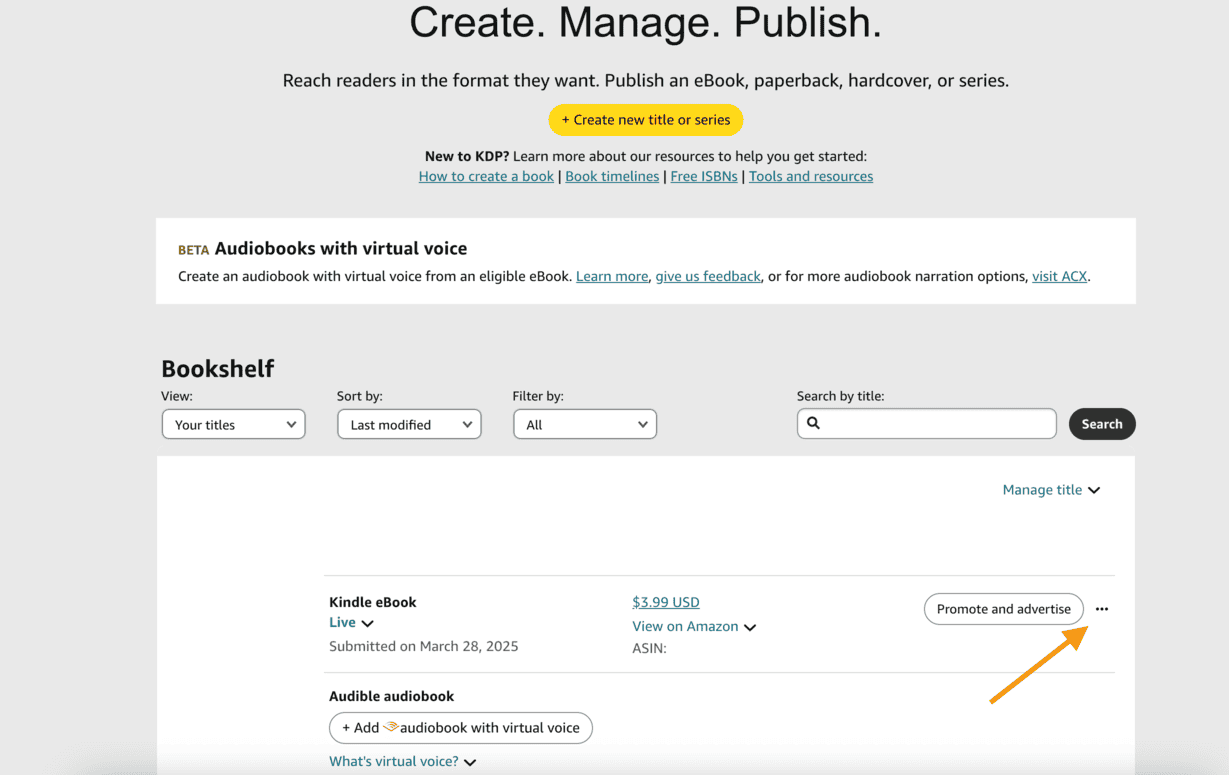
Log in to your Kindle Direct Publishing account and go to your Bookshelf, where all of your published titles are listed.
This is the main dashboard where you manage each ebook.
Step 2: Open the ebook’s content settings
Find the ebook you want to review.
Click the three-dot menu next to the title, then select Edit eBook content.
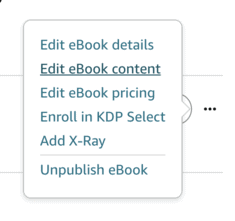
This opens the page where Amazon stores the manuscript file and delivery settings for that ebook.
Step 3: Scroll to the DRM section
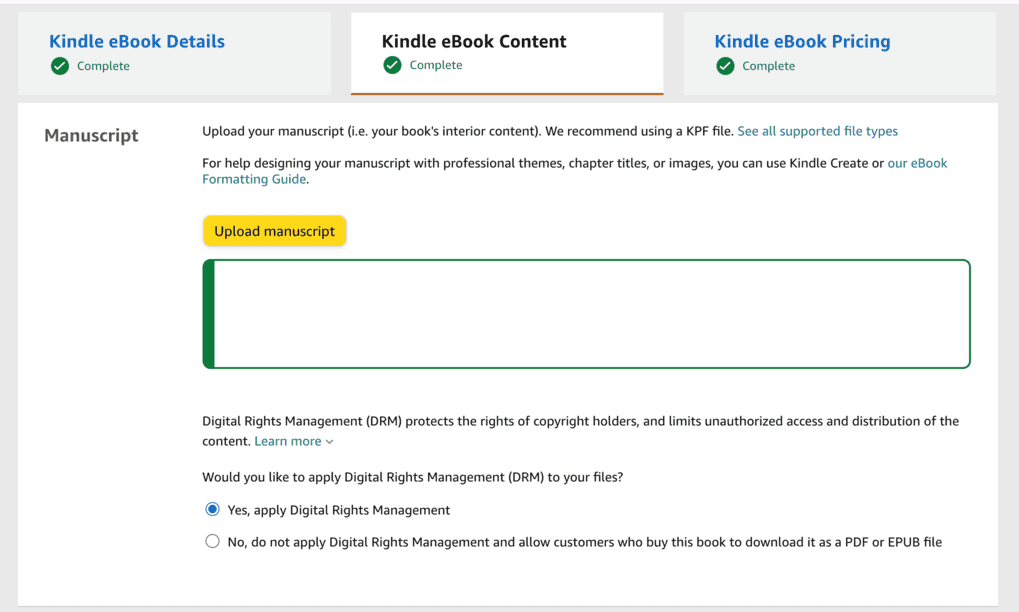
On the Kindle eBook Content page, scroll down past the manuscript upload area until you reach the Digital Rights Management (DRM) section.
This section controls whether your ebook is locked to Amazon’s ecosystem or made available without DRM.
Step 4: Check the selected DRM option

Here you’ll see which DRM option is currently selected:
- Yes, apply Digital Rights Management
DRM is enabled. This update does not affect the ebook. - No, do not apply Digital Rights Management
The ebook is DRM-free and may be eligible for EPUB and PDF downloads, depending on when it was published.
This is the setting Amazon uses to determine whether readers can download your ebook as a standalone file.
Step 5: Decide whether you need to take action
If DRM is enabled, you don’t need to do anything. Nothing about this update changes how your ebook is delivered.
If DRM is disabled and the ebook was published before December 9, 2025, downloads will remain off unless you manually opt in.
For newer DRM-free ebooks, downloads are enabled automatically.
That’s why Amazon recommends authors review their existing titles rather than assume settings are unchanged.
Which Books Are Affected
In short, whether a Kindle ebook is affected by this change depends on two things: its DRM status and when it was published.
Here’s the quick breakdown:
- Ebooks with DRM enabled — Not affected. Readers won’t see download options.
- DRM-free ebooks published after December 9, 2025 — Downloads are enabled automatically.
- DRM-free ebooks published before December 9, 2025 — Downloads are not enabled by default. Authors must opt in manually.
In short, whether a book is affected depends on DRM status and publish date.
A quick way to think about it
If you’re unsure whether this update affects one of your books, this simple rule helps:
- DRM on → no change
- DRM off + new book → downloads enabled
- DRM off + older book → author must opt in
That’s how Amazon is handling it, and it’s a useful way for authors to think about their own books.
What This Means for Authors
This update doesn’t force authors to change anything.
But it does make an existing tradeoff harder to ignore.
Allowing EPUB and PDF downloads makes life easier for legitimate readers. It also lowers the friction involved in copying and redistributing files. That tension has always been there. Amazon’s change just makes it more visible.
How you feel about that tradeoff depends on what you value more: reader flexibility or an extra layer of protection.
There’s no universal answer, but here’s how Dave is thinking about it.
What Dave is Doing With His Books
For now, Kindlepreneur's founder, Dave Chesson, is keeping DRM enabled on his ebooks.
Not because DRM is foolproof (it isn’t), but because it still works as a deterrent. And with Amazon now allowing EPUB and PDF downloads for DRM-free books, turning DRM off removes friction without offering a clear, offsetting benefit for authors who care about protecting their work.
As Dave puts it:
“Personally, I don’t like the idea of giving up DRM. If you do, readers can download your book and read it on their own device, which is nice, but it also makes it easier for people to steal and upload your book elsewhere. Even though DRM can be removed by someone determined enough, I’d rather not make that process easier.”
That’s how he’s thinking about this change. If DRM already exists as a speed bump, removing it simply to enable downloads isn’t a tradeoff Dave’s willing to make.
It’s worth saying explicitly, though: this is one informed choice, not a rule. Some authors prioritize reader flexibility and are comfortable with the risks that come with downloadable files. Others aren’t.
What matters most is choosing deliberately (and understanding what you gain and what you give up).
The key takeaway for authors
This update doesn’t require immediate action.
If you’re comfortable keeping DRM enabled, you can leave things exactly as they are and nothing changes. And if you publish without DRM, the new download options simply make the tradeoff more visible.
Video: Amazon’s New DRM Change

Want more videos like this? Be sure to subscribe to our YouTube channel!
Amazon DRM, EPUB, and PDF Downloads: Frequently Asked Questions for Authors
Yes. For ebooks published after December 9, 2025, EPUB and PDF downloads are enabled automatically if DRM is turned off. There’s no separate setting authors need to enable.
No. Before this update, DRM-free Kindle ebooks still had to be read through Amazon’s ecosystem, such as a Kindle device or Amazon reading app. Readers could not download standalone EPUB or PDF files. Amazon’s 2026 update is what introduces downloadable EPUB and PDF files for DRM-free ebooks, which is why authors who previously felt comfortable disabling DRM may want to review their settings now.
No. For ebooks published before December 9, 2025, DRM-free status alone doesn’t enable downloads. Authors must manually opt in through their KDP account if they want to allow EPUB or PDF downloads for those titles.
That depends on the author’s priorities. At Kindlepreneur, the default approach is to keep DRM enabled, even though it isn’t foolproof. Other authors may prioritize reader flexibility and be comfortable with that tradeoff. There’s no universal rule.
No. DRM can be removed by someone determined enough. However, it does act as a deterrent and adds friction, particularly against casual redistribution.
No. DRM settings and download options are separate from Kindle Unlimited enrollment and exclusivity requirements.
No. This update doesn’t change ebook pricing, royalty rates, or payment structure.
Final Thoughts on Amazon's DRM Change
Amazon’s decision to allow EPUB and PDF downloads for DRM-free ebooks doesn’t force authors to rethink their publishing strategy. But it does make existing choices easier to see.
If you already prefer to keep DRM enabled, nothing changes. And if you publish without DRM, this update simply brings the tradeoff into clearer focus.
What matters is understanding how your books behave once they leave Amazon’s ecosystem, and being comfortable with that reality before you change anything. Once you’ve made that call, the rest is straightforward.