As the CEO of 100 Covers, a business with 56 designers, illustrators, formatters, and project managers who have produced over 20,000 book covers, I'm driven to help self-published indie authors be successful.
So in early 2022, I had kind of a crazy idea to hire someone to go through our entire archives, find every book cover we had done on the Amazon market, and identify the most successful ones in hopes of learning valuable lessons about what works (and what doesn't).
We tracked the real world performance of all of our book covers for several more years, and our sort of “scientific” inquiry into what makes for a winning book cover ended up being extremely eye-opening. I’d love to share the main takeaways from this exercise with you, as ending up with a winning book cover that is extremely likely to perform well in the market is dependent mostly on authors understanding and embracing this approach to book cover design, and doing the appropriate research to identify key trends in their specific niche.
But before we get into an in-depth discussion of book cover design, remember that context and your unique vision may not be suited to the strategies discussed. This is not meant to be the gospel applied to all authors, all genres, and all niches. This applies to most indie authors, in most genres and subgenres, most of the time.
The goal of this article is to give you a solid foundation and understanding about how the RIGHT book cover can dramatically increase the probability of your book’s success. And once you understand that, you’ll be ready to apply a few basic steps to figure out what cover elements will give the type of book you’ve written the best chance of success.
How Important is Your Book Cover, Really?
The greatest book cover design on earth, alone, is unlikely to make you successful. But the right book cover at the right time in the right place can absolutely stack the deck in your favor.
Starting out, I would have guessed that the cover is maybe 10-20% of the successful book formula. Maybe that’s because I came from a nonfiction background where the cover certainly has less impact.
But after having our team track the performance of every single book cover we’ve designed in the Amazon market (with most of those covers in the big mass market genres like romance, thriller, science fiction, and fantasy), my estimate is that the perfect on-trend book cover can be responsible for as much as 50% of the sales performance and, in some cases, even more than that.
Again, context matters here. I’m talking about how impactful the book cover is for:
- Indie authors, particularly ones without a large audience and notoriety before launch
- Authors selling books online to book browsers who have never heard of them or their books prior
For authors heavily reliant on paid Amazon or Bookbub ads, the book cover’s importance is even more exaggerated.
How to Improve Your Odds
The formula for improving the odds of your book’s success, especially in the largest and most competitive fiction genres (thriller, romance, sci-fi, fantasy, etc.), is actually extremely simple…
- Identify the current cover design trends in your specific subgenre or niche–this consists mostly of images, color schemes, and typography (font type, size, color, and placement)
- Craft a cover like the current bestsellers–entering the market with a cover that piggybacks off of the hottest trends
Voila! Simple. It’s actually not any more complicated than that.
However, performing step 1 takes a little know-how and research, and getting a cover that truly looks like a current bestseller out of a designer, design company, AI image generator, or yourself is certainly easier said than done.
The rest of this article will focus on how to successfully accomplish steps 1 and 2 above, but first, let me show you what I mean about book cover trends…
Book Cover Design isn’t a Beauty Contest, it’s a Lookalike Contest
One of the sayings I’ve developed over the years as I’ve observed what really works consistently for indie authors, is “Book cover design isn’t a beauty contest, it’s a lookalike contest.”
This saying can come off as a little distasteful, as we authors pride ourselves on being original and unique, but the book cover is not always the best place to try to establish originality. It’s best to look at book covers, not as art (which they aren’t, although it certainly takes artistry to craft a good one), but as product packaging (which they are).
The biggest mistake I see is authors straining to have a book cover that “stands out” from the crowd in their niche. Here’s the thing though: most readers, especially the highest-volume readers, buy and read lots of books with covers that look almost EXACTLY THE SAME, not different.
Anybody from my generation or older remember when almost every romance book cover looked like this?
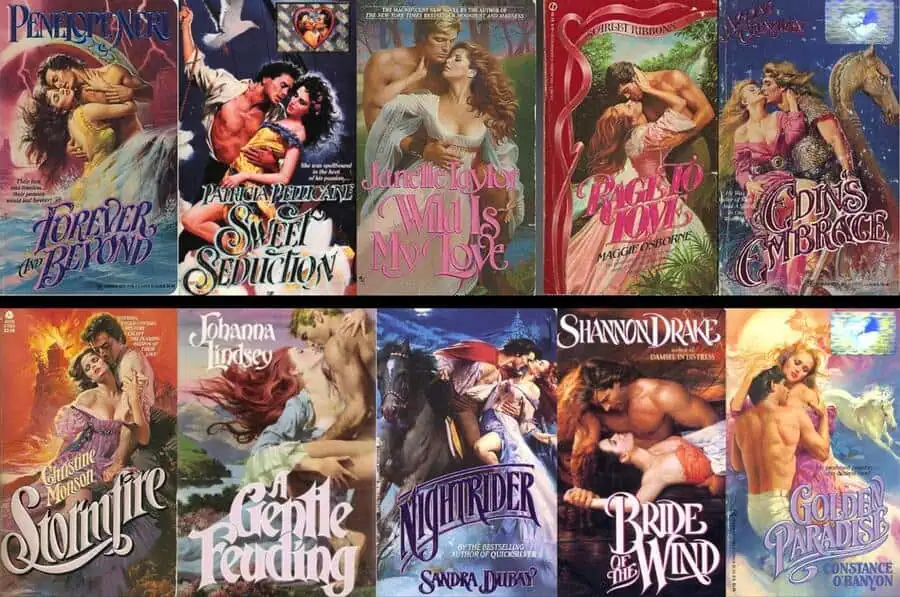
You know why they all looked like that? Because any steamy romance book that didn’t look like that wouldn’t sell.
Why wouldn’t it sell? Because romance readers wouldn’t be able to tell a book was a romance by its cover if its cover didn’t look like a romance cover, and back then, a romance cover had a tan, studly, bare-chested Fabio-esque dude on there passionately embracing a woman.
This type of cover doesn’t work anymore, unfortunately. With the magic of photoshop, you’d think splicing my face on an old 80’s style romance image would be a guaranteed banger.
I mean, look at this badboy. Absolutely Mattjestic…

But no, trends have changed many times since then, which begs the question, where do trends in imagery, colors, and typography come from?
Where Book Cover Trends Come From
The answer is simple:
Book cover trends come from new, breakthrough successes that send shockwaves through the industry.
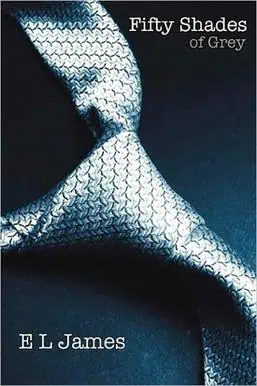
While we’re deep into romance, let’s look at one of these breakthrough successes. One of the best examples is 2011’s blockbuster, 50 Shades of Grey.
This book was so popular it launched an entirely new romance subgenre, billionaire romance, and 15 years later most of the covers are still predominantly black and white and feature neckties!
Below is a screenshot from the most recent billionaire romance genre report from a tool called K-lytics. The numbers and down arrows you see on that image indicate that a man on the cover is still very common (62% of books in the top 500, and 48% of the total royalties being earned in the genre).
However, the trend is decreasing and moving to different styles, which is important because it shows how trends are always changing.
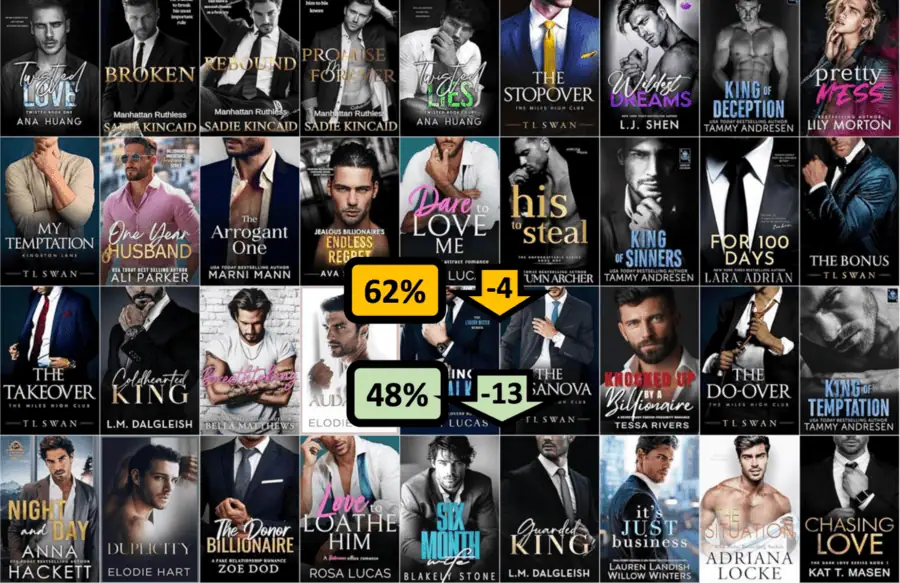
You can see though how the covers all look nearly identical. Dark-haired dude with stubble, suit and/or tie, text on the bottom third of the cover, one brightly-colored word in the title, mix of script and block fonts. By sticking with the common genre trends, they all shout “I’m a billionaire romance book!” which is why they are so effective at selling these books to people shopping for a new billionaire romance to read.
Put another way, the sale of a billionaire romance book starts with a reader looking for something that looks like a billionaire romance. Books that look like billionaire romance have a dramatically higher probability of selling to readers of billionaire romance than ones that do not.
Now, it’s absolutely possible to enter the market with something that looks totally different and completely redefine the look of covers in billionaire romance. Your cover will likely do just that if it turns out to be a runaway bestseller!
But 99.99% of the attempts to do that result in readers of billionaire romance having no clue that the thumbnail image they just saw was the cover of a billionaire romance. No clicks. No sales. Pitiful clickthrough rates on ad campaigns. And another hundredaire indie billionaire romance author.
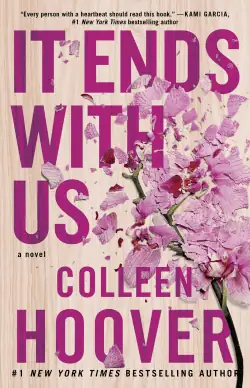
Another fun trendsetting romance example that comes to mind is Colleen Hoover’s breakout seller It Ends with Us about a flower shop owner named Lily Blossom Bloom. The cover, fitting for the story, was covered in flowers. Because it became such a hot seller, flowery covers popped up everywhere for a couple of years.
So much so that, for a brief time, flowers literally came to symbolize gritty romance books like Colleen’s.
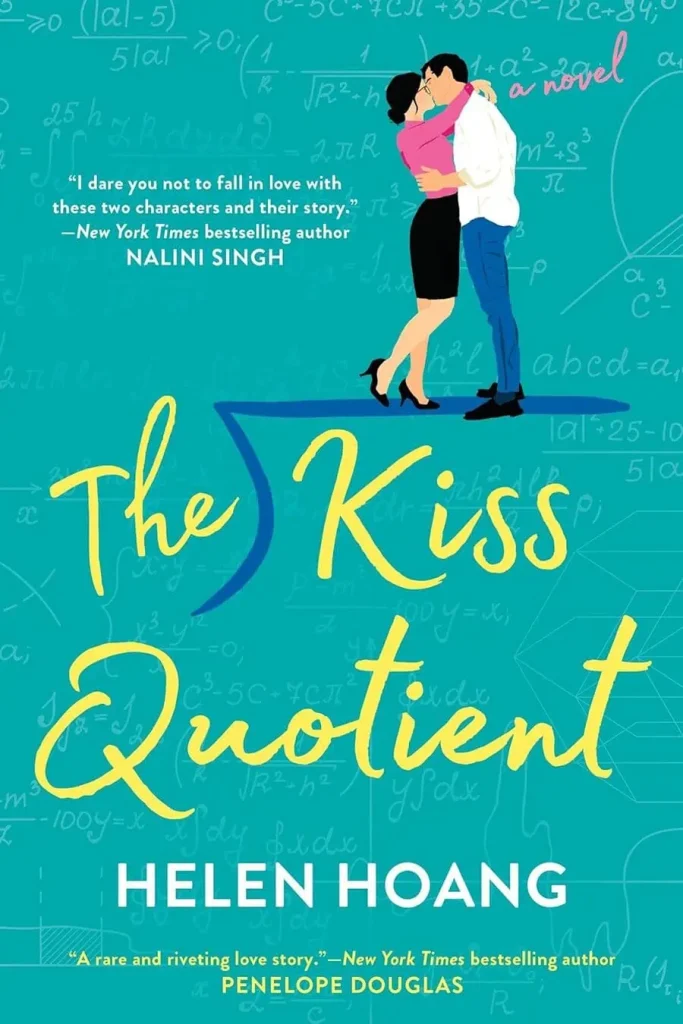
As of 2026, the most dominant trend in romance by far is the super cartoony illustrated cover. Once contained to romantic comedy, it’s now spreading into all kinds of romance genres. The first cover completely in this style to hit the scene was Helen Hoang’s The Kiss Quotient.
Been to any major bookstores lately, like Barnes and Noble?
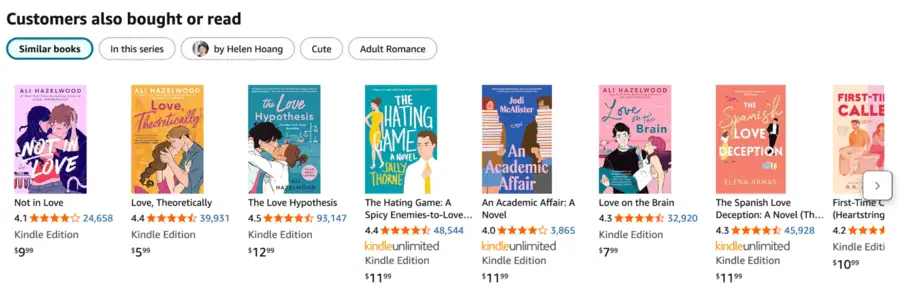
You might see a few that look similar. And by “a few,” I mean a few THOUSAND. They’re everywhere!
But as you can see from the screenshot below, readers still tend to buy a bunch of books that all look the same! For that reason alone, trying to look “different” and “stand out” is usually a bad idea, especially for indie authors with a small to nonexistent fanbase to launch to, little to no name recognition, nearly all sales happening online, and a heavy dependence on ads (Amazon and Bookbub ads in particular) for their marketing.
Why So Many Covers Look the Same
It’s kind of a strange phenomenon to see so many book covers in a genre gravitating towards looking almost identical, isn’t it? Why it happens is very simple though.
If a book is very successful, it gets read by millions of people, and a large percentage of those readers loved the book and are left hungry for more books like it. That creates a horde of people looking for similar books, and they look with their eyes for something that looks like it. Writers who write similar books to those bestsellers and give them a similar cover usually sell a lot of books!
Look Like a Bestseller, Sell More Books
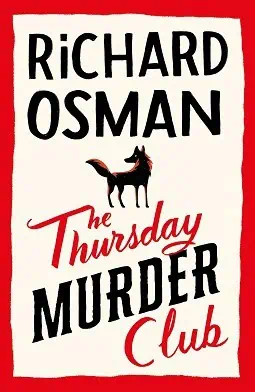
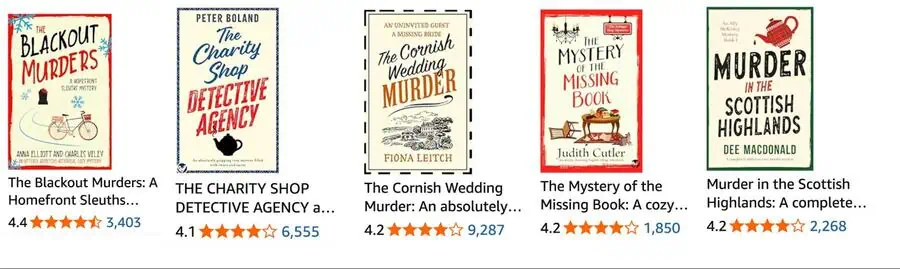
Notice how similar these covers are to Richard Osman’s bestselling cozy mystery, The Thursday Murder Club. And also notice how they all have a ton of reviews because they have been purchased and read by a lot of readers!
Creativity Kills Covers
One of my sayings that I’ve developed over the years is “creativity kills covers.” Shockingly, even in POETRY, where art and creativity and originality is the name of the game, there are clear book cover trends based on huge successes like Rupi Kaur’s Milk and Honey.
And authors who are not afraid to be completely uncreative and just look the same are succeeding at a high rate…
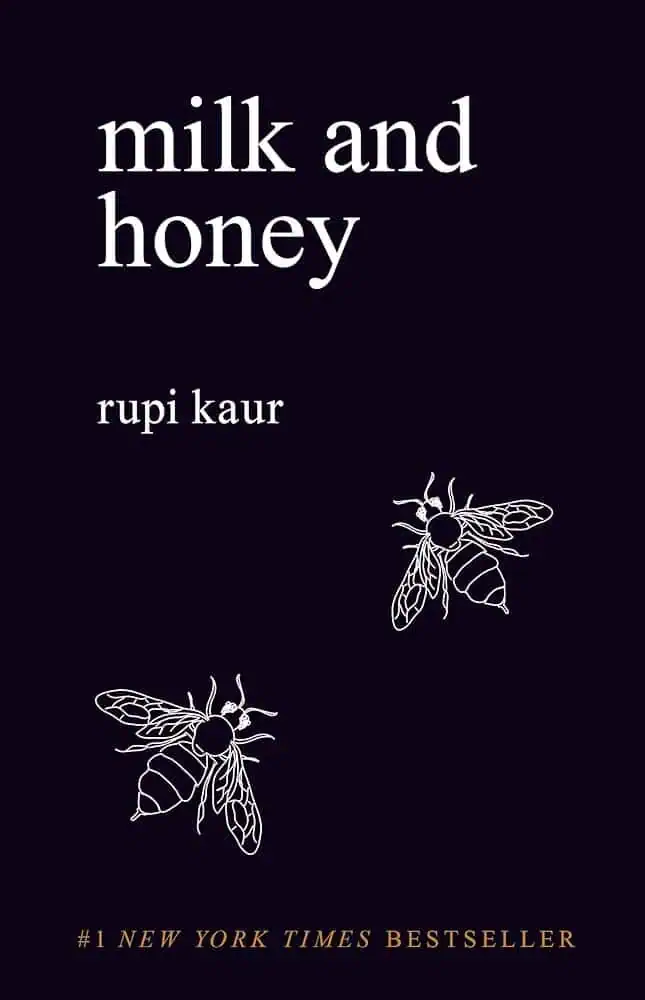
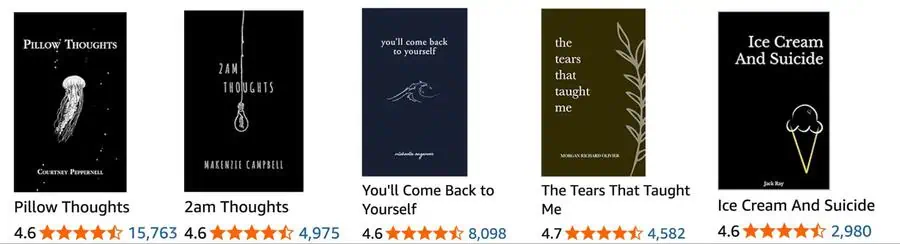
I could literally spend years of my life showing you examples of bestselling books, the trends that they started, and the books that entered the market with similar covers that had success.
The main point is that after seeing which customers of ours were having success and what their covers looked like, it became clear that almost every single successful book in our portfolio was a close match to a pre-existing bestseller.
Authors Taught Us
Admittedly when it came to the successful books we’ve made covers for, it usually wasn’t OUR idea to make the cover look the way we made it.
Typically, our customers really knew their niche, had a targeted plan to create a book to sell to readers of a very popular book or author, and they knew the best way to get those readers’ attention was a cover that looked almost identical. They did the research, showed us one or two example covers, and made sure their designer didn’t drift very far from those examples.
Only when we tracked down every cover of ours on Amazon did we truly realize how effective this is.
A Note on Nonfiction Book Cover Design
Most nonfiction genres have predominantly text-only covers (cookbooks and memoirs being notable exceptions), which leaves a lot less room for clearcut trends to emerge in many niches. However, you should still get to know your niche, look as best you can for trends, and abide by the same set of rules I’ve laid out for fiction.
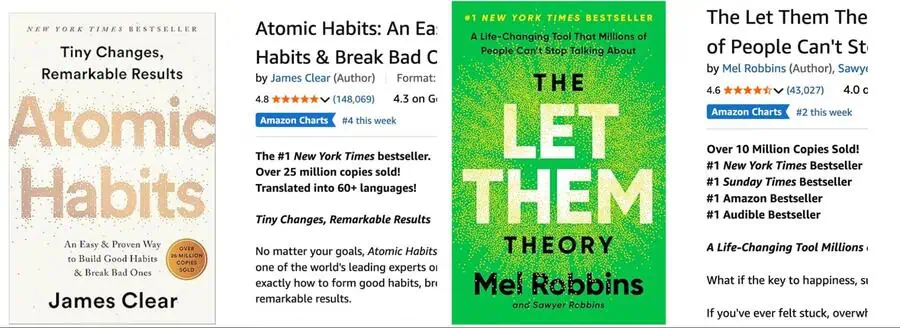
Don’t think copycatting bestsellers can work for nonfiction? Check out the biggest self-help book of the previous half decade, Atomic Habits. Now check out the current breakout top seller in self-help, The Let Them Theory.
Notice anything similar? It’s basically just a green Atomic Habits! Little gold dots surrounding the title for the win! (you may have to zoom in on those to see those tiny little “atoms”). Yet it worked, no? #2 on Amazon charts ain’t half bad!
How to Find the Trends
Now let’s get into what really matters: how to identify the current trends in your niche.
Every genre and subgenre is unique, and some subgenres have clearer and more obvious and repetitive trends than others. Go have a look using the following methods, see what’s repeating most frequently, and hopefully you’ll start to have a clear idea of what your cover should look like in order to best get the attention of your target readers.
1. Find the biggest sellers in your niche
Hopefully you know your niche and know exactly what THE book in your niche is right now. If not, go to the Kindle top 100 bestseller list in your subgenre and see what’s at the top of the charts. Give more weight to books that have a higher price and more reviews–those are proven winners most likely to be driving book cover trends.
Be sure to click on the top books and see the publishing date as well. The more recently it was published, the more relevant that book cover design is. Hopefully you can narrow down the most important books in your niche right now to just a few books.
2. Browse the “Customers Also Bought or Read” section on Amazon
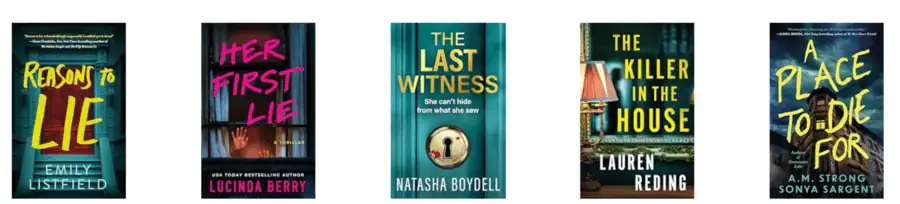
For each of the handful of bestsellers you’ve identified in your subgenre, look carefully at the Customers Also Bought or Read section. Look for repeating colors, images, and typography (text type, size, placement, and color). Look for obvious copycats as well, and be sure to click on those and browse the Customers Also Bought or Read sections for those books also, as that usually narrows down the trends even more.
The books won’t all look exactly the same, but you should see some trends, and the more you look the more obvious those trends should become. In the example below, what’s repeating is: home images (doors and windows), large, bright yellow title text in all caps, and the most common color is teal blue.
3. Use research tools like Publisher Rocket
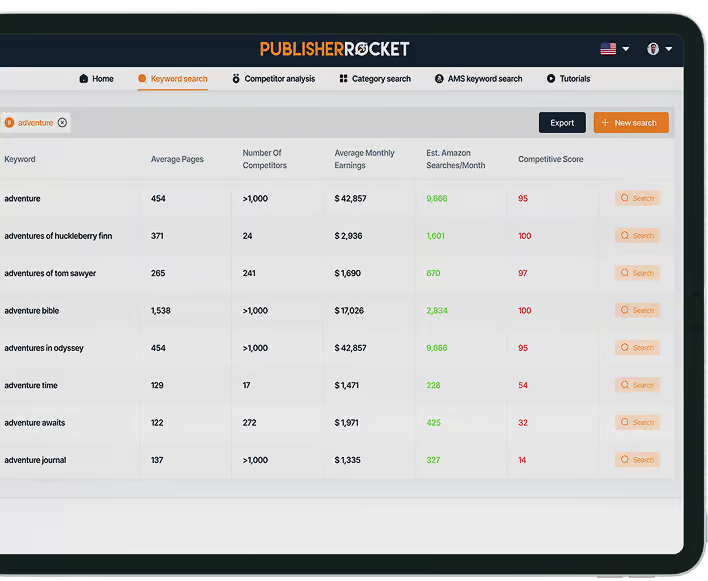
If you have the means, tools like Publisher Rocket are extremely handy. With Rocket, you can do deep research, analyze categories, and even spy on competing books. Tools like K-lytics and Kindletrends can also be helpful.
4. Go to bookstores
While not as targeted or scientific perhaps, bookstores are a great place to check out the hottest trends coming out of the big publishing houses in the major genres.
5. Add a 5th item to your list
Seriously, I couldn’t just end that list at 4, it just felt weird. But hey, you should make a list of repeating patterns and hopefully narrow it down to no more than 2-3 books for your designer to use as a guide in the creation of your cover.
The Final Piece: The Creation of the Perfect Cover
Okay, you’ve done your research and narrowed down your subgenre to just a small handful of current, recently-published trendsetting bestsellers. Now what?
First and foremost, don’t complicate it. You don’t need to launch an expensive design contest, you don’t need to go on a lengthy hunt for a freelance cover designer who has a ton of experience designing covers like your examples, and you don’t need to bombard a designer with a novel-length set of character descriptions, plot points, Pinterest board inspiration images, AI mockups, and other superfluous information. Your example covers are all a competent designer really needs to craft something similar for you.
The question I get more than any other about our book cover design service is, “How is your service so cheap?” Our prices at 100 Covers start at just $100 and we often run sales. The answer is simple: Creating a cover that dramatically increases the probability of a self-published author selling the book well, having successful ad campaigns, etc. is EASY.
It’s easy because showing up with two, well-researched example covers makes the vision for what your cover should look like very simple. The images, color schemes, and typography are already mostly laid out. No hours searching for the right images and fonts. No hours mulling over a creative concept to capture the essence of the book. For our designers, creating something similar to two clear examples is like shooting a basketball at a hoop the size of a swimming pool.
The result is that we had 2,686 first drafts accepted as final by the author in 2025. Did I mention we like to obsessively track things?! That is extremely efficient. And it all stems from having a very clear philosophy and guiding indie authors to find the best examples to base their cover on for maximum sales performance. Let’s sum that all up…
What to Give Your Designer
- Ideally TWO perfect example covers that perfectly represent the hottest trends in your niche or subgenre
- Basic details about your book for your designer to incorporate into the design to still represent your unique book
- Not much else, although it’s also a good idea to share one or two specific Kindle categories you’re hoping to be competitive in
And when you receive first drafts, don’t hesitate to be very demanding about making sure your book lines up well enough with your example covers that readers of those books will immediately recognize yours as being a similar book. Let your designer “cook” (don’t try to quarterback the process yourself too much), but remember it’s your restaurant at the end of the day, and you make the final call on what gets delivered to the table!
What NOT to do
For best results and an efficient design process without too many time-consuming and stressful rounds of revisions, I suggest that you don’t:
- Let your personal preferences (favorite colors, fonts, images, etc.) interfere with crafting an on-trend cover
- Design the cover yourself if you’re not a skilled, experienced graphic designer (our designers complete an entire year of rigorous apprenticeship under our top designers before they even join our official design team)
- Dictate the design process TOO much (it’s fine to show your designer what you want, but telling them how to do it usually muddies up the process and yields a frankencover that doesn’t quite look right)
- Submit AI mockups, as those mockups often don’t look right, stifle designer creativity (SOME creativity is still needed in crafting a good cover), and authors often fall too deeply in love with their own AI creation and have trouble seeing the flaws in it
- And most important of all, never EVER feed your designer after midnight! #80smoviesrule
Final Thoughts
I hope you found this information useful!
If you decide to use 100 Covers for your next book cover, be sure to enter the code “DAVE” without the quotes at checkout to save 20% on all of our book cover packages (and sometimes even more than 20% during special promos!).