When choosing keywords for you books on Amazon, most authors make a simple but costly mistake.
They broadly describe their book.
They choose phrases like “fantasy,” “self help,” or “epic adventure.” And while those descriptions may technically be accurate, they do almost nothing to help your book succeed on Amazon. In fact, using overly broad keywords is one of the biggest reasons books struggle to gain consistent sales once the initial launch momentum fades.
Here’s why.
When you choose vague, high-level keywords, you are not giving Amazon enough information to truly understand what your book is about or who it is for. Amazon’s system relies on detailed relevance. It needs signals that help it determine which readers are most likely to buy your book.
If your keywords are too broad, Amazon lumps your book in with thousands of others that used the same generic terms. You disappear into a massive sea of competition, and discoverability becomes nearly impossible. Instead of helping your book stand out, broad keywords often bury it.
What you should be doing instead is selecting keyword phrases that are specific enough to signal clear intent, clear audience, and clear positioning.
In this article, I’m going to show you a smarter way to choose keywords. A way that helps Amazon better understand your book and positions it in front of readers who are far more likely to buy…and I'll even prove this. Because keyword selection is not about describing your book. It is about matching your book to the right buyer.
- The Proof Behind Broad vs Niche Keywords
- Examples of Fiction and Nonfiction in Practice
- So, How Do You Find These Specific Phrases that Help?
- One Big Secret Tip
The Proof Behind Broad vs Niche Keywords
After years of analyzing book shopper behavior and Amazon search patterns using Publisher Rocket and its data, we discovered something surprising.
Books that rely on broad keyword phrases not only struggle to gain traction in Amazon search results, they also perform poorly from a buyer behavior standpoint.
To understand why, let’s look at how shoppers actually behave.
According to Amazon, 66% of all book shoppers begin their buying journey using Amazon’s search bar. The remaining 34% arrive through external links or by browsing categories.
But here’s the statistic that really matters:
Of the shoppers who begin with Amazon search, 89% end up making a purchase during that visit.*
Now, let’s clarify what that means.
It does not mean that 89% of individual searches result in a sale. It means that 89% of shoppers who begin their session using search will eventually purchase something before leaving Amazon. That distinction is critical.
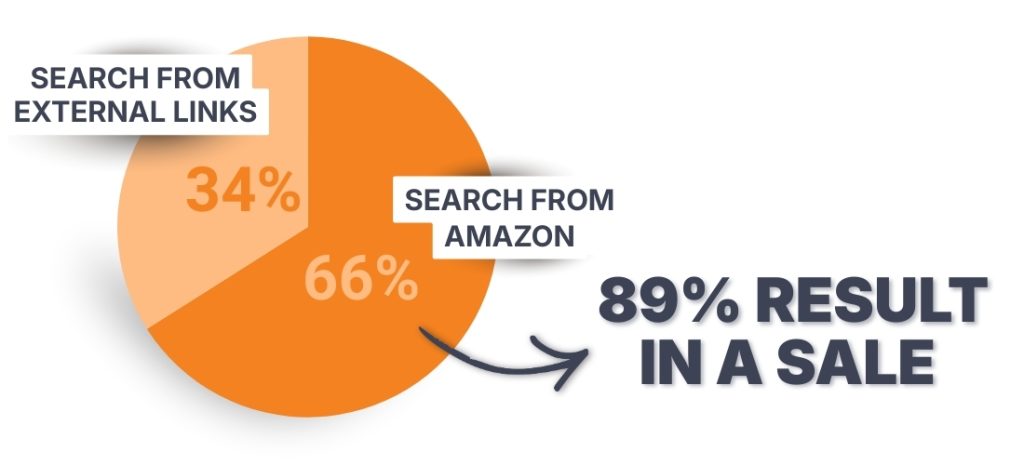
*This statistic was gained at Amazon KDP’s own webinar on KDP publishing
Because what happens between that first broad search and the final purchase is where keyword strategy lives.
To put it bluntly, shoppers rarely purchase from vague search terms like “fantasy adventure.”
Publisher Rocket’s data shows that there are many phrases shoppers type into Amazon regularly, yet those searches rarely result in a sale. For example, while more people may search for “fantasy adventure,” significantly more buyers actually purchase from a phrase like “fantasy books for kids age 11-14.”
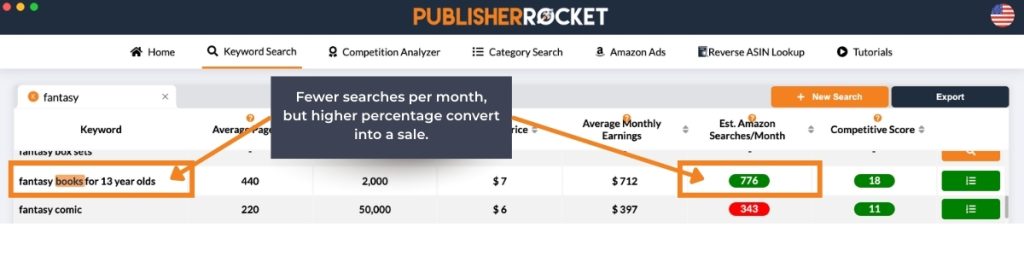
That difference matters.
And when you think about it, it makes perfect sense.
Imagine you type in:
“Romance book.”
What are the chances Amazon immediately shows you the exact type of romance you had in mind? Slim to none.
So what do shoppers do?
They refine. They add words. They narrow their intent. They search again.
“Wholesome romance.”
“Wholesome cowboy romance.”
“Wholesome cowboy romance small town.”
Each added word signals clearer buying intent.
And Amazon is watching this behavior. Amazon tracks whether a search phrase leads to a purchase. If customers repeatedly search a specific phrase and buy books, Amazon learns that those results satisfy buyers and better understands the books that show up for those phrases.
Now imagine your book consistently converts on a highly specific search phrase. Amazon begins to recognize that your book fits that audience. Over time, that performance signal can help expand your book’s presence across the store.
This is why niche phrases often outperform broad ones…SIGNIFICANTLY!
Broad searches signal exploration.
Niche searches signal buying intent.
Examples of Fiction and Nonfiction in Practice
To help highlight this point, and what it would look like between nonfiction specific keyword phrases and fiction specific keyword phrases, here are two examples
Fiction Example:
Say you type in “Romance Book.”
After seeing most of the results showing muscular men holding scantily clad women, you may realize that you don’t want steamy books and so you’d add some phrase that tones it down, like “wholesome” or “family.”
Then after looking at the results, you realize you love “prairie home style” or “cowboy romance.”
So you type something like “wholesome cowboy romance book”.

NonFiction Example:
Say you type in “back to school.”
After looking at the results you realize that there are different levels of school like GED, college, or Masters. So, you add “college” to your search phrase. But now you see book covers that show elderly people, young people, and people in suits, so you add something like “corporate”.
Then you find options about online learning or what appears to be”‘physically” going to school and so you change your search again.
As you can see through these two examples, shoppers start with something fairly broad and narrow down until they find what they are actually looking for.

So, How Do You Find These Specific Phrases that Help?
If you're going to do this manually, then break out a sheet of paper and a pen.
For fiction keywords, you’ll want to use the steps I chronicle in this article here, but the premise is that you should create 4 columns on the below subjects and come up with as many different keyword phrases in each category that you can think of:
- Time period and setting
- Character types or roles
- Plot Themes or special events
- Style and tone of your genre
Then work to combine them into 5-6+ word phrases that truly describe your book.
For nonfiction, I go into specific details here, but the premise is that you need to create a list of 3 columns on the below subjects and come up with as many keywords as you can think of for each:
- Pain point
- Desired Results
- Demographic
Once you have your list of potential words in all of those categories, you’ll want to start to group them and create 7 or so 5-6+ word phrases.
Here's the Problem:
The downside to this manual approach is that you won't know whether or not the combination of phrases you created are actually searched for, or are phrases that end up in buyers.
Those that have Publisher Rocket, that won't be a problem.
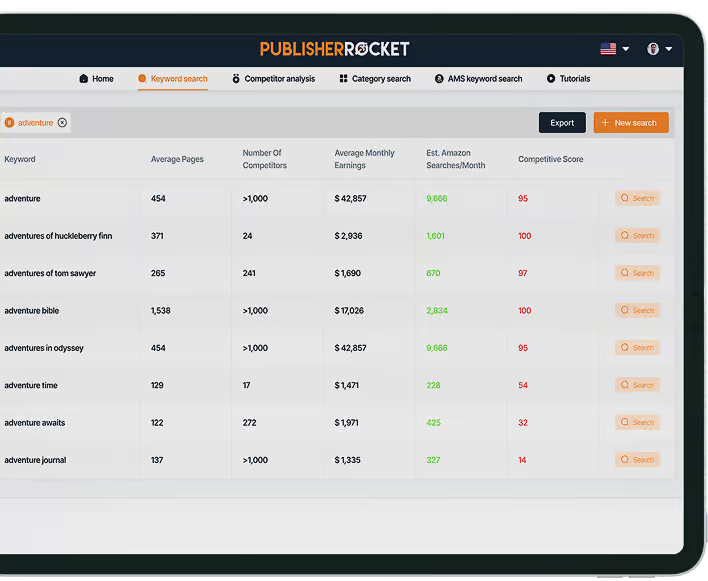
Not only will Publisher Rocket's keyword feature help you to find some of these great niche phrases, it will tell you how many shoppers search for that phrase and how much money books are making.
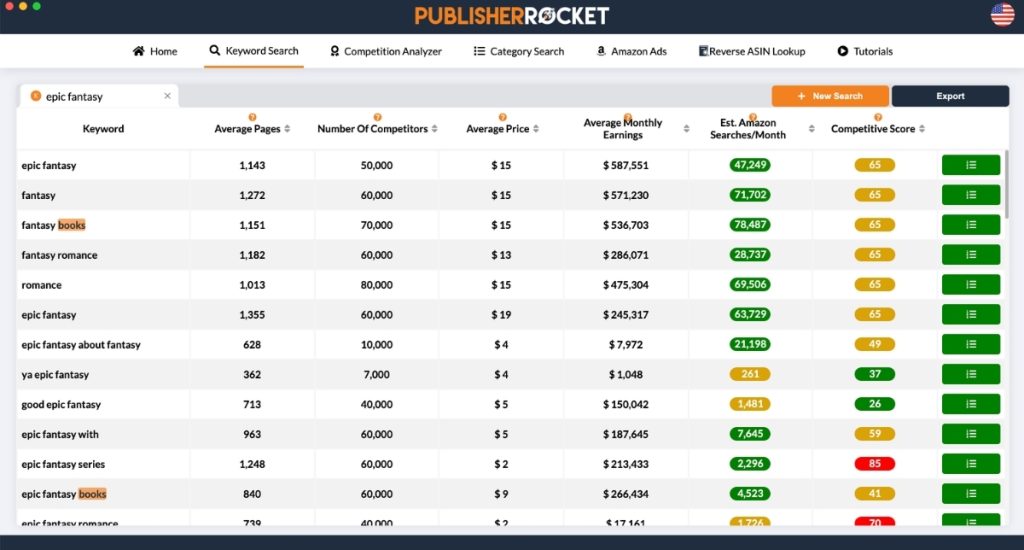

As you can see, finding keywords that are both searched for and niche and specific is much easier with a tool like Publisher Rocket showing you real data so as to make better decisions.
But more importantly, Publisher Rocket's database will let you know which phrases are prone to get sales, and which ones won't. As you saw above, there are search phrases where it has higher search. But luckily Rocket tracks them and knows that while lots of people type that phrase in, not many end in a sale.
That is why you will see keyword phrases in Rocket that have a lower search number but are marked green (making them great to use), while others with larger search numbers are in red (meaning they aren't great for sales). This not only gives you a clearer understanding of which phrases are better, but helps you to make better decisions when choosing your 7 KDP keywords for your book.
One Big Secret Tip
There's an even easier way to find the best keywords for your book using this method.
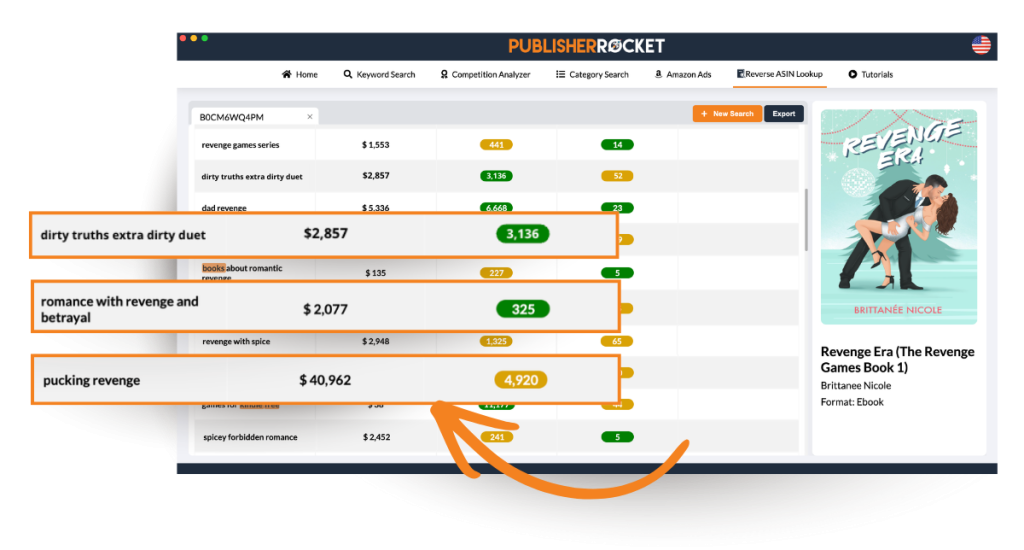
Publisher Rocket created a feature called Reverse ASIN. All you have to do is enter in the ASIN number of any book on Amazon, and Publisher Rocket will tell you what keywords that book has ranked for, and thus benefited from.
As you can see, it literally shows you all of the niche keyword phrases shoppers have typed into Amazon. So, just scroll through them and find the ones you like best, and use them. Best yet, it also tells you the number of searches that phrase gets and its competition score.
Amazon tracks which keyword phrases lead to sales. When a book consistently performs well for certain search terms, Amazon learns how to categorize and position it.
So when you strategically select niche phrases that align with your book and have proven buyer activity, you are not only increasing your chances of appearing in those searches. You are also helping Amazon better understand your book’s market fit.
That clarity helps Amazon know:
- Who your book is for
- What other books it belongs next to
- Which readers are most likely to buy it
Reverse ASIN removes the guesswork.
Instead of hoping your keywords are good, you can see which phrases successful books are already benefiting from and make informed decisions.
If you have not used Reverse ASIN yet, it is one of the fastest ways to upgrade your keyword strategy.
Stop guessing. Start analyzing.
Why Publisher Rocket Will Pay For Itself
It may seem like a bit of an investment, but just know that you get Publisher Rocket for life. That means you can use it on your current book, as well as all previous and future books. So, with this in mind…
Publisher Rocket will easily pay for itself:
- If using better keywords helps you to sell 62 more book in your entire author lifetime…
- If it saves you more than 10 hours of research in your entire author lifetime…
As you can see, its an easy statement to make considering the thousands of authors who have benefited from using Rocket and its data than just guessing, or spending countless hours working on manually finding opportunities.
Conclusion: Niche Keywords are Better
As you can see, there are a lot of phrases on Amazon that get searched a lot but have a lower chance of actually landing a direct sale.
And just like shoppers, we authors need to niche down our keywords so we can put our books in front of the right readers.
We can do this by using the column strategy listed above, or we can use Publisher Rocket to get a concrete idea of what is better for our book.
But either way, knowing about niche terms and book shopper habits can help us make better decisions on what keywords to choose, which will help to better position our books for more sales.
Good luck!