When it comes to formatting your book, you don’t have to spend thousands of dollars to get something ready to publish. And you definitely don’t need to spend hundreds of hours figuring it out just to get something that is just, mediocre.
Formatting should be the easy part. And there’s no single “right” way to do it.
If you are exploring your options, you’ve probably seen many tools, services, and even tutorials on what to do.
Some authors prefer using dedicated formatting software like Atticus – personally my top choice. Others choose to hire a professional to do everything. And many might choose the DIY route, using tools they already have on hand while learning the formatting process along the way.
No matter which path you choose, you have options.
But one that doesn’t get talked about much… structured guides to walk you through the entire process step by step.
To be honest, most of these tend to be complex and leave authors more confused about the process than when they started. However, I came across one recently that I found to be very helpful, well put together, and not overly complicated at all.
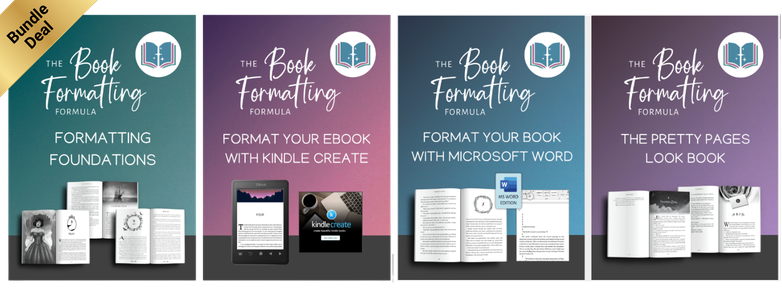
It’s called The Book Formatting Formula by Julia Scott. It’s a bundled set of resources designed specifically for authors looking to take on the DIY route without feeling overwhelmed, and who want to actually understand why they are doing something (rather than just knowing the process).
What Do You Get?
For less than $60, The Book Formatting Formula bundle includes with a collection of guides that were designed by an author to help walk through the entire formatting process step by step.
But it’s not just the formatting mechanics you get.
One of the biggest challenges authors run into is help with imagery and design. And believe me, I know that’s not an easy task if you aren’t already familiar with those techniques.
This bundle addresses that directly.
There is also the option to purchase individual guides, rather than all at once. These are ranging between $12 – $30 each and focus on genre-specific fonts and designs. You will learn things like understanding the usage of imagery, creating visuals by yourself, and ensuring everything looks right in your final manuscript.
Why You Should Consider It
This kind of system isn’t for everyone. But if you’re still unsure whether you might find benefit, here are a few reasons this might be suited for you.
- You’re looking for the why and not just the how.
These guides don’t just show you what to do, they explain why it matters. For example, you’ll learn why a font like “Alegreya SC” might be better for your Urban Fantasy rather than something like “Metal Mania”. Rather than just being told here’s a good font to use.
- You feel overwhelmed piecing together DIY guides.
I know that trying to stitch together free tutorials and guides can quickly turn tricky. You often get looped into something listed as “free” but then find yourself needing to purchase different tools or upgrades just to make it to the end. This system has done a great job of breaking down each guide into bite-sized pieces, while also offering a complete bundle if you want it all in one place. - You’re working with imagery and visual elements.
If your book goes beyond just plain text, like illustrations, diagrams, or even maps, having clear guidance on image preparations can save you a significant amount of time and frustration.
Who Might Not Be the Right Fit
Like most things in publishing, it really comes down to how you, as the author, prefer to work, your workflow, and budget.
Where a system like this might not be right is if you fall into one of the following:
- You’re looking for speed and not something manual.
If you’re looking for something quick, automated, and don’t really want to walk through the ‘learning process,’ you might not find this to be ideal. That said, some of the individual guides, like the “Look Book” or the “Image Prep” could still be useful since they focus more on design than technical execution. - You’d rather hire a professional.
Some authors simply don’t want to spend the time of trial and error that comes with formatting. And that’s perfectly fine. If that’s you, you may be better off learning how to find and hire a quality formatter.
This bundle is built around learning and doing the work yourself. While you’ll get the guidance and structure, it still requires you to apply what you’ve learned.
So, take a moment to consider what approach fits you and your workflow best.
Final Thoughts
Formatting doesn’t have to be complex, expensive, or even time consuming. They key is finding an approach that aligns with how you like to work and what you have readily available to you.
If you enjoy learning hands on, want to gain a better understanding of the why’s behind formatting, and have a bit of time to do it right, The Book Formatting Formula is a great option worth considering.