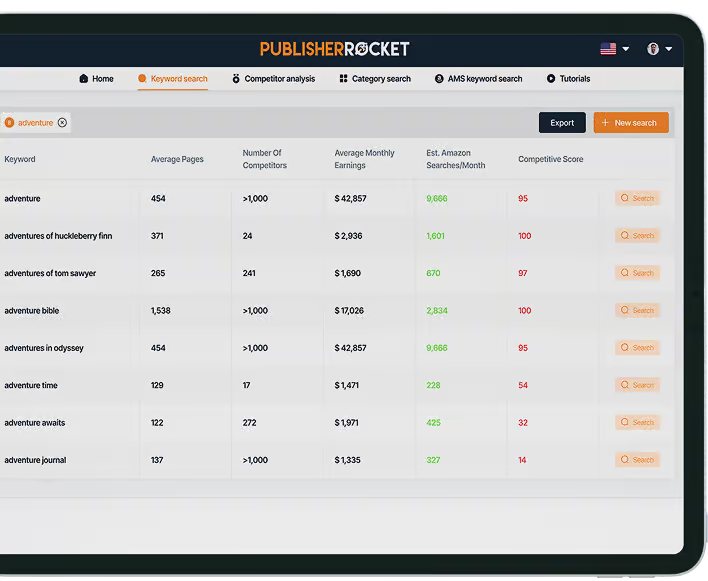
Thanks to advancements in Publisher Rocket, we’ve been analyzing data from Amazon for a while. Because of this, we picked up on a pattern in how Amazon treats books and their discoverability that I think changes a lot in the industry, and how we authors should operate.
Basically, through analytical proof, we found that when a book has a rise in sales on Amazon through just about any means, Amazon responds by increasing the number of keywords that that book shows up for naturally (or also known as organically), and its rankings for those keywords as well. Therefore, because of the increase in a book's popularity, the book would show up more often in the Amazon's store, and thus increase its sales further.

On the one hand, this makes sense. However, this also opens up a lot of questions like how does Amazon do this and what does this mean for authors? Are there things we can do to help ride this popularity effect or take advantage of it? Make better decisions? Plan better launches?
But to answer these questions, we need to understand more about the popularity effect, and how far it really goes. Therefore, in order to help understand this phenomenon and see what else we can learn from Amazon, I decided to conduct a full experiment, record the data and give my thoughts on what is going on here.
- What the Amazon Popularity Effect is
- How this affects authors
- The effect of a single promotion
- The data and science behind an excellent book launch
- Does Amazon prefer newer books?
- What tactics you should employ based on its findings
How I Got the Data for This Experiment
I began with a simple hypothesis: Amazon gives increased discoverability to books that demonstrate strong conversions and sustained sales over time.
If that were true, then as a book generates more sales, Amazon should begin showing it in more keyword searches across the store.
To test this, I needed two things:
- A way to track book sales trends over time
- A way to track how many keywords a book ranked for and how those rankings changed
For long-term market data, I relied on Publisher Rocket, which now actively collects and stores Amazon data to track historical trends and keyword visibility.

To measure indexing and ranking changes, I also used a custom crawler originally built for my 7-keyword experiment. It tracked how often books were indexed for keywords and how those rankings shifted over time.
Using both systems together, we tracked over 500 books and identified 164 that experienced measurable sales increases, either through spikes or sustained growth. These books spanned fiction and nonfiction, new and established titles.
From there, we monitored two primary variables:
- Sales performance over time
- The number of keywords each book ranked for
This allowed us to answer three key questions:
- Do increased sales affect how many keywords Amazon ranks a book for?
- Do sales spikes influence Amazon to show a book more often?
- What is the effect of consistent, sustained sales growth?
The patterns we observed were strong enough to draw meaningful conclusions.
Limitations to the Experiment
Like any experiment, this one had constraints:
- We tracked 164 qualifying books. While larger datasets are always ideal, the patterns were clear and consistent.
- We did not isolate by genre. The assumption was that Amazon’s discoverability logic functions similarly across categories.
- We did not control for external promotions. Sales increases may have been driven by ads, emails, or other tactics.
- We were unable to measure changes in Also Bought placements or other merchandising areas.
Despite these limitations, the correlation between sales increases and expanded keyword visibility was strong enough to support the Popularity Effect hypothesis.
Amazon Popularity Graphs Explained
Before diving into the results, a quick note about the graphs below.
Each graph combines data from Publisher Rocket and our scraper to show overall trends. The orange line represents sales, and the dashed white line represents the number of keywords a book ranked for.
We intentionally removed the y-axis to avoid suggesting a fixed numerical relationship between sales and keyword rankings. The graphs are meant to show correlation, not exact ratios.
With that in mind, let’s dive in.
Experiment 1: Sales vs Number of Keywords
In this first experiment, I wanted to see if books that had a clear increase in sales, would also have an increase in the number of keywords they show up for. As you can see from the graph below, this did in fact happen in a majority of books analyzed. Not only did the number of keywords a book showed up for increase, but so did the rankings for certain keywords as well.
However, it should be noted that the effect of the increase in the number of keywords took on average between 6-8 days before the number became noticeable.
On the whole, this sort of response by Amazon makes sense considering that the increase in a book's popularity might be cause to believe that the book is more popular in general and can convert better. Considering that the overall objective of Amazon's search algorithm(s) is to help increase Amazon's sales by showing the right product to the right customer more often, it can be assumed that Amazon would take such a action, and try to show more proven popular books over less popular.
Basically, if I were the one in charge of the algorithm, I'd make it so that when a product starts to increase in popularity, I would work to show that product more to see if I can ride a trend. So, these results track logically.
So, how did they do this? I will explain my ‘belief' in the next section.
Conclusions From the Results
1.The more sales a book made, no matter where the sales came from, a book would start to index for more phrases on Amazon over time.
2. It took about ~6-8 days of consistent new sales before Amazon would start to show any notice.
What Kind of Keywords Does Amazon Add to Popular Books?
If Amazon is choosing to show a book for more keywords because it is selling more, then the next real question is what kind of Keywords is it showing a book for, and what can we do about that.
After analyzing the data, I believe that Amazon started showing books for two things:
- More terms that are like the ones the book was already ranking for
- Broader or tertiary terms that fit the natural character of the original keywords
The first one makes sense in that Amazon knows what keywords do well and how certain keywords are related to others. They track everything from previous books and would know that if a book is doing great for ‘Keyword A,' then historically, it would also perform well for ‘Keyword B.' I saw a lot of keywords added to popular books that were similar to those it was previously ranking for.
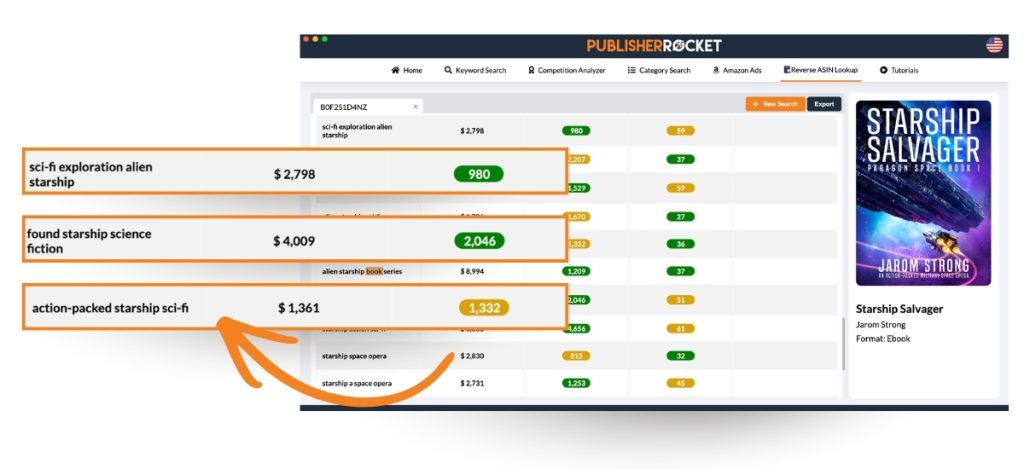
It is for this reason, that you ensure that the 7 KDP keywords you choose, are very specific and well described. This way, Amazon will have a better understanding of what your book is truly about. Here is an example of what great, specific keyword phrases look like, as compared to broad and non specific:

Getting the right specific keyword phrases that truly describe your niche topic, or sub sub genre, will be key to getting Amazon to better understand what your book is truly about, and therefore, can start to add more terms to you, instead of guessing and failing.
The best way to do this, is to use Publisher Rocket's Reverse ASIN feature. Using this, you can enter in the ASIN number of any book, and see all the keywords that work best for it. Select the best keyword phrases that are very specific, and use those as your book.
As for the second point, I noticed that certain books would also be added to more broad terms than what they were originally listed for (this part is using last years experiment where we did control the keywords people selected and changed and watched what happened – you can see that here). Here’s an example:
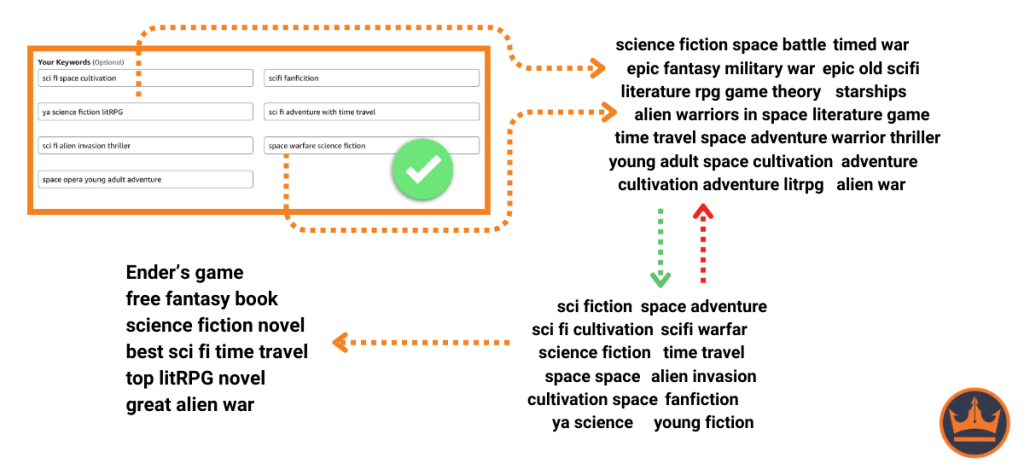
In the example above, the book initially ranked for a tightly defined group of niche keywords. As the book performed well for those terms, Amazon began testing it in broader, higher-traffic searches where it still logically fit.
When the book continued converting at acceptable levels, Amazon expanded its reach even further into more competitive phrases. However, once performance dropped in those broader terms, Amazon reduced its exposure there and shifted the book back toward the keywords where it had proven stronger conversion.
This illustrates something critical:
Amazon expands visibility based on performance.
If you choose keywords your book does not truly fit, your conversion rate will suffer. When that happens, Amazon has little reason to test your book in broader markets. In fact, it may limit its discoverability.
On the other hand, when you select highly relevant, specific phrases that accurately reflect your book, you create the foundation for growth. Strong performance in those niches signals to Amazon that your book deserves broader exposure.
This is why choosing the right 7 KDP keywords matters so much.
Using Publisher Rocket to evaluate search volume and competition is important. But just as important is selecting phrases that genuinely describe your book and align with buyer intent.
Start specific. Perform well. Let Amazon expand you upward.
Now that we've seen a direct correlation between sales, and Amazon increasing the number of keywords a book ranks for, as well as discussed my thoughts on how this actually happens, let's look to see if a sales spike has any effect or not. This will help us in understanding book promotions and how we should best treat them.
Experiment 2: Single Book Promotion or Sales Spike Effect
As many authors have seen, when you do a major but specific book promotion, there is usually a spike in sales or downloads. The hope is that when the promotion is over, the momentum of the promotion continues and sales continue beyond the promotion time period.
This was a major tactic that authors used back in the day to beef up their sales. Using a Free Kindle promotion, or some tactic of the sorts, they could keep their books relevant. However, as most authors have noticed, this sort of practice has lost its efficacy. Therefore, if the popularity effect is correct, we should see data to help us understand this better.
To answer this, we did a couple of experiments where we tracked books sales before a promotion, during, and after. We compiled the data to create this general graph of our findings:

While the above graph would show that there is a higher number of sales during the promotion than before, it appears as though there was not enough time for the Amazon Popularity Effect to take effect. The problem with promotion site marketing efforts is that they are generally ephemeral and as we’ve seen under previous studies, spikes in marketing efforts do not gain Amazon’s attention.
We can conclude that a single promotion will have little effect on your book’s popularity on Amazon. Sure, you could have more downloads and sales during that brief period of time. However, this will not be enough for you to breathe new life in your book or grow it…unlike what it used to be 4+ years ago when this would help.
As I’ve said before, it is much better to directly sell 1000 copies evenly over a 30 day period, than to sell 1000 copies on the first day, and none for the next 29 days. As we'll see in the next experiment, consistent sales gain Amazon’s attention.
Conclusions From the Results
1.Spikes in sales do not have a long term effect
2. Book promotion sites are not as effective as they used to be if they are not stacked one after the other
3. Authors should look to build a series of promotion efforts so as to feed off of each other, rather than isolated tactics
Why Publisher Rocket Will Pay For Itself
It may seem like a bit of an investment, but just know that first you get Publisher Rocket for life. That means you can use on your current book, as well as all previous and future books. So, with this in mind…
Publisher Rocket will easily pay for itself, if:
- If using better keywords helps you to sell 62 more book in your entire author lifetime…
- Saves you more than 10 hours of research in your entire author lifetime…
As you can see, its an easy statement to make considering the thousands of authors who have benefited from using Rocket and its data than just guessing, or spending countless hours working on manually finding opportunities.
Experiment 3: Book Promotion Launch Effect
One thing I’ve always wondered is, does Amazon give preferential treatment to new books? Even more so, what does a well-planned book promotion launch look like, and if done right, how does Amazon respond?
Well, after analyzing the data, here is a general representation of what we saw:

The above is an example of a well planned out book launch. In this, the promotions and marketing tactics were spread out over time and thus minimized giant spikes left with low valleys. Instead, it created a high level of consistent sales.
And, as we’d expect, Amazon rewarded these books with increased keywords and popularity in their store.
But then something happened.
After the a specific point in time (ranged differently between books), the number of keywords would drop even if the sales stayed consistent. Now, the drop wasn’t terrible if the book continued consistent sales…but it was still there and noticeable.
I believe that this is an indication that Amazon does give preferential treatment to books that are newer, rather than older. I like to say that at about the 30-40 day mark, the honeymoon period is over and the climb is a bit harder. I've expanded on this point, and publishing a full article on this honeymoon period because there is even more to dig into on this subject.
Conclusions From the Results
1. Combining promotions together has a great effect on Amazon’s Popularity Effect
2. Maintaining a consistent book launch will increase your overall popularity on Amazon
3. Amazon does seem to favor newer books and gives them preferential treatment
4. You can minimize the drop of the effect by having consistent sales
Recap: What Authors Can Learn from This Experiment
Books that make consistent sales show up for more keywords and have better rankings. It appears as though Amazon puts those books in tertiary terms or phrases they know are connected with the phrases the book is doing well in. Therefore, this Popularity Effect grows a book’s discoverability.
Book Promotion Sites are not as effective as they used to be. The Amazon search algorithm does not give short-lived spikes any attention that helps a book stick. There are more sales than if you hadn’t done a book promotion, but it does not solely turn the tide on a book’s discoverability.
When launching a book for the first time, it appears as though there is some kind of new book factor in place. Our data shows that new books get a benefit of the doubt over older books. I like to call this the Honeymoon Period.
Amazon Ads create continuous consistent sales if done correctly. Those sales help to kick in a book’s Amazon Popularity Effect and thus, Amazon keeps the book listed in more keyword phrases than it would have if it hadn’t done the ads.
This data shows that there is extreme importance in spreading out your book marketing efforts over time so that you gain consistent sales during that time period. This has a greater effect on your keyword rankings and thus improves your Amazon Popularity Effect even more.
Cheers,