It would be easy to write a puff piece here.
Atticus is a Kindlepreneur product, after all. I could give it every trophy, send Lacuna home with a participation ribbon, and write the whole thing like the outcome was never in question.
But I didn't want to do that. So before we get into it, I'll say this: Lacuna is a legitimate tool. It does a lot of things well, and for the right author, I can genuinely see the appeal. Especially if you're someone who wants your software installed locally on your computer, wants nothing to do with the cloud, and believes every app that asks you to log in online is one step away from becoming Skynet.
For what it's worth, I started using Atticus years before I ever joined Kindlepreneur. So I came to this comparison with a pretty clear sense of which side I was already on. But that's exactly why I wanted to be careful with it.
When most people start comparing Atticus and Lacuna for writing and formatting books, the first thing they notice is pretty straightforward. Lacuna is a desktop app. Your files live on your machine. Atticus is cloud-based. Your files are backed up online, and you can access them from pretty much any device with a browser.
But so what?
Does that matter when you’re trying to format a book?
After spending time with both, my answer is yes. It matters a lot. But not because “cloud-based” is automatically the smarter choice, or because local software is somehow stuck in the past. It matters because those two approaches, cloud-based and desktop, quietly determine how you work every day. How many devices you can write on. Whether your manuscript is safe if your laptop dies. And how often you find yourself wondering which version of your book is the latest one.
There are other differences too. Pricing is more complicated than it looks at first. Refund policies are very different. And when we tested Lacuna’s exports, we ran into a few issues that could be problematic given their “all sales are final” policy.
So yes, Atticus is the winner for me. It's more flexible, less risky, and a whole lot easier to live with.
And in this as-unbiased-as-I-can-possibly-make-it guide, I'll tell you why.
Atticus works wherever you work
Let’s say you normally write and format on your Mac.
During the week, you open the Atticus app, work on your manuscript, make a few formatting changes, and close it when you’re done.
Then you visit your parents over the weekend. You didn’t bring your Mac, because you were trying to be a normal human being for once, but now you have 30 minutes of downtime and want to check something in your book. With Atticus, you can open Chrome on their PC, log in, and pick up right where you left off.
Later that night, you’re waiting to be seated at a restaurant. You remember one more thing you wanted to check. So you pull out your phone, open Safari, and review the latest version there.
With Lacuna, the experience is VERY different.
For one thing, you can only use Lacuna on a Mac or PC. Got a phone, tablet, Chromebook, or Linux device? Sorry, you can't use Lacuna on it. But secondly, your project is only on the machine where Lacuna is installed. If you want to work on it somewhere else, you need to have 1) purchased a second Lacuna license and 2) made sure you’ve manually moved the right file to the second Mac/PC.
And that last one is not a small thing. If you're someone who tends to have file names like Final_Book_Version_REALLY_FINAL_2.docx scattered all over your computer, it's a recipe for frustration.
Local-only sounds nice until you need a backup
Now, I can already hear the Ron Swansons of the world clearing their throats.
Some authors don’t trust the cloud. They don’t want their manuscript stored online. They don’t want syncing, and they certainly don’t want another login. They want their software installed on their computer, their files on their hard drive, and preferably a framed photo of Nick Offerman nodding approvingly in the background.
Fair enough. If that’s you, Lacuna’s local-only approach may be exactly what you want.
But it also means backups are your job.
Lacuna saves your work locally, but if your laptop dies, gets stolen, takes a coffee bath, or is dropped into the actual bath by one of your kids, your book is only as safe as your most recent backup.
And not just any backup…
A backup stored somewhere else.
Because if your Lacuna project and your backup are both sitting on the same machine, that’s not really a backup. That’s just two passengers on the same sinking boat.
With Atticus, your work is automatically backed up to its secure cloud. So if your computer dies, you haven’t lost your book. You just log in from another device and keep going.
Offline use isn’t the advantage it appears to be
One argument for desktop software is that it works offline. And yes, Lacuna does that.
But Atticus works offline too, and that's the part most cloud-versus-desktop comparisons skip right past. People hear “cloud-based” and assume it means “useless the second your internet connection gets spotty.”
That's not how Atticus works. You can write and edit without an internet connection just like you would in Lacuna. The difference is that once you're back online, Atticus syncs your changes automatically. With Lacuna, you're still on your own.
And speaking of which…
The local-only workflow can get messy fast
I already touched on this briefly, but here’s where Lacuna’s setup would personally make me nervous.
Let’s say you have Lacuna installed on your desktop and your laptop. You work on your desktop Monday morning. Then you need to travel, so you copy the project to your laptop. You make changes on the laptop. Then, when you get home, you need to remember to move the newest version back to your desktop.
Simple enough, right?
Sure, until you forget. Or you move the wrong file. Or you make changes on both machines. Or you can’t remember whether the version on your laptop is newer than the version on your desktop. Or you open the wrong one, make more changes, and now you’ve created a tiny manuscript multiverse where every version is slightly different and none of them can be trusted.
This is the kind of thing that turns otherwise calm authors into Jack Torrance.
Now, some Lacuna fans will point out that you can set up Dropbox or Google Drive to handle your backups automatically. And that's true. But it doesn't solve the version problem. Dropbox might have the latest copy of your manuscript, but you still have to remember to grab it before you start working, which is just a different version of the same problem I described above. Plus, if you're already syncing your manuscript to the cloud anyway, you've essentially built a cloud-based workflow (just a more complicated one). At that point, you might as well start with software that handles it for you.
And that's exactly what Atticus does. The latest version of your project is always the one you're looking at, whether you're on your Mac, your PC, your Chromebook, your tablet, or your phone.
Lacuna looks cheaper until you need more than one device
At first glance, Lacuna wins on price.
It's $139 for one machine. Atticus is $147.
So if you stopped reading right there, you’d think, “Okay, Lacuna is cheaper. Not by much, but cheaper.”
And technically, yes. But those numbers don't tell the whole story.
Lacuna’s $139 price is for one machine. If you want to use it on two machines, it'll cost you $229. If you want to use it on three, it jumps to $319.
Atticus is $147, regardless of how many devices you use it on.
Use it on your desktop. Use it on your laptop. Use it on your spouse’s computer. Use it on the family PC in the game room that somehow still has a printer from 2008 connected to it. It’s still $147.
Plus, there's the whole “local-only” thing I mentioned earlier…
Even if you buy Lacuna for multiple machines, those machines don’t talk to each other. The copy of your project on your desktop doesn’t magically sync with the copy on your laptop.
You still have to move files around yourself, and it's on YOU to ensure you're working with the correct version of your book.
With Atticus, the device doesn’t matter nearly as much. If you’re online, you’re working from the latest synced version of your book. If you work offline, your changes can sync once you’re connected again.
So yes, Lacuna has the lower starting price. But Atticus is the better value because you get the flexibility to use it across your devices without buying extra machine licenses, manually moving project files around, or wondering whether the version on your laptop is the one you worked on yesterday or the one you forgot to update three weeks ago.
To me, that peace of mind is worth more than eight bucks.
The export issues worried me
The real test of any formatting app isn't the preview or the interface. It's the exported file.
That’s what you’re eventually uploading to Amazon, IngramSpark, Draft2Digital, or wherever else you publish. And if you’re exporting to DOCX, it’s probably because you need to send the manuscript to an editor, proofreader, or someone else outside the app.
But in our team's internal testing, Lacuna's DOCX export wasn’t something I’d want to rely on without checking it closely afterward.
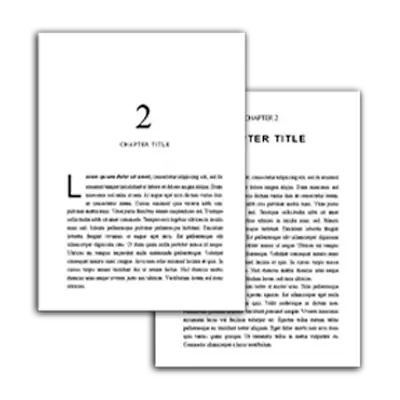
The biggest issue was drop caps. Inside Lacuna, they looked fine. Then we exported to DOCX, opened the file, and found that the first letter of each chapter had an extra return after it. Which meant the opening paragraph didn't flow correctly. Which meant we were now fixing formatting issues in a file we'd just finished formatting.

That's not a great feeling.
We also had images come through incorrectly, including at least one that appeared corrupted. That won't matter if your book is all text, but if you have chapter images, screenshots, maps, diagrams, illustrations, or anything else visual, now you have to slow down and check every image in the exported file.
The hyperlink behavior was odd too. In our test, linked text didn’t stay as linked text. The export showed the full URL instead, which is obviously a problem if your book uses more than a couple links.
Sure, none of these are impossible to fix. But I shouldn't have to fix them.
Once I export a book, I don’t want to wonder what might have changed in the process. I don’t want to check every drop cap, every image, every link, and every chapter opening like I’m proofreading the software instead of the manuscript.
And with Lacuna, that’s how the DOCX export made me feel.
This matters even more because Lacuna doesn’t have the same collaboration setup Atticus has. If you need someone else to review your manuscript, exporting to DOCX is one of the most common ways to do it. So if that export creates cleanup work for you, it really affects the workflow.
Maybe your file would export perfectly. Maybe the issues I ran into were specific to my test manuscript. That's certainly possible.
But I didn’t run into those same problems with Atticus.
The difference in refund policies is huge
Normally, I don’t spend much time thinking about refund policies.
If a product is good, great. If it isn’t, hopefully the company gives you a reasonable window to figure that out.
But with book formatting software, the refund policy matters quite a bit because some of the most important tests happen at the end of the process. You don’t really know how your book is going to export until you export it.
And with Lacuna, that creates a problem.
Lacuna has a free version, which is nice. There’s no time limit, and you can use it to test the software before buying. That’s genuinely helpful, and I don’t want to brush past it like it doesn’t matter.
But the free version doesn’t let you export your finished files.
Which makes sense, of course. If you could use the software for free and export your final book, there wouldn’t be much reason to buy it.
But it also means you can’t fully test the thing that matters most until after you’ve paid. And once you’ve paid, there's no safety net: all sales are final.
That's where the export issues I mentioned earlier become more important.
If the only thing I disliked about Lacuna was the interface, fine. You can test that in the free version. Same with the style options, the editor, the previewer, and most of the general workflow.
But the issues I ran into with drop caps, images, and hyperlinks showed up after exporting. And that's the part you can't fully test for free.
Think about what that means in practice. You spend real time learning the software. You format your book. You export it. And then you find out the exported file has problems. At that point, you've already paid, you can't get your money back, and your options are to fix it manually or start over somewhere else.
Atticus handles this very differently.
It doesn’t have a free version, but it does have a 30-day money-back guarantee. You can buy it, put it through its paces, export your files, and see how it performs with your manuscript. If you’re not happy, you can get a refund.
That’s the better setup. I’d rather have 30 days to fully test everything, including exports, than unlimited time to test everything except the final step.
Atticus vs. Lacuna: Here's where I landed
There are plenty of smaller feature comparisons we could keep digging into.
Fonts. Chapter themes. Preview options. Tables. Footnotes. All the little things people usually stack into a comparison chart so the article can pretend every feature matters equally.
But that’s not how I’d choose between these two tools, and it's probably not how you would choose either. Both Atticus and Lacuna can format a book. Both can create professional-looking files. And depending on your preferences, either one could work for you.
For me, the differences that matter are the ones you feel every time you sit down to write.
Atticus works on more devices without charging me extra for the privilege. My work stays synced and backed up. And if I want to test the exports before committing, the 30-day refund window is there for exactly that.
Lacuna has its strengths too. If you want local-only software and you’re comfortable managing your own files and backups, I can see why you’d like it. Some authors want that setup, and if that’s you, there's nothing I could say that would talk you out of it.
But personally, local-only is more hassle than benefit.
It means more file juggling and the constant, low-grade anxiety of wondering whether you're working on the right version. And if your laptop suffers death by orange juice because your kid wanted to ‘help,' whatever backup system you remembered to create is all you've got.
Add in the DOCX export issues I ran into, plus the all-sales-final refund policy, and the choice becomes pretty easy.
At the end of the day, I don't want to think about which device has the latest version of my book, or move files around every time I switch computers. And I definitely don't want to discover an export problem after I've already paid and can't get a refund.
Atticus solves all of that. Lacuna, at least in my experience, doesn't.
And for most authors, I think that's the only comparison that really matters.