Being asked to write a foreword is one of those writing assignments that sounds flattering until you sit down to do it and realize you’re not entirely sure what you’re supposed to say.
Because you’re not the author, but your words are going at the front of the author’s book. You’re not writing the introduction, but you are helping introduce the reader to what comes next. And you’re not there to make the book about you, but you also can’t write something so bland and distant that it feels like you were chosen by committee and handed a paragraph to approve.
That’s the odd little job of a foreword. The author is borrowing a bit of your credibility, your relationship with them, or your connection to the topic, and trusting you to help the reader feel like they’re in good hands before the book really begins.
Which is also why a foreword can go wrong pretty quickly when the person writing it tries to make it too formal.
A good foreword usually doesn’t need to sound grand or literary. It doesn’t need to explain the whole book. And it definitely doesn’t need to become a second introduction where you summarize every major idea the author is about to cover. Most of the time, what readers need from you is much simpler than that. They need to know why you’re the person writing this, why the author is worth listening to, and why this book is worth their time.
So in this article, I’ll walk through how to write a foreword for a book without turning it into something stiff, self-important, or awkward. We’ll cover what a foreword is supposed to do, what to include, how to structure it, how to format it, and a few examples you can look at before writing your own.
This post is part of a series that discusses the different parts of a book and how they all help each other to create the perfect book. Check out our Master Guide.
Why authors ask for a foreword in the first place
Most of the time, this comes down to trust.
If a reader doesn’t know the author yet, they’re making a quick judgment before they even start the book. A foreword can help with that, especially if it’s written by someone they already recognize or respect.
I’ve seen this matter a lot more with nonfiction than fiction. In nonfiction, a strong foreword can signal, “This is worth your time,” before the reader has to figure that out on their own. It doesn’t guarantee anything, but it lowers that initial hesitation.
There’s also a marketing angle to it…
If the person writing the foreword has an audience, or even just a bit of authority in the space, that connection can carry some weight. It gives the author something to point to, whether that’s on the book cover, the sales page, or in early promotion.
That said, it’s not magic. If the foreword feels generic, or like it could have been written for any book, most readers will skim it or skip it entirely. And if the name attached to it doesn’t mean anything to the reader, the impact is pretty minimal.
When it works, it’s subtle. It adds a layer of credibility, sets the tone a bit, and helps the reader ease into the book.
Video: How to write a foreword
For a nice summary of this article, along with a few more of my own personal thoughts on the subject, be sure to check out this video on how to write and format a foreword.
Want more videos like this? Be sure to subscribe to my YouTube channel for weekly videos!
A few deas on how to write a foreword for a book
Once you sit down to actually write it, this is usually where things slow down a bit.
You know what a foreword is supposed to do, but figuring out what to say — and how personal to make it — isn’t always obvious right away.
These are the angles I tend to come back to when I’m trying to shape one out.
1. Talk about your personal relationship with the author.
Share how you met the author and how you know them. This can actually be a bigger deal than you think. By doing this, you help show the author as likeable and relatable.
2. Discuss how the author has helped people like the readers (including you).
This is particularly useful if the author has helped with something that is going to be discussed in the book. These are great for self-help books or non-fiction, but can also be used for fiction. For example, if the author writes about a detective overcoming alcohol addiction through group therapy AND has been a tireless advocate for helping people overcome addiction in real life…That would be an amazing foreword.
3. Signify why the author is qualified to write this book.
If the author is writing a book on psychology (or a psychological thriller), mentioning that they are a Psych professor shows just why you want to read this book. Readers will definitely appreciate hearing that the author knows their stuff.
4. Talk about your involvement in the book.
You may actually have helped out with the book. Whether as a resource or research assistant, it would be an awesome read to get deeper insight into the author's creative process.
The 4 basic parts to a foreword (and how to write them)
Most forewords end up looking pretty similar once you break them down.
Not in a rigid, formulaic way, but there’s usually a natural flow to them. You’re introducing the author, giving a bit of context, and helping the reader step into the book without overdoing it.
They also tend to be shorter than people expect. Somewhere in the 750 to 1,200 word range is pretty common. That's usually enough space to say something meaningful without dragging it out.
If you’re not sure how to structure it, this is a simple way to think it through.
The beginning
Starting out with a great introduction provides the base for your writing. Here you want to introduce yourself and how you know the author. Provide your credentials as well. What are you known for? There may be times where you don't personally know the author, but you're the best person for their foreword. Simply explain the importance of what the author is writing. This should only be a few sentences, and done properly that's all you'll need.
The middle
This section is the real meat of your foreword. It's where you convey your primary message, whether from one of the prompts above or otherwise.
The end
Your conclusion should not only wrap up your personal writing, but get readers excited to start the book.
Your name
Finally, it's time to sign your name. Be sure to list any and all relevant titles you may have. When appropriate, this is also a wonderful place to give your own book a shout out (“author of…”).
Pro Tip: Before you write a book foreword, it's a good idea to read several of them. And the good news is, they're easy to find. Pull a few favorite books off your shelf, or check out the examples we have below, looking for some that are similar to the book you're writing a foreword for. See what other writers did, noticing which ones get you most excited for the book ahead.
How to format a foreword
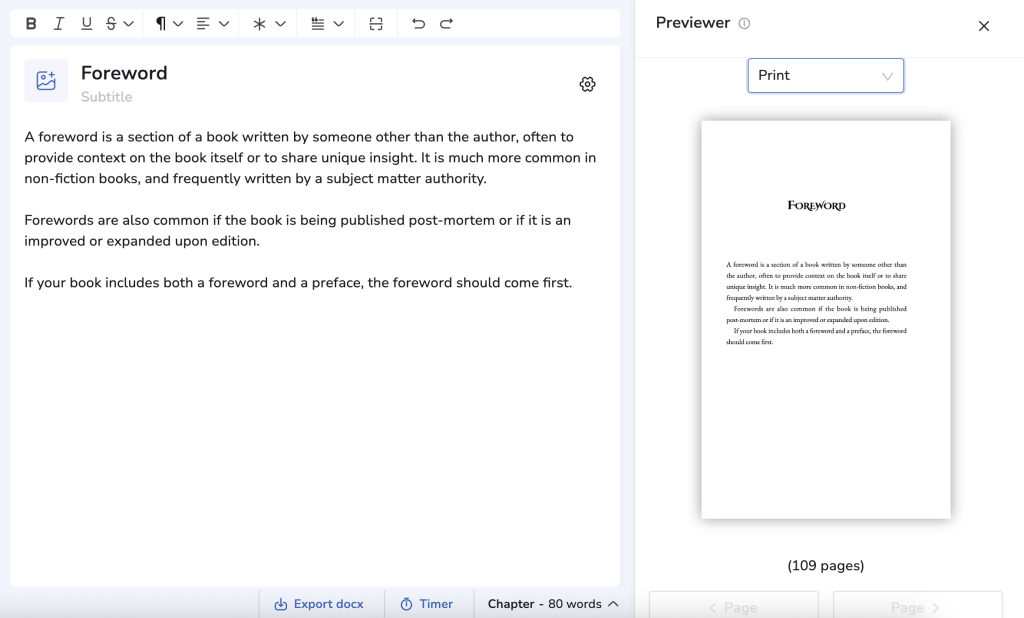
Formatting a foreword is similar to formatting a regular chapter, but with a few subtle differences worth noting:
- The foreword uses less ornamentation such as larger first letters.
- The first paragraph is usually not indented.
- The title is usually just “Foreword” — no need to get fancy
- You can add a subtitle (e.g., “Foreword by John Smith”) if desired
- Page numbers use roman numerals, since this section appears in the front matter
If you are formatting in a program like Microsoft Word, and already have your trim size, margins, gutter margins, font licenses (be sure you have the commercial license for all fonts, as Microsoft Word only gives you the license for personal use on most fonts), then formatting the foreword should be relatively simple. Just make sure it has minimal ornamentation compared to the chapter pages, and gets the page numbers right.
Thankfully, a program like Atticus will help to do this for you.
Atticus automatically handles trim size, margins, and page numbering — and ensures your foreword matches the rest of your book’s professional design.
And you won't have to worry about any lawsuits from the fonts you use, which might get you into trouble if you're using your own fonts with MS Word.
Created in Atticus.io
What a good foreword looks like
It’s one thing to talk through this in theory. It’s another to see how people actually handle it.
If you look at a few real forewords, you’ll notice they don’t all follow the same formula. Some lean more personal, some focus on the author’s background, some spend more time setting up the ideas in the book.
That’s part of the point. There’s a structure underneath it, but there’s also a lot of room for your voice and your relationship to the author to come through.
Here are a few examples worth looking at.


What comes after the foreword?
The page right after the foreword is the preface or introduction, if you have one.
Side note: “preface” and “introduction” are often used interchangeably. There is a distinction, but generally speaking they serve the same purpose to introduce readers to what they are about to read. They are both also, usually, written by the author.
Here's the most common formatting order for the front matter of a book:
- Title Page
- Copyright Page
- Table of Contents (i.e. chapter headings)
- Dedication Page
- Acknowledgments
- Foreword
- Preface
- Epigraph
You don’t need every piece of front matter — but most nonfiction books include a foreword, preface, or introduction. Choose the elements that best serve your reader and your book’s tone.
Pro Tip: If you're unsure what order to put your front matter in, Atticus has you covered. By default, the program automatically puts each part of a book in the correct order, so you don't have to worry about getting your foreword where your copyright page should be.
How to ensure an eReader doesn't skip your foreword
Ever opened an eBook and found yourself dumped straight into Chapter 1? That’s because many eReaders automatically skip past the front matter — including your foreword.
But if you want readers to see your foreword first, there’s a fix.
Instead, Amazon and other retailers estimate where the book starts, and in some cases this can lead to a reader starting with chapter 1 and completely missing your foreword!
So, assuming your foreword has vital information you want to convey, you need a way for readers to start there, instead of on chapter 1.
Thankfully, Atticus is the only formatting program that lets you do this.
All you have to do is go to the Book Details and scroll down until you find the section labelled Start Page.
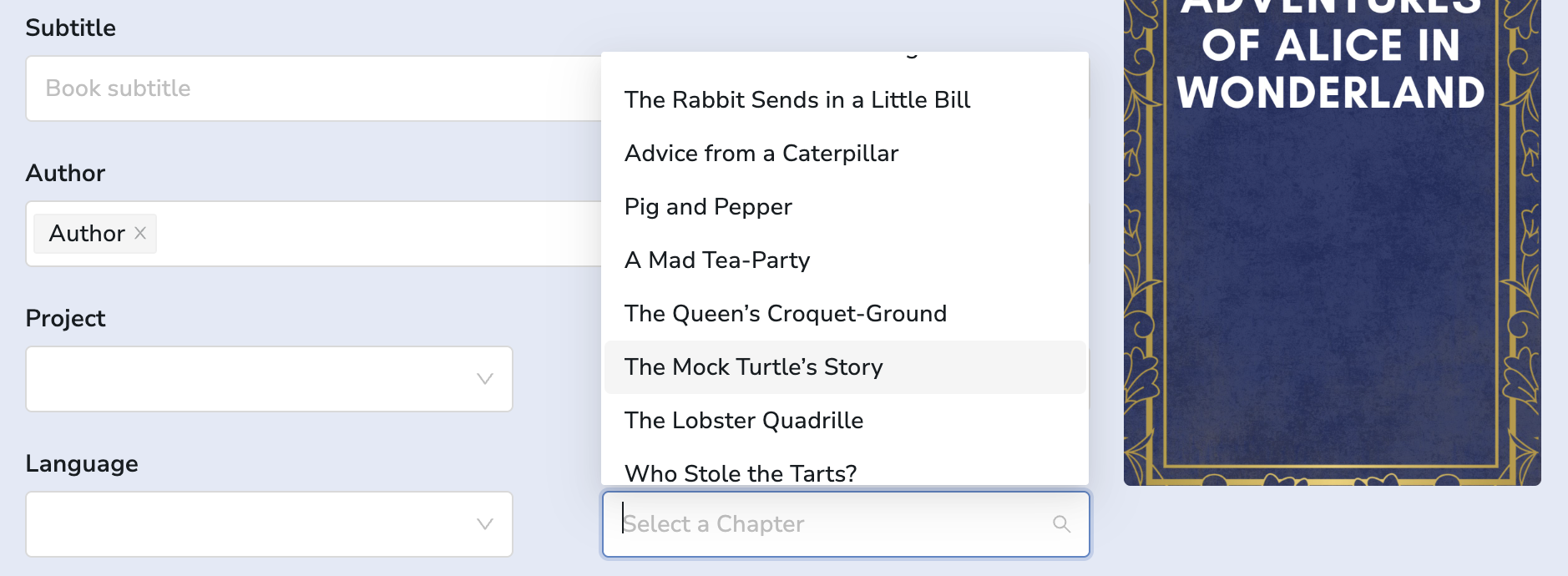
From there, you simply select where you would like readers to start when they open your book for the first time.
This inserts a special code into the eBook file that lets Amazon know exactly where to open the book for new readers. Simple as that!
Atticus is the currently the only formatting software that lets you customize the Start Page of your book, and not only that, but it also works on virtually every platform, and it's over $100 cheaper than the competition (which does not have this Start Page feature).
Don’t make the foreword bigger than the book
A good foreword doesn’t need to feel like a speech at a black-tie dinner where everyone is trying very hard to sound profound.
Most of the time, it works better when it feels like a trusted person pulling the reader aside for a minute and saying, “Here’s why this book is worth your attention,” then giving them enough context, confidence, and understanding of the author to start reading with a little more trust than they had before.
You might talk about how you know the author, why their experience matters, how the book came together, or what you think readers will get from it. But once you’ve done that, you can hand the book back to the author and get out of the way.
And honestly, that’s where a lot of forewords go wrong.
The writer tries to make it too polished, too impressive, or too sweeping, and the whole thing starts to feel like something printed on fancy paper at a fundraising gala. A foreword doesn’t need all that. It just needs to be specific, sincere, and useful to the reader who is about to start the book.
So if you’re writing one, keep it focused. Explain your connection. Share why the author or book matters. Give the reader a reason to keep going.
Then sign your name and let the book do what it's supposed to do.