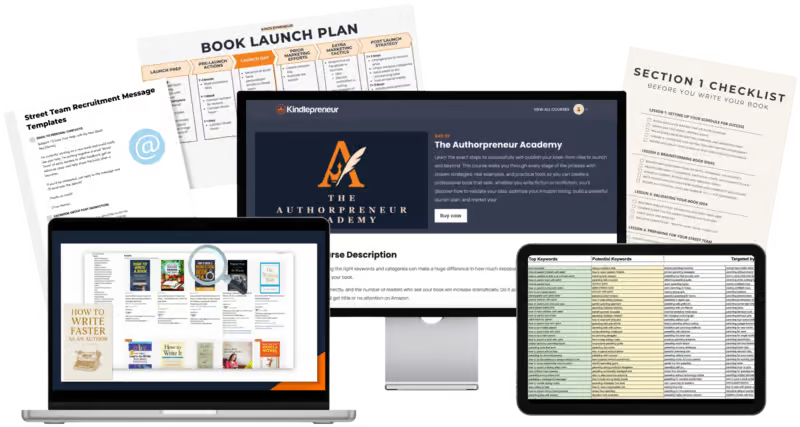
If you’ve spent any time publishing on Amazon, you’ve probably run into the same issue most authors do at some point.
You publish a book, and it goes nowhere because your ideal readers can’t find it.
Usually when that happens, it comes down to things like keywords, categories, and how your book is positioned on the search engine disguised as bookstore known as Amazon. That’s the side of publishing I’ve spent a lot of time helping authors understand over the years, and it’s really the reason my team and I created Publisher Rocket (formerly KDP Rocket).
AI tools like ChatGPT may be able to help you come up with ideas or even draft content, but they don’t have access to Amazon’s actual search data. Publisher Rocket does, and it’s why over 117k authors have grabbed it since we launched a few years ago.
In this review, I want to walk through what it does, how authors use it, what’s improved over time, and whether it’s something worth using for your specific use case. Spoiler: I’m a big fan of Publisher Rocket, and I think you’ll be too once you learn about it.
How Publisher Rocket has evolved (and what’s been added)
Publisher Rocket didn’t stay the same after we launched it, and that’s been intentional from the beginning.
One of the things I’ve always told Rocket users is that we keep building on it over time. Not in a “pay again for the next version” kind of way, but as ongoing improvements and features that get rolled in as we go.
If you look back at where it started, it had the core pieces in place early on. Keyword research. Competition data. The things authors needed most. From there, it’s been a steady process of adding more depth, improving accuracy, and expanding what you can do with the data.
Here’s a quick look at how that’s played out over time:
- July 2016: KDP Rocket was launched with only the Keyword Feature and Competition Feature
- December 2016: Overhaul of the system to increase speed and accuracy
- June 2017: Added the AMS Keyword Feature to help authors effectively and efficiently build Amazon book ads
- November 2017: Added the Unleash the Categories capability to the Competition Feature
- March 2018: Added the Category Feature to help authors efficiently find bestselling categories
- May 2019: Version 2.0 Publisher Rocket was launched with Book Data, new interface, faster speed, and more
- July 2019: Many improvements to 2.0 as well as additions to the category feature, and more to come
- August 2021: Additional improvements to the keyword and category features
- January 2022: Addition of Audible features and data
- November 2022: Rocket for Chromebook released
- February 2023: Large Publisher and Kindle Unlimited Data
- June 2023: Greatly enhanced Category feature with keyword suggestions
- April 2024: Added Category tags to quickly find ghost categories and duplicates
- September 2024: Addition of the Reverse ASIN feature
- April 2025: Added international markets (French, Italian, Spanish, Australian, Canadian) and additional language support
- May 2025: Improved data reliability and upgraded server performance
- December 2025: Added review data to the Competition Analyzer
- February 2026: Increased keyword data accuracy
That’s not everything, but it gives you a sense of how often things have been updated.
And a few of those changes are worth calling out, because they’ve had a bigger impact on how authors use Rocket.
For example, the addition of Audible search data made it possible to look beyond just Kindle and start understanding how audiobooks are performing, which is something most tools still don’t handle very well.

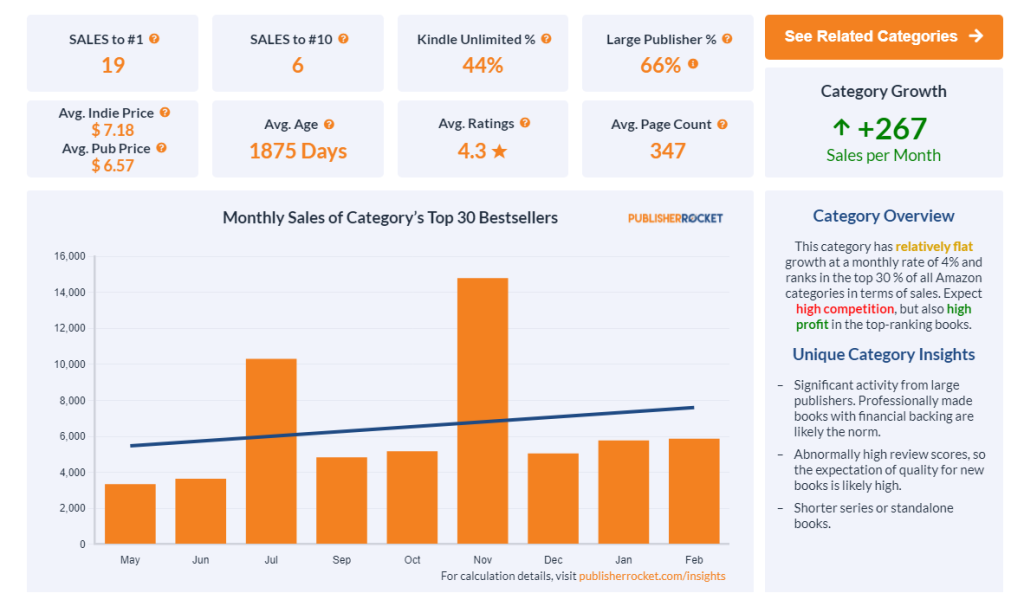
Historic category data was another big one. Instead of just seeing a snapshot of a category, you can look at how it’s behaved over time. That makes it easier to spot whether something is consistently competitive or just having a moment.
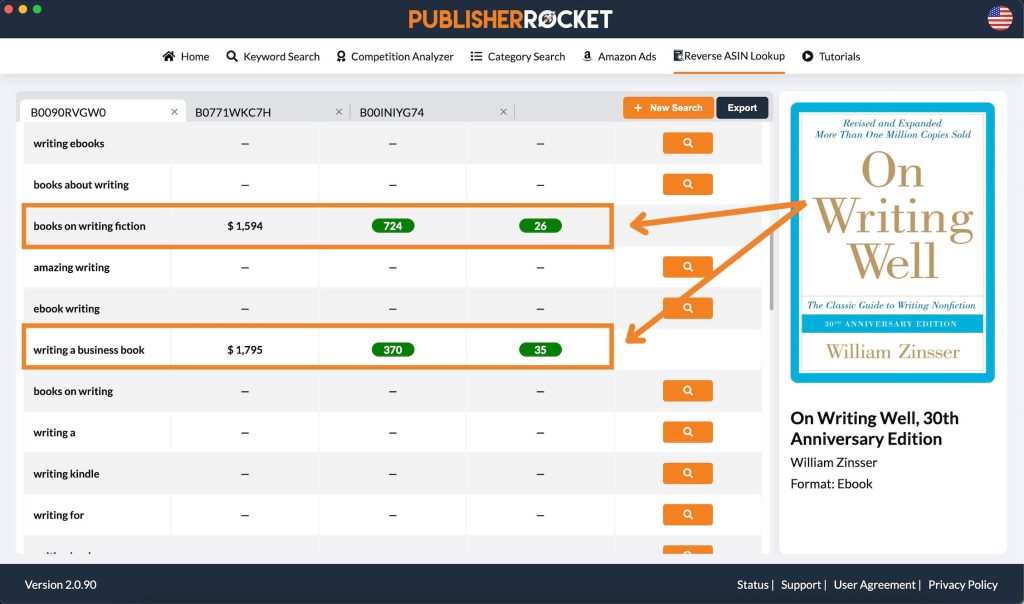
And then there’s Reverse ASIN.
This is one of those features that changes how people use Rocket once they see it in action. Instead of starting from scratch, you can take a book that’s already doing well and see what it’s ranking for, which gives you a much clearer starting point than guessing.
So while the core idea behind Publisher Rocket hasn’t changed, what you can do with it has expanded quite a bit.
With that in mind, let’s look at the individual features and how authors tend to use them.
What Publisher Rocket helps you do
When people talk about Publisher Rocket, they usually describe it in terms of features. Keywords. Categories. Competition. Ads.
That’s all true, but that’s not really how authors think about it once they start using it. What they’re trying to do is figure out why a book isn’t getting seen and what to change so it has a better shot.
That usually means:
- Getting your book in front of the right searches on Amazon
- Choosing categories where you have a chance to rank
- Understanding what other books in your space are doing
- Building ads without having to guess your way through keywords
And these are all things that Publisher Rocket excels in.
I’ll walk through each of these so you can see how it works in practice.
Getting your book in front of the right Amazon searches
One of the biggest ways shoppers find their next book on Amazon is by typing into the Amazon search bar phrases or words that describe what they are looking for. Based off of this, Amazon chooses which books to show those shoppers.
In order to get your book discovered by your kind of book shoppers, you need to choose Amazon Keywords for your book. But not just any keywords. In order to have your book benefit from them and make sales, you need keywords that:
- People type into Amazon when shopping for a book
- People end up buying books that show up for it
- Aren’t too competitive so that you can show up for them
You see, most authors just guess at their keywords, thinking of terms they think are fitting. But if those ‘guesses’ don’t fit perfectly into any of the 3 criteria above, then you won’t get your book found by those hungry book shoppers.
So, how do authors find keywords that people type in, make sales, and aren’t too competitive?
You use Publisher Rocket. Instead of trying to come up with the “right” keywords, you’re starting from what readers are already searching for.

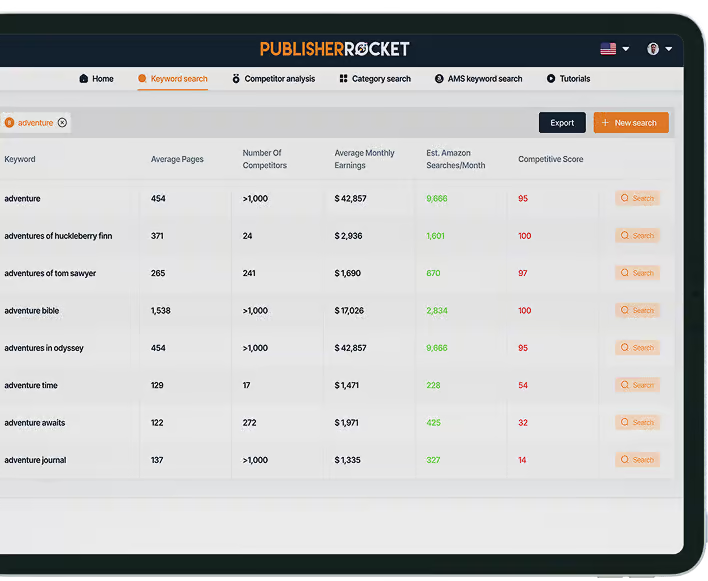
All you have to do is give Rocket a phrase to start off with and it will not only find other terms that shoppers have used, but it will also show you:
- How many people type in that phrase – This is huge!
- How much money books are making that rank for that term
- How competitive that term is with an easy score of 0-100, with 0 being easy and 100 being hard
- Give you separate information for eBooks and Audiobooks
Just like that, no more guesswork and no more thinking or hoping. This unveils the information you need in order to make the right choices and get your book in front of more book shoppers.
Finding categories where your book can compete
Choose the wrong category for your book, and you could be hard pressed to ever make it as an Amazon bestseller. Choose the right one though, and you can not only become a bestselling author, you can maintain that bestseller rank and keep the awesome orange bestseller tag to make your book stand out more and, ultimately, make more sales.
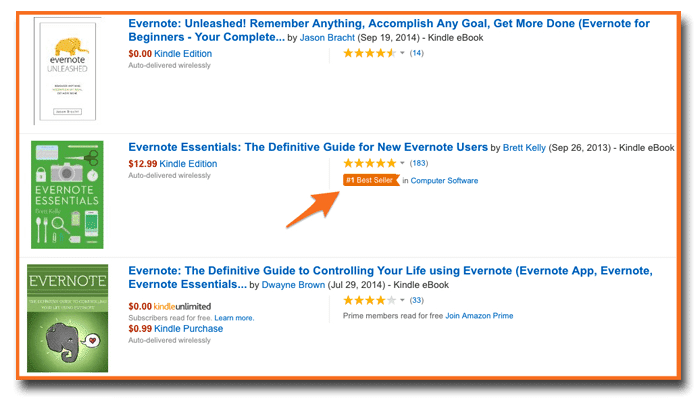
So, how does one find those awesome Categories?
You can follow the steps here to learn how to choose the best categories and even some extra secrets about categories that most authors don’t know.
However, for the purposes of this article, there are two really hard things for authors when it comes to Categories:
- You can only choose up to 3 categories for your book (check out this video to see how)
- Yet, there are over 16,000+ Categories on Amazon
So, how does Rocket help you with this?
->Want to see every Amazon Book and eBook category in a list, and even use filters to quickly find the best for your book?
->Want to know how many books you’d need to sell in order to be #1 for that Category?
Well, with Publisher Rocket, you can:

Seeing what other authors in your space are doing
Wouldn’t it be nice to know how well other books are doing on the Amazon market and what’s working for them?
Even better, wouldn’t it be nice to know who your book would be competing with on Amazon?
Well, now you can. Using Publisher Rocket’s Competition Analyzer, you can gain key insight into other books and how well they are doing.

As you can see, knowing this information can help you make better decisions about what niches to focus on and what is hot in the market. It can also help you to see which books are doing well and help you to analyze what is working for them so that you can either emulate and improve upon those areas.
Building Amazon ads without guessing your keywords
This is where a lot of authors get stuck, because they’re picking keywords for ads the same way they pick keywords for their book… by guessing.
Amazon Ads are an incredibly powerful way to get your book in front of book shoppers, but it has two big problems:
- You need to have lots of keywords in order to get traction
- You need to keep monitoring, updating, and adding to your campaigns
Therefore, to help authors save time from tedious searching, copying & pasting, and researching, we created the AMS Keyword Feature.
Just type in an initial phrase that describes your book, and Rocket will get to work finding hundreds of pertinent keywords plus their ASIN numbers (a feature that jives well with Amazon’s ads system).

Pretty neat, right?
Publisher Rocket will pay for itself
That might sound like a bold claim, but here are two simple ways to think about how Publisher Rocket pays for itself, especially since it’s a one-time purchase with no recurring fees:
- If you make 2 extra sales per month* in your entire author life because of the data and features, then Rocket just paid for itself.
- If Rocket saves you from doing 10 hours of research** for Categories, or Keywords, or Amazon Ads in your entire author life, then it paid for itself.
* assuming you’re priced at 2.99 and we figured in Amazon’s 30% cut – so this is a most conservative estimate
** This is assuming that 1 hour of writing is worth $20 to you, but for many their time is worth more
For most authors, it ends up being some combination of both. A little more visibility, a little less time spent guessing, and over time that tends to add up.