Finishing a book feels like it should be the hard part.
And to be fair, it is hard. You’ve written the chapters, fixed the messy middle, chased down the weird plot hole you created 200 pages ago, and probably questioned every life decision that led you to writing a book in the first place.
But once the manuscript is finally done, a new question shows up pretty quickly:
Where are you actually going to publish it?
That’s where a lot of authors get stuck, because self-publishing is not just one button or one company. You can publish directly through retailers like Amazon KDP, Apple Books, Kobo, and Barnes & Noble Press. You can use an aggregator like Draft2Digital or PublishDrive to reach multiple stores at once. Or you can work with a more full-service company if you want help with formatting, cover design, distribution, and other pieces of the process.
None of those options is automatically right or wrong. It depends on your book, your goals, your audience, your budget, and how much of the publishing process you want to handle yourself.
In this article, we’ll look at some of the best self-publishing companies for authors, how retailers and aggregators differ, and how to think through which option makes the most sense for your book.
Book Retailers vs Book Aggregators vs Full Service
Before we dive into the list of self-publishing companies, it’s helpful to understand the three main types: retailers, aggregators, and full-service companies.
Book retailers are platforms where readers can buy your book. Some retailers, like Amazon KDP, Barnes & Noble Press, Apple Books, and Kobo Writing Life, also let authors publish directly by creating an account and uploading files. Others, like Bookshop.org, may sell self-published books, but authors typically reach them through distributors such as IngramSpark, Draft2Digital, or KDP expanded distribution.
Book aggregators act as distributors. Instead of uploading your book to multiple retailers one by one, you submit it to an aggregator, and they send it out to dozens of stores on your behalf. This saves time and streamlines the publishing process. Popular aggregators include Draft2Digital, PublishDrive, and StreetLib.
Full-service companies take a more hands-on approach. These offer editing, formatting, cover design, publishing, and sometimes marketing support, all in one place. They’re a better fit for authors who want help with the entire publishing process, not just distribution.
So, Should You Choose a Retailer or an Aggregator or Full Service?
It really comes down to how you plan to market your book and how much control you want over the process.
Retailers let you publish directly, which usually means you keep a higher royalty percentage. Aggregators simplify the process by distributing to multiple stores at once, potentially expanding your reach but taking a small cut in return.

Amazon is usually the first platform self-published authors think of, and for good reason. It gives authors access to a massive reader base through Kindle, Amazon’s retail store, and Kindle Unlimited. But that doesn’t mean the other stores should be ignored. Readers still buy from Apple Books, Barnes & Noble, Kobo, and other retailers, and those sales can add up over time.
So how do I publish my own books? Which platforms and aggregators do I personally use? I’ll share that at the end of the article.
For now, let’s explore the best self-publishing companies available and break down what type of service each one offers.
The 8 Best Self Publishing Book Companies (in No Particular Order)
1. Kindle Direct Publishing (Retailer)

Owned by Amazon, KDP is the leading self-publishing platform in the world.
The number of sales generated through Amazon far exceeds all other retailers combined, thanks to its massive customer base and competitive royalty structure. KDP offers 35% or 70% royalties, depending on the price and region settings you choose.
KDP also runs an optional program called KDP Select. When you enroll, your Kindle ebook must remain exclusive to the Kindle Store for each 90-day enrollment period, though you can still distribute print, audio, and other formats elsewhere. In return, your ebook is included in Kindle Unlimited and becomes eligible for promotional tools like Free Book Promotions and Kindle Countdown Deals. Kindle Unlimited royalties are based on pages read from the KDP Select Global Fund. KDP Select renews automatically every 90 days unless you opt out.
When publishing with KDP, be sure to format your ebook using a file Amazon currently accepts. For reflowable ebooks, KDP recommends EPUB, DOCX, or KPF files. MOBI is no longer supported for new or updated ebook uploads, so if you still have an older MOBI file, you’ll want to convert or re-export it in a supported format.
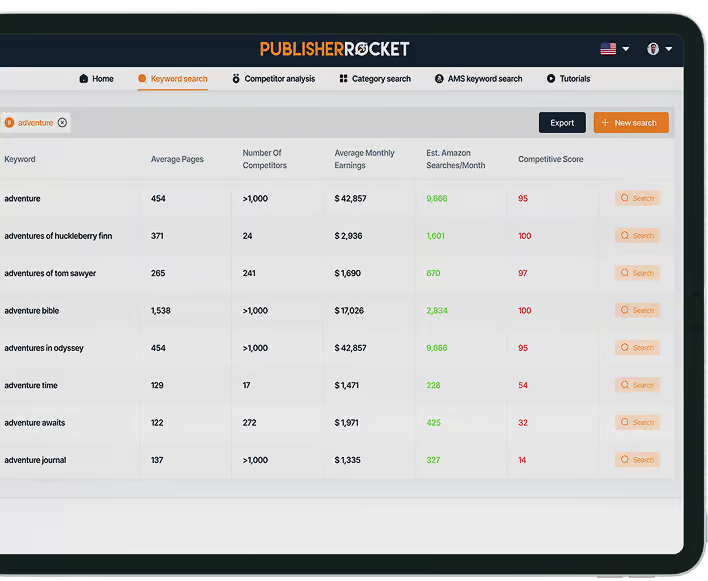
KDP is the best way to reach the largest pool of readers, but that also means it’s a crowded marketplace. To stand out, you’ll need a strong launch plan, well-chosen categories and keywords, and effective ads. Tools like Publisher Rocket can help you optimize your listings and get the most out of your Amazon presence.
Extra Resources for Kindle Direct Publishing
- KDP Tools and Resources
- Digital Pricing and Royalty Rates
- Is KDP Select right for you?
- Pros and Cons of KDP Exclusivity
2. Apple Books (Retailer)
Apple Books is Apple’s dedicated ebook platform and a solid alternative to Amazon KDP. While it doesn’t match Amazon’s market share, it does have a strong advantage: direct access to millions of loyal Apple users.
That loyalty matters more than you might think. Apple users often stick within the ecosystem — reading on iPhones, iPads, and Macs using the Apple Books app. Many discover ebooks through the app and never feel the need to look elsewhere.
One older drawback to Apple Books was that direct publishing used to feel very Apple-device dependent. That’s less of an issue now. Apple allows authors to publish from the web using the Apple Books publishing portal and an iTunes Connect account. You can also prepare files with Pages on a Mac, iPad, iPhone, or even from a PC through iCloud.com. If you’d rather not manage Apple Books directly, you can still use an aggregator like Draft2Digital or PublishDrive.
For direct publishing, Apple Books is primarily EPUB-based. You can upload an EPUB through Apple’s publishing portal, while other formats such as PDF or KF8 generally require working with one of Apple’s approved partners.
Royalty-wise, Apple offers a flat 70% (regardless of price) with no exclusivity requirements or tiered payouts.
If you’re looking to reach readers in the Apple ecosystem, especially outside the Amazon bubble, Apple Books is worth considering, either directly or through an aggregator.
Extra Resources for Apple Books
3. Kobo (Retailer)

Kobo’s market share in the U.S. is small, but that doesn’t mean you should overlook it.
Kobo is especially worth considering if you want to reach readers outside the Amazon ecosystem. Kobo Writing Life gives authors access to Kobo’s international retail partnerships, including online bookstores in over 190 countries, and it does not require exclusivity. Headquartered in Toronto, Kobo has also expanded globally and now operates in dozens of countries through retail partnerships and its parent company, Rakuten.
If your goal is to reach readers beyond the U.S., Kobo can be a valuable piece of your distribution strategy. It’s especially strong in Canada, parts of Europe, and select Asian markets.
Kobo offers up to 70% royalties on ebooks priced above $2.99 and has no exclusivity requirement. You can publish directly through Kobo Writing Life, their self-publishing portal, which is free to use and includes access to promotional opportunities within the Kobo store.
For authors aiming to expand their international presence, Kobo is well worth considering.
Extra Resources for Kobo
- How to publish a book on Kobo
- Selling more books on Kobo with Joanna Penn and Mark Lefebvre
- How to Set the Price on your Kobo
- Kobo Tips and Tricks
4. Barnes & Noble Press (Retailer)

Formerly known as NOOK Press, Barnes & Noble Press is the self-publishing platform for the well-known book retailer. It lets you publish both ebooks and print books directly to Barnes & Noble’s online store — and in some cases, titles may even appear in physical store locations through promotional programs.
One useful feature of Barnes & Noble Press is its built-in print-on-demand service. That means you can offer paperback versions of your book without the need to order large quantities or store unsold inventory.
Royalty rates are competitive. For ebooks priced $0.99 and higher, Barnes & Noble Press pays a 70% royalty. For print books, authors receive 55% of the list price minus printing costs. There’s no exclusivity requirement, and the publishing process is straightforward.
If you're targeting readers who still buy from Barnes & Noble (or just want to diversify beyond Amazon), this is a solid platform to include in your strategy.
Extra Resources for Barnes & Noble Press (aka NOOK)
- Barnes and Noble Press Royalty Rates and Calculator
- Self-Publishing Services for Barnes and Noble Press
- Barnes and Noble Print on Demand Services
- Getting your Self-Published eBook Sold in Barnes and Noble as a Physical Copy
5. Draft2Digital (Aggregator)
Draft2Digital (D2D) is widely regarded as the top ebook aggregator for self-published authors. Since acquiring Smashwords in 2022, D2D has become a one-stop solution for distributing ebooks to nearly every major retailer and digital library, including Apple Books, Barnes & Noble, Kobo, and more.
What makes D2D stand out is how author-friendly the platform is. Beyond distribution, it offers a range of helpful features:
- Free ebook formatting tools
- Universal Book Links (a single link that points readers to multiple stores)
- Print-on-demand services
- Integration with Findaway Voices for audiobook distribution
Their formatting tools aren’t required, but they’re easy to use and save time, especially if you’re new to publishing. As for royalties, D2D earns its money primarily through a commission on book sales, equal to about 10% of the retail price of each sale. Draft2Digital’s current FAQ also lists a one-time $20 activation fee for new publishing accounts and a $12 annual maintenance fee for accounts earning less than $100 per year in book sales.
If you want broad distribution without the hassle of managing multiple retailer accounts, D2D is one of the best options available.
Extra Resources for Draft2Digital
6. BookBaby (Full Service / Aggregator Hybrid)
If there’s a company that comes close to offering everything in one place, it’s BookBaby.
BookBaby positions itself as a full-service self-publishing solution. They handle nearly every step of the process, from formatting and editing to distribution, cover design, and even promotional tools. Their goal is to simplify publishing for authors who want support at each stage.
They distribute to both ebook and print platforms, including major retailers like Amazon, Apple Books, Google Play, Kobo, and Barnes & Noble. Print-on-demand is included, and they also offer design services if you need help creating a professional-looking book.
One of BookBaby’s more helpful features is its pricing calculator, which lets you estimate costs upfront. They also offer bundled packages for authors who want everything handled in one place.
For authors who want a hands-on team and a streamlined process (and are willing to pay for convenience), BookBaby is worth exploring.
Extra Resources for BookBaby
7. PublishDrive (Aggregator)
Founded in 2015 by Kinga Jentetics, PublishDrive is a relatively new player in the self-publishing space but has quickly grown into a global platform. What began as a way to publish a thesis has expanded into a full-scale distribution network operating in more than 75 countries and supporting over 75 languages.
PublishDrive distributes to all major retailers, including Amazon, Apple Books, Google Play, Kobo, and Barnes & Noble, along with many international stores and library systems.
What sets PublishDrive apart is its pricing model. Instead of relying mainly on a royalty-share structure, PublishDrive currently uses subscription-based plans that let authors keep 100% of eligible royalties while paying a monthly fee. Their current public pricing starts much lower than the older $100/month model, and they also offer free ebook distribution to selected stores for authors who want to test the platform first.
PublishDrive previously offered a royalty-share option, but that legacy plan is no longer available for new accounts. New authors should review the current subscription and free-distribution options before deciding whether PublishDrive makes sense for their catalog.
If you like the idea of paying a predictable fee instead of giving up a percentage of each sale, PublishDrive is worth comparing against other aggregators, especially once your catalog is earning enough for the subscription model to make sense.
Extra Resources for PublishDrive
8. IngramSpark (Aggregator)
Backed by Ingram Content Group, IngramSpark is one of the biggest names in print-on-demand and global book distribution for indie authors, with more than 45,000 bookstores, online stores, chain stores, ebook retailers, libraries, universities, and other partners.
If you're aiming for wide reach, IngramSpark gives you tools to go far beyond Amazon and other major retailers.
One of IngramSpark’s standout strengths is its print quality. They offer a wide variety of trim sizes, binding options, and paper types, making it a popular choice for authors who want polished, professional-looking print editions. Whether you’re publishing a picture book, a novel, or something in full color, IngramSpark delivers consistently sharp results.
That quality comes at a price. IngramSpark isn’t the cheapest print-on-demand option, and they don’t try to be. But for authors who value presentation, it’s often worth the investment.
In terms of author earnings, the math works a bit differently. IngramSpark uses a wholesale discount model. You set the list price and wholesale discount, and your publisher compensation is what remains after the wholesale discount and print costs are subtracted. A higher discount can make the book more attractive to retailers, while a lower discount can increase your earnings per copy but may reduce bookstore interest.
IngramSpark also offers ebook distribution, though most authors use it primarily for print. If your priority is bookstore-quality print and global availability, it’s one of the strongest platforms out there.
Extra Resources for IngramSpark
Which of These Self-Publishing Companies Should You Use?
If you’re looking for a single, clear-cut winner, there isn’t one. Each platform has its own strengths and you don’t have to choose just one. In fact, many authors use a combination to get the best results.
For example, if you’re publishing for a U.S. audience, Amazon KDP is an obvious choice. It’s the largest book retailer in the world. And if you choose not to enroll in KDP Select, you can also distribute your ebook through Draft2Digital to reach additional stores.
Now let’s say your target audience is based in Canada or South Africa. In that case, Amazon might not be the most effective starting point. Kobo would likely get more traction in those regions. Pairing Kobo with an aggregator could expand your reach even further.
Or maybe this is your first book, and you’re not interested in managing the entire process yourself. If you’d prefer a more guided experience — with editing, design, and distribution handled for you — then a full-service provider like BookBaby might be the better fit.
It all depends on your goals, your audience, and how hands-on you want to be. There’s no one-size-fits-all answer and that’s actually a good thing.
Which Self-Publishing Company Should You Use?
There isn’t one self-publishing company that makes sense for every author.
If most of your readers are on Amazon, KDP is probably going to be part of your plan. If you want to publish wide without uploading your book to every store yourself, an aggregator like Draft2Digital can save you a lot of time. If print quality and bookstore distribution matter most, IngramSpark may be worth considering. And if you want more help with the process, a full-service option like BookBaby might be a better fit.
For my own books, I’ve usually preferred to upload directly to the major retailers I care about most, then use Draft2Digital to reach the stores I don’t want to manage one by one. That gives me more control where it matters, while still letting me distribute more widely without turning publishing into a second full-time job.
That may not be the perfect setup for you, though.
Some authors want the simplest path possible. Others want every bit of control they can get. Some care mostly about Amazon, while others want to reach readers in as many stores and countries as possible.
So I wouldn’t worry too much about finding the “best” self-publishing company in some universal sense. Start with what you actually need for this book, how much you want to manage yourself, and where your readers are most likely to buy. That usually makes the decision a lot clearer.