Most people know Substack as a newsletter platform… a simple way to send posts straight to your readers’ inboxes. For a long time, that's how I viewed it too.
But over the years, Substack has evolved into something bigger:
- A blogging platform where your posts live online
- A social platform where readers can discover writers (and writers can discover each other)
- A monetization platform where you can offer paid subscriptions and get paid directly by your audience
- And yes, a newsletter platform where you can email your subscribers
That mix is a big reason why Substack has exploded in popularity. Instead of juggling a blog, an email tool, and a social account, Substack gives you one place to publish content, grow your audience, and even turn your writing into income (if you're into that sort of thing).
But that mix has also led to some complexity. After all, the pro to “all in one platforms,” like Substack, is they can do a lot of things. But that can also be a con – it can do a lot of things.
And to some, it also muddies the waters a bit. If Substack focused on only one thing (like newsletters), knowing if it's a good fit for you is pretty clear. You either want a newsletter platform or you don't. But now that Substack can do so many things, the proverbial “is it for me?” question might not seem as cut and dry.
So, in this guide, I'm going to try to help you answer it.
If you're a writer, and you want to know if Substack is worth looking into, I'm going to walk you through several scenarios. But first, I think we need to tweak how we frame it.
And by that, I mean don't think of Substack as an all-in-platform, but as a…
Choose your own adventure platform
Just because Substack can do many different things doesn't mean you have to use all of those things.
If you want to use Substack only as a newsletter, you can. If you only want to use it as a quasi-social platform to grow your audience, you can. Only want to use it as a blog? You can. And so on and so on. You don't even have to monetize if you don't want to.
You can choose how much or how little of Substack's ever-growing list of features as you see fit. And you can tweak how you choose to use it as time goes on.
In other words, “I don't need <insert feature here>” isn't a reason to skip Substack, at least not by itself. I use Kit for my email marketing, so I don't use Substack's newsletter features. And I'm a die-hard WordPress user, so I don't need it for my blog either. However, I love the social media elements it has for audience building.
But that's me. Your situation may be totally different.
So let's look at a few common ways people use Substack, depending on what they want out of it.
Scenario 1: “I want to grow my audience without social media burnout.”
Even ignoring politics and angry sports fans venting because their team just lost 12 games in a row, social media can be a bit much.
You're chasing engagement, timing your posts for visibility, trying to stay a step ahead of whatever the algorithm is doing this week. It's a lot.
Substack is one of the few places where that pressure mostly goes away.
“Notes” is their version of a social feed. You can post short thoughts, reply to people, share links… all the usual stuff. But it doesn’t feel nearly as frantic.
The bigger shift, though, is how growth works.
Instead of trying to force your way into people's timelines, a lot of it comes from other writers recommending you. That’s been a meaningful source of subscribers for me, and it’s a very different dynamic than most platforms.
You still have to show up and write, of course. That part doesn’t change. But, to me, at least, Substack feels less like you’re performing for attention and more like a place you can slowly build an audience over time.
That said, it’s not a full replacement. If you want the massive reach that X or LinkedIn can give you, Substack probably won’t give you that. But if you’re trying to grow without feeling like you need to be “on” all the time, it’s one of the better options right now.
Scenario 2: “I just want a blog.”
A lot of people say they want a blog, but what they really want is a place to write and publish without dealing with the tech headache.
With Substack, you don’t set up a site. You don’t choose themes or plugins. You don’t spend a weekend trying to figure out hosting or setting up DNS records.
You write something, hit publish, and it’s live on a clean page. And, if you like, every post can go out to your subscribers at the same time, which solves a problem (SENDING EMAILS!) most people don’t think about until later.
There's a tradeoff, though. Control.
You’re not going to customize much. You’re not building a site that feels completely your own. For someone like me, someone who loves controlling every aspect of my site, this is less than ideal.
But if your goal is simple…
Write. Publish. Do it again next week.
Substack makes that very easy.
Scenario 3: “I want an email platform.”
This is what Substack was originally built for… sending posts straight to your readers’ inboxes.
You write an update, hit publish, and Substack emails it to every subscriber on your list. It lacks the automation features that email platforms like MailerLite have, but there’s no fussing with HTML templates, confusing automations, or third-party integrations.
Some things to know:
- Emails + blog posts: If you choose this, anything you send gets published to your Substack site and delivered by email at the same time. Alternatively, you can choose to skip the email and only publish the post to your site.
- Free or paid subscribers: You can choose whether posts go to everyone or only to paying supporters.
- Simple analytics: This lets you see open rates, paid subscriber growth, and conversions at a glance.
For a site like Kindlepreneur, or even my own email list, the advanced features offered by MailerLite or Kit are musts. But most people don't need such features. So if your needs are simple, Substack can work really well.
I should note that in late 2025, Substack announced that “drip campaigns” would be available to all users in “early 2026.” Once that happens, Substack could start to become a real, viable alternative to the Kits of the world.
Scenario 4: “I want to make money from my writing.”
This is what pulls a lot of people into Substack.
The pitch is simple. Charge for your writing. Get paid directly by readers. No ads. No middleman.
And to Substack’s credit, it does make that part easy. You can turn on paid subscriptions in a few minutes and be up and running.
The part some writers forget is not everyone has an audience that's ready to pull out a credit card. And even if they do, there’s still a gap between “wow… this is good” and “wow… I’d pay for this every month.”
So you end up with two groups…
People who already have traction somewhere else, who use Substack to monetize it. And people who are starting from scratch and realize pretty quickly that paid is something you grow into, not something you start with.
Substack works well for the first group.
And it can work well for the second group, too, but only if you keep your expectations realistic at the beginning.
Scenario 5: “I want to build a community, not just an audience.”
This is the part about Substack that I personally find really exciting.
You’ve got replies, Notes, and chat. People can respond, have conversations, stick around longer than they would on a typical blog. If you were around during “the golden age of blogging” over a decade ago, where every post published had the potential to receive dozens (if not hundreds) of thoughtful blog comments (that weren't spam or written by AI), Substack can feel nostalgic.
Some writers can build real communities with their readers here. However, it depends a lot on your audience and how you use it (and how active you are).
If you’re expecting it to feel like a full community platform out of the box, you'll be disappointed. But if you just want more interaction than a traditional blog gives you, with the potential for much (much) more, there's nothing else like it right now.
Scenario 6: “I already have everything… does Substack still make sense?”
This is where it gets a little more situational.
If you already have a blog, an email list, and an audience somewhere else, Substack can feel redundant at first.
You don’t need another place to write. You don’t need another email tool. And you certainly don't need another social platform where people shake their fists at the sky.
That was my initial reaction when friends mentioned Substack to me. But eventually, the “discovery” side of things won me over. Sure, I already had an audience (even if it's modest compared to Kindepreneur's). But I could always get a bigger one. After all, not everyone is on X or LinkedIn, and not everyone else is Googling the things I write about.
Substack's Notes, recommendations, and built-in discovery features offered me a way to reach people I wouldn't have reached otherwise.
So for me, it’s less “replace what you already have” and more “add a layer on top of it.”
That said, it’s still “another thing” to maintain, so if you’re already stretched thin, be mindful about adding something new.
But if you’re looking for another way to get in front of people without relying entirely on social media or Google, it's really good for that.
How Substack works (and how to make things easier on yourself)
If everything you've read sounds good and you're ready to get started, you can go to substack.com and sign up. It's free, and you'll never have to pay a penny unless you get a paid subscriber (in which case Substack takes its cut).
But I should give you a heads up…
The complexity I mentioned earlier? It's real. Because Substack does so many things and offers so many features (whether you choose to use them all or not), figuring out “the right way to do things” is often a lesson you have to learn the hard way.
Still, I have some tips I can offer you (that, yes, I learned the hard way).
1. Use “Notes” strategically
Substack’s Notes feature might look a bit like X/Twitter, but the culture is quite a bit different. If you show up using it only to promote yourself, readers will tune you out fast.
It's best to think of Notes less like a marketing channel and more like a conversation with friends. Here are a few ways to use it effectively:
- Be helpful, not salesy: Share insights, ideas, or opinions that give readers value on their own. Show your expertise, but let your content do the selling naturally instead of constantly pitching your newsletter.
- Restack your own posts, but with context: You can “restack” (think: X/Twitter's “retweet”) a compelling line or paragraph from one of your Substack posts and add new thoughts above it. It’s a subtle way to draw attention to your writing without spamming links or sounding pushy.
- Amplify other writers with restacks: Notes make it easy to restack something written by someone else. It’s a quick way to build goodwill, spotlight Substack creators you admire, and introduce your audience to new voices.
- Engage thoughtfully: Browse the Notes feed and reply to other writers’ posts where you can add something meaningful. Showing up consistently in conversations (especially around your niche) will help you build visibility faster than broadcasting into the cold, cruel void.
- Share quick, in-between ideas: Use Notes for content creation that doesn’t need a full newsletter (a sharp insight, a behind-the-scenes thought, a snippet from something you’re working on, etc). These small pieces make you discoverable without overwhelming readers’ inboxes.
In short…
When you treat Notes like a community instead of a billboard, things will go a lot smoother.
2. Build relationships through referrals
Referrals are about rewarding your existing subscribers for helping you grow. You set up a referral program with perks (like free months of a paid newsletter, exclusive content, etc) and Substack tracks it automatically.
Here are a few tips for making referrals work:
- Pick rewards that matter: Choose incentives your readers will actually care about.
- Make it easy: Substack generates referral links for subscribers automatically (you just need to promote the program occasionally).
- Start small: You don’t need a full rewards ladder right away. Even one simple perk can get readers sharing.
Referrals turn your best readers into ambassadors, so once you've accumulated some true fans, be sure to set them up.
3. Use recommendations to get discovered
Recommendations are completely different from referrals.
Instead of rewarding your existing readers, they connect you to new readers by plugging you into Substack’s broader network.
Here's a quick breakdown of the differences:
| Referrals | Recommendations | |
|---|---|---|
| What it is | A subscriber-driven growth tool (your readers get rewards for referring friends). | A network-driven discovery tool (other writers’ audiences are shown your publication). |
| How it works | You set up a referral program with perks. Subscribers share your newsletter with friends to earn rewards. | When someone subscribes to a newsletter similar to yours, Substack automatically suggests your publication. |
| Who drives growth | Your existing readers | Substack’s ecosystem + other writers |
| Effort required | Medium. You’ll need to choose rewards and promote your referral program occasionally. | Low. Once enabled, it runs passively in the background, putting you in front of potential subscribers. |
| Best for | Turning loyal subscribers into ambassadors who actively grow your list. | Getting discovered by new readers who’ve never heard of you. |
When someone subscribes to a newsletter similar to yours, Substack can automatically suggest your publication on the thank-you page or follow-up email.
Here's how to make the most of them:
- Recommend others first: The best way to earn recommendations is to give them genuinely (and without expecting anything in return).
- Be clear about your focus: Substack uses signals like your newsletter name, tagline, About page, and tags to match you with relevant readers.
- Publish consistently: Active newsletters get surfaced more often. (As someone who will forget his Substack for days at a time, I can attest to this.)
- Optimize your Substack profile and About page: Make it clear why someone should subscribe to you. Be clear, not clever.
Recommendations are one of Substack’s most powerful growth engines. And, unlike referrals, they work passively once you’re plugged into the network.
4. Cross-promote outside Substack
Substack’s ecosystem is strong, but you don’t have to stay inside it.
Share your newsletter on social media, link to it from your external blog (if you have one), and invite your existing audience to subscribe.
The combination of Substack’s built-in tools plus your external platforms is where growth can really compound.
5. Be consistent and clear
I alluded to this earlier, but…
The biggest “growth hack” isn’t a hack at all: you need to show up consistently and be clear about who your Substack is for. Whether you're doing a new post once a week, daily Notes, a monthly podcast video, whatever… be consistent with it.
When your readers know exactly what to expect (and when to expect it), they’re far more likely to subscribe and stick around.
6. Learn from someone who already knows the ropes
Back when I worked for Jon Morrow, he taught me that the fastest shortcut to learning something is paying someone who's already mastered it to teach it to you.
Sure, I could spend dozens or hundreds of hours researching articles or watching YouTube videos (which, alas, could give me conflicting advice), or I could pay a small price for a coaching session or a great online course and learn everything I needed to know in a lot less time.
Dave (Chesson) has a similar mindset.
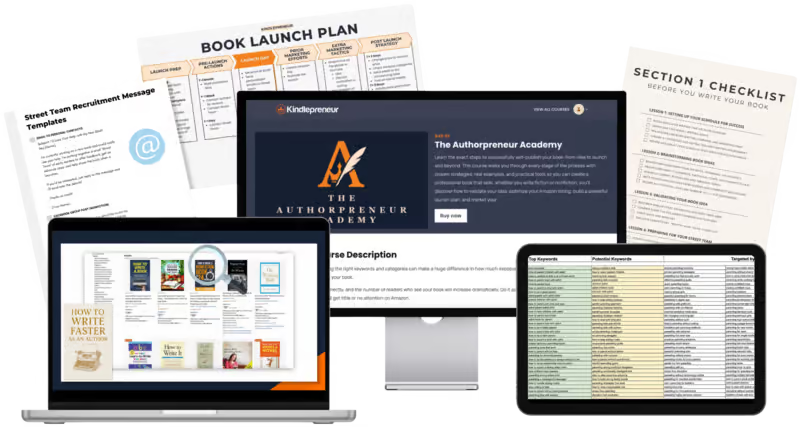
When he created Kindlepreneur's flagship Authorpreneur Academy course, he told readers that most of the information in the course could be gathered from the free blog articles on Kindlepreneur, but that the course offered students a way to get the process in one place, within a logical, step-by-step structure. To most, that's easier (and far faster) than reading separate guides and figuring out how they connect to each other.
So, with that in mind, I wanted to find the best online training for Substack. I didn't want theory, and I didn't want something created by ChatGPT (inevitably by someone who'd barely even used Substack).
I wanted something with real-world insights, created for writers, and created by a writer who's lived and breathed Substack for years. And I found it with Jaime Buckley's course, Substack for Authors.
I've known Jaime for years, so I had the honor of being the first person to purchase the course and go through the material.
It's easy to follow, packed with info it'd have taken me years to learn on my own, and it has the two qualities all great courses have:
- It over delivers (so you feel like you get far more than you paid), and
- It's extremely affordable
For a single payment of $225 (neither Dave nor I like recurring fees, so we're all about one-time payments), you get lifetime access to the course, which includes all future updates.
PRICE UPDATE
As an exclusive discount for Kindlepreneur readers, you can snag Substack for Authors for only $199. To get the discounted price, use the coupon code “KINDLEPRENEUR” (without the quotes) on the checkout page.
It's a course I highly recommend, so click here to check it out.
Final word on Substack (for now)
Substack has grown so quickly for a reason: it gives writers, authors, and creators a simple way to publish, share, and build their target audience, without the tech headaches that usually come with it.
It can be your newsletter platform.
It can be your blog.
Heck, it can even be your social space.
Or, if you’d like, it can be all three.
True, because it does so much, it can be complicated and overwhelming. But it's nothing you can't learn in time, whether you get training through a course like Jaime's or you tackle it on your own.
So, give it a try. And when you do, be sure to say hi.