When I only had one book on one platform like KDP, using a book sales tracker service was unnecessary.
However, when I started having multiple books on multiple platforms like KDP, D2D, Apple Books, Kobo, Barnes and Noble, etc…it would seriously take a lot of time to check each platform’s sales and ensure things were tracking.
And let’s face it, as self-published authors, it’s important to track things like daily sales because this is your income lifeblood. But to do that daily eats up too much time.
On average it takes me 15 minutes to adequately review all sales platforms and look for trends in my different markets. If done every day, that would equate to 92 hours a year wasted…eek!
That’s way too much.
Luckily, there are some services that help alleviate this. Not only do they present your book’s sales information in a much better layout, they’ll make it seamless for you to keep a thumb on your sales pulse and allow you to focus on more important things….like writing your next book.
- What book sales reporting services can do
- List of book sales tracking services
- My favorite service and why you should use it
- And yes, there is one that is superior to the others and one of my all time favorite services out there.
Note that if you click the links below, I may get a small commission from them, but it costs you nothing extra, and every scrap goes to our collective coffee fund.
What Can Book Sales Trackers Do?
Put simply, book sales trackers allow you to see all of the data from your book sales in one place.
Let’s face it, KDP’s own sales reporting platform is not great. It can be difficult to parse out the data in beneficial ways (dividing your books up by series, for example), and if you’re on any other platform, it won’t do you any good.
A good book sales tracker will not only let you see all your sales from across multiple platforms, but will also help you organize that data to give you the best insights into the performance of your books.
But book sales trackers are hard to come by. In fact, Amazon is tricky who it allows access to its information. For that reason I actually found quite a few sales trackers that have closed down because Amazon shut them out. See these for example:
Obviously, none of these links work anymore, which only leaves a few services that provide quality book tracking.
Thankfully, all that technical pressure means that the remaining candidates are the cream of the crop. Here are my favorite book tracking tools for authors:
What is the Best Book Sales Tracking Software?
The best book tracking tool is Publisher Champ, with PublishWide coming up as a close (but expensive) second. I generally would only recommend PublishWide over Publisher Champ if you are a large publisher and want to make simple sense of big data.
Here is a general comparison of the top book sales tracking apps:
| Product | Platforms it Tracks | Pricing | Link |
|---|---|---|---|
 |
|
| |
 |
|
| |
 |
|
| |
 |
|
| |
 |
|
|
Publisher Champ – My Favorite
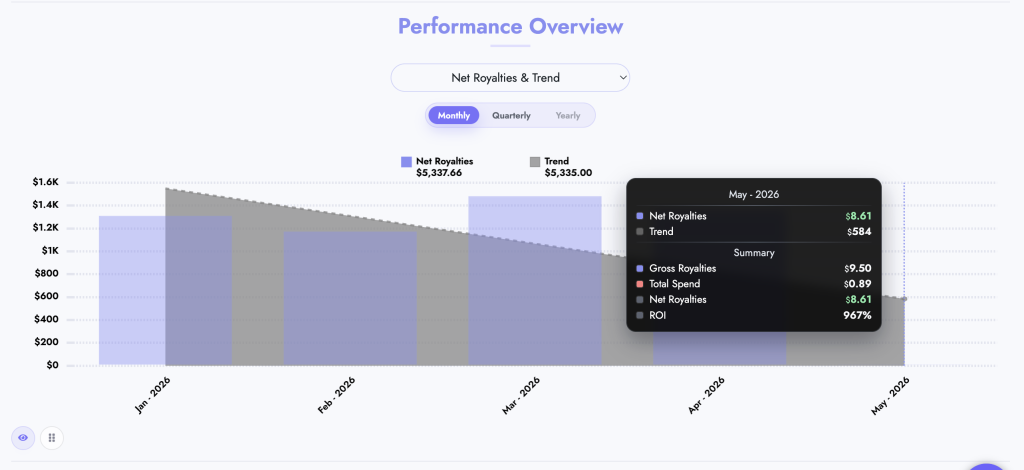
Publisher Champ is by far my favorite option for tracking all your book sales. It is affordable, it has a clean interface, it interacts with all the major book retailers and more to track your sales.
It includes integration with the following platforms:
- Amazon
- Draft2Digital
- Google Play
- Apple
- Barnes & Noble
- Kobo
- BookBub
- Shopify
- IngramSpark
While also integrating with other e-commerce sites like ThriveCart, Squarespace and Fourthwall. In total, there are currently 24 different integrations to sync with your one account.
But that's not all!
Publisher Champ doesn't just track sales, it also can pull and chart out:
- Amazon Followers
- BSRs (to include historical data)
- Author Stats (if you write under different names)
- Pre-Orders
- Book Series Stats
- Ads (Meta and Amazon)
- and so much more!
That definitely makes it one of the best aggregators of all time, and definitely the best on this list that I've seen.
Although Publisher Champ offers a ton of integration options, it can be a bit overwhelming with all the data. However, they also have a good system that allows you to save filter settings and organize what you want to be seen and where.
So that definitely helps.
Publisher Champ Pricing
Publisher Champ has two tiers of pricing:
- $16.99/month or $182.99/year – Standard
- $21.99/month or $235.99/year – Plus
All book sales platform integrations are included within the Standard tier. What comes with Plus is the ability to track an additional 7 e-commerce sites to review key analytics of sales. Plus also comes with the ability to create custom tracking ‘Smart Links'.
On top of that, Publisher Champ has a 14-day free trial of their Plus system.
Publisher Champ Pros and Cons
Here is everything that I liked and didn’t like about Publisher Champ:
Pros:
- Every book sales and e-commerce platform integration I could need to help track book and merch sales
- Easy to use platform
- Quickly sync with integrations (even if something gets un-synced it takes a couple minutes to sync again and pull up any missed data)
- Quick and efficient support
- Fully customizable home dashboard – for me a big pro is having the ability to order and see exactly what I want
- Chart layout customization
Cons:
- The abundance of data and integrations can be a bit overwhelming at first
The Bottom Line: Publisher Champ is by far the most impressive platform out there. With so many integrations already available, you'll find it easy to quickly review data and add in new books or integrations you start up.
PublishWide – Good for Large Publishers

There is one other big name in book sales tracking and that is PublishWide.
PublishWide, like Publisher Champ, pulls in a lot of data so you can clearly see how your books are doing across all major platforms. It currently pulls from the following:
- Amazon
- Apple Books
- Barnes & Noble
- Draft2Digital
- Kobo
While this is still less than what Publisher Champ offers, they are continuing to add new platforms.
One of my favorite features for PublishWide is that it gives you the opportunity to integrate with Amazon Ads and Facebook Ads, to give you new insights into your overall profits, and the effectiveness of your ad spend.
PublishWide also does a really good job with its design and interface, making it really clean and easy to understand.
Overall, PublishWide is a good option, but I recommend it mostly for large publishers and people with a MASSIVE number of books, as this seems to be their target audience.
The big reason why it’s not #1 on this list is largely due to a lack of customization and the pricing…
PublishWide Pricing
PublishWide is primarily geared towards larger organizations, going so far as to ask for those earning more than $1 million dollars to contact them about enterprise pricing.
For the rest of us, the program costs $29/month regardless of income level.
This is a more expensive option than what Publisher Champ or Book Report offer, and it doesn’t offer anything that at least one of those tools offer, which is why PublishWide is not my #1 recommendation for most authors.
However, if you are interested in trying it out, they do offer a 14-day free trial.
PublishWide Pros and Cons
Here’s my breakdown of the good and the bad from PublishWide:
Pros:
- Excellent design and understandable breakdown of the data
- Gives insights on ad spend from Facebook and Amazon Ads
- Good for sorting large quantities of data for people like big publishers
- Offers a downloadable PC or Mac version
Cons:
- Goes through ‘open' and ‘closed' seasons for new customers
- More expensive without the features to justify it (THIS IS A BIG CON)
- Not as customizable as Publisher Champ
- Still lacks several publishing platforms to report on
- Almost too simple in its reporting
The Bottom Line: If you’re looking for a good book tracker, PublishWide will certainly do the job. However, its features do not justify the expense, since you can easily get the same features with other platforms. The only instance where I might consider it is if I were a large publishing house and wanted to simplify big data.
Book Report

Early on, Book Report was one of the go-to book trackers for authors. However, they have downside: they have limited trackable data. Although they cover the major book publishing services, that's the limit. They don't offer additional tracking unlike other options now available.
In essence, Book Report came about because KDP’s own sales reporting dashboard was awful. However, KDP’s beta reporting dashboard has gotten better with time, and is almost (not quite) as good as what Book Report will give you.
That said, Book Report has a very clean-looking interface, and makes it really easy to see your data, and its pricing is strictly dependent on how much you make when can be a good thing to help you work up towards. While also offering a fully free version for authors making less than $1000 a month.
Book Report Pricing
Book Report has several pricing tiers:
- FREE – for authors making less than $1000/month
- Core ($19/month) – Authors who track up to $5,000/month
- Plus ($29/month) – Authors who track up to $10,000/month
- Pro ($49/month) – Authors who track up to $25,000/month
- Business ($99/month) – Authors who track up to $100,000/month
- Enterprise ($249/month) – Authors who track unlimited earnings
That puts their pricing strategy very reliant on what you earn rather than what features you may want.
For those who are already making more than $1000/month, Book Report will also provide a 14-day free trial to test it all out.
Book Report Pros and Cons
Here is what I did and didn’t like about Book Report:
Pros:
- Nice clean interface
- You can sort the data with a really nice tagging system
- Shows you the earnings based on marketplace, author, book, or custom tag
- Good variety of book platform integrations
Cons:
- Does not include other e-commerce platforms
- Frequently requires logging into my KDP account again
The Bottom Line: I recommend Book Report only for those who are exclusive to the major publishing platforms, and only if you want a simple layout without many bells and whistles. Otherwise if you want more in depth data and a wider selection of integrations, you'll likely benefit more with something like Publisher Champ.
ScribeCount

ScribeCount has been around for a while, and years back was my favorite choice. However, a lot has changed since then and I somewhat hesitated to include it here in this list.
Back in the day it was the best option available but their company has been going down for quite sometime and are starting to work their way back up to a better standard.
It includes integration with the following platforms:
- Amazon
- Google Play
- Apple
- Barnes & Noble
- Kobo
- Draft2Digital
- Shopify
- Bookfunnel
- WooCommerce
They cover all the big players in the self-publishing space, plus e-commerce sales which is a big deal if you're looking to expand your platform. They also just recently integrates with Audible so you can track audiobooks as well, which was a welcomed upgrade.
Although ScribeCount tracks your sales across many platforms, similar to Publisher Champ, it also pulls in the following data:
- Your Kindle Unlimited page reads
- Your book ranks
- Your book reviews
- Geographical sales data
- And more
However, even with such array of available integrations – ScribeCount has run into a lot of issues and are slowing getting things back on track.
ScribeCount Pricing
ScribeCount has several tiers of pricing:
- $9.99/month – For authors earning between less than $1000 a month
- $19.99/month or $185/year (approx. $15/month) – For authors earning over $1000 a month
All data and features are available at all tiers, meaning that if you are just starting out and don’t make more than $1000 yet, you can absolutely access all the features at the $9.99 tier.
Additionally, ScribeCount has a 14-day free trial.
ScribeCount Pros and Cons
Here is everything that I liked and didn’t like about ScribeCount:
Pros:
- A ton of data collected and available to authors
- A great selection of platforms
- Easy setup
- You can sort by series or create custom tags to organize your data
- Shows you the earnings based on marketplace, author, book, or custom tag
Cons:
- The sheer quantity of data can be overwhelming and the UI design could be easier to understand or use
- Not a very responsive support team
- Major down times for pulling report data
- No free version
The Bottom Line: ScribeCount has gone through a ton of major internal changes. Even their CEO has jump in online to help out customers directly and apologize for the issues they've encountered. Since then, they've mentioned hiring up a new and better support team and appear to be taking steps in the right direction. However, it's still a bit too early to see how well they can recover at this point.
Verdict: What is the Best Book Tracking Software?
The best book tracking app for authors is Publisher Champ. With all of its many features, its level of customization, not to mention a great team backing it up, I’m excited to see where this one continues to grow.
I’ve used all the tools listed here at some point within my author carrier. After running into issues with ScribeCount I needed something reliable and would require spending more time getting the program to work than actually getting into the data. Once I found Publisher Champ I switched all my books over to that platform and have been using it ever since.
Be sure to check them out!
That said, there’s no such thing as a perfect tool for every author, which is why I would suggest PublishWide as a potential alternative. PublishWide is more expensive, but I believe it is set up better for authors and publishers who have a large number of books or who make a lot of revenue. If this describes you or your organization, you can check out PublishWide here.
For everyone else, check out Publisher Champ today!
Cheers,