Genres feel simple… right up until you have to choose one for your own book.
As a reader, you don’t think about it much. You pick up a book, get a sense of what it is, and decide if it’s your thing. Mystery, romance, sci-fi. It’s mostly instinct.
Writing is where it gets a little more complicated.
At some point, you have to decide where your book fits. And that decision matters more than most authors expect. It affects how readers find your book, what they expect when they start reading, and whether it connects with the right audience.
At the top level, it’s straightforward. Fiction or nonfiction.
After that, things branch out quickly. Subgenres, overlaps, categories that sound similar but mean different things.
And if you’re trying to figure out where your book belongs, it’s easy to feel like you’re guessing.
This guide walks through the most common book genres, how they’re typically defined, and how to think about where your book fits within them.
What genres tend to be popular right now
We ran a quick survey with the Kindlepreneur community in January 2026 and got responses from 450 self-published authors.
A few patterns showed up pretty clearly.
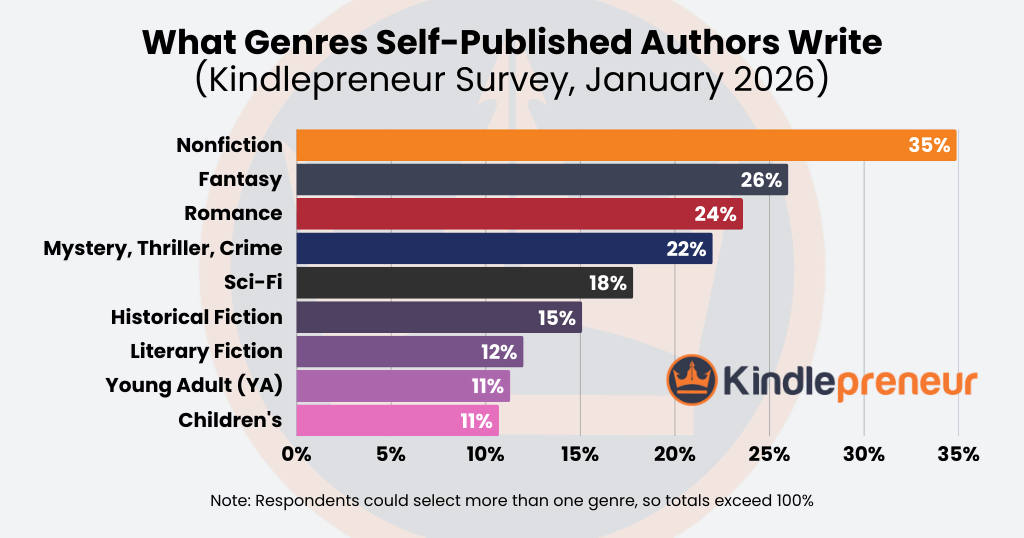
Nonfiction (34.9%) came out on top, which isn’t too surprising. A lot of indie authors are writing from experience, teaching something they know, or building around a specific niche.
Fantasy (26%) and romance (23.6%) were right behind it, both of which tend to do well in self-publishing, especially for authors writing in series.
Mystery, thriller, and crime (22%) also showed up consistently, along with sci-fi (17.8%) and historical fiction (15.1%). These are all genres with strong reader demand and well-established audiences.
Some categories, like literary fiction, young adult, and children’s books, showed up less often in this group. That doesn’t mean there isn’t an audience, just that they’re less common among the authors we surveyed.
One thing that stands out is how much overlap there is.
A lot of authors don’t stay in one genre. They blend ideas, experiment, or move between categories over time.
Still, it helps to understand the main groups before you get into the details.
If you want a quick reference point, here are some of the most common genres and what you’ll typically see in each:
A quick look at common book genres
| Genre | Key traits | Well-known examples |
| Mystery | A central puzzle or crime, clues, investigation, and resolution | Gone Girl, The Girl with the Dragon Tattoo |
| Thriller | High stakes, constant tension, and a strong sense of urgency | The Da Vinci Code, The Silent Patient |
| Romance | A central love story with emotional development and a satisfying ending | Pride and Prejudice, The Notebook |
| Fantasy | Imaginary worlds, magic, and often large-scale quests | The Lord of the Rings, A Song of Ice and Fire |
| Science fiction | Advanced technology, futuristic settings, or speculative science | Dune, The Martian |
| Historical fiction | Stories set in a real historical period, blending fact and fiction | The Book Thief, All the Light We Cannot See |
| Contemporary fiction | Real-world settings and situations that reflect modern life | Little Fires Everywhere, Normal People |
| Literary fiction | Character-driven stories that focus on theme, style, and depth | The Road, Beloved |
| Young adult | Teen protagonists and coming-of-age themes | The Hunger Games, The Fault in Our Stars |
| Memoir and autobiography | Personal stories told from the author’s perspective | Hillbilly Elegy, Greenlights |
Why there isn’t a fixed number of genres
If you stick to the main categories most people already know… fantasy, romance, mystery, history… you’re dealing with a manageable list.
But once you start breaking those down, the number grows quickly.
What looks like one genre on the surface often splits into several smaller ones. Fantasy turns into epic fantasy, urban fantasy, dark fantasy. Mystery becomes cozy, police procedural, psychological thriller.
And depending on where you look, you’ll see very different numbers. Some lists show a few dozen genres. Others go much deeper, especially when you include subgenres and marketplace categories.
That doesn’t mean there are thousands of completely different kinds of stories.
It’s mostly the same core ideas, just labeled in more specific ways.
At a high level, you’ve got the main genres most readers recognize. From there, things branch out into narrower categories based on tone, setting, or subject.
For now, it’s more useful to focus on those main genres.
Once you understand those, it’s much easier to see how subgenres and overlaps fit in.
Major fiction genres
When people talk about book genres, they’re usually talking about fiction.
These are the categories most readers recognize right away. Mystery, romance, fantasy, sci-fi. The labels that shape expectations and help readers decide what to pick up next.
There are dozens of ways to break fiction down further, especially once you get into subgenres. But most stories still fall into a handful of main categories.
That’s what we’ll focus on here.
Mystery
Most mysteries start with something that doesn’t make sense.
A crime. A disappearance. Something that doesn’t quite add up.
From there, everything revolves around figuring out what actually happened.
As the story unfolds, new details shift your understanding. Someone who seemed harmless isn’t. A small clue changes the direction. Then something else shows up and throws everything off again.
Just when you think you’ve got it, you probably don’t.
A good mystery lets you build a theory and help you feel like you’re getting close, then quietly pulls things apart just enough to keep you second-guessing.
By the time you reach the end, the answer should feel surprising, but also make sense in hindsight. Like the clues were there the whole time, even if you didn’t see how they fit together.
That tension is what keeps people reading.
You’re trying to figure it out as you go, staying just close enough to the story to keep going, but never completely ahead of it.
Books like Murder on the Orient Express and Gone Girl both follow this idea, even though they handle it very differently.
From there, you get variations like cozy mysteries, police procedurals, and classic whodunits, each with its own way of building and solving the puzzle.
Tip for writing mysteries: If the answer is too obvious, the story loses its tension. If it feels impossible to solve, readers stop trying. The sweet spot is somewhere in between, where the clues are there, but they don’t fully come together until the end. If you want to go deeper on this, we’ve broken down how to structure a mystery step by step in our mystery writing guide.
Thriller
If you’ve ever told yourself “just one more chapter”… and then looked up an hour later, that’s usually a thriller.
These stories don’t give you much room to breathe.
Something is already in motion, and it doesn’t really slow down. The main character is reacting, making decisions, trying to stay a step ahead of whatever’s coming next.
There’s pressure the whole way through.
Not just curiosity about what happened, but a sense that something’s about to go wrong if they don’t figure it out in time.
That’s where it starts to feel different from a mystery.
You’re not piecing together the past as much as you’re watching things unfold, and hoping they don’t spiral.
Sometimes the stakes stay small. One person in danger.
Other times it opens up into something bigger. A conspiracy. A situation that keeps getting worse the more you see of it.
Either way, the tension doesn’t let up for long.
The Da Vinci Code and The Silent Patient are good examples. Different setups, but the same pull to keep going.
Zoom in and you get psychological thrillers, political thrillers, legal thrillers.
Tip for writing thrillers: Pacing matters more than anything here. If you give too much away, the tension drops. If you hold back too much, readers get lost. The interesting part sits in the middle… where they know enough to feel the pressure, but not enough to get comfortable. If you want to dig deeper, check out our thriller guide.
Romance
In a romance, everything comes back to the relationship. That’s the center of it.
It’s not just that two characters fall for each other. It’s whether that connection holds once things start to get messy.
And they usually do. Something gets in the way. Expectations don’t line up. One person pulls back. The timing is off.
The story keeps putting pressure on the relationship to see what happens.
That’s what readers show up for. They want to watch that tension play out, and see where it lands.
There’s also an expectation going in.
A romance isn’t building toward an ending where everything falls apart and stays that way. The payoff matters. It has to feel earned… even if getting there isn’t smooth.
Pride and Prejudice and The Notebook both follow that pattern. Very different settings, same focus.
Once you start narrowing it down, the genre splits in a few directions. Historical romance. Paranormal romance. Romantic suspense.
Tip for writing romance: Tropes are part of the draw. Readers aren’t always looking for something completely new. A lot of the time, they want a dynamic they already like… just handled well. Same setup, different execution. If you want to see how those tropes show up across the genre, we’ve got a full list you can dig into.
Fantasy
Fantasy steps outside the real world.
That can mean a completely invented setting… or something that looks familiar at first, but runs on different rules underneath. Magic, new worlds, creatures that don’t exist. Sometimes all of it at once.
Once you’re in, the story plays by its own logic.
Readers will go along with a lot. More than you’d expect, honestly. But there’s a catch. The rules have to hold.
If something works a certain way early on, it has to keep working that way. That’s what makes the world feel real, even when none of it is.
The Lord of the Rings and A Song of Ice and Fire both do this well. Different kinds of worlds, but they feel complete. Like they could keep going whether you’re watching or not.
From there, fantasy goes in any number of different directions. Epic fantasy. Urban fantasy. Darker stories. Lighter ones.
Tip for writing fantasy: You can invent almost anything. That’s the fun part. Where it falls apart is when the rules start shifting to fit the plot. Once readers notice that, it’s hard to pull them back in. We cover this in more detail in our fantasy guide, and if you’re leaning darker, there’s a separate guide for that too.
Science fiction
A lot of science fiction starts with a simple question.
What if something changed.
Technology moves faster than expected. We leave Earth. Life starts to look different than it does now.
From there, it can go in a lot of directions.
Sometimes the science is front and center. The details matter, and the story leans into how things work. Other times, the idea is just a starting point. What matters more is how people deal with it.
Either way, there’s usually some kind of logic holding everything together.
Not the same rules we’re used to… but rules that make sense inside that world.
Once that’s in place, the story just follows it and sees where it leads.
That’s one reason why the genre varies so much. Dune leans into politics, culture, long-term consequences. The Martian stays much more grounded, focused on problem-solving and survival.
From there, you get hard sci-fi. Space opera. Dystopian stories. Cyberpunk.
Each one pushing on a different part of the idea.
Tip for writing sci-fi: The idea is just the starting point. What matters is what it does. How it changes people, decisions, everything around it. That’s where the story really comes together. If you want help working through that, we’ve put together a list of sci-fi story prompts.
Dystopian
In a dystopian story, the world isn’t falling apart.
It’s working exactly the way it was built to.
That’s the problem.
The rules are there to control people. Keep things in place. Limit what’s possible.
It can show up in different ways. A government that sees everything. A system where most people get almost nothing. Sometimes even the environment is part of it.
Either way, it’s not random. The structure is doing what it’s supposed to do… and it’s hard to get out of.
That’s what makes it feel dystopian.
Most of these stories follow someone who starts to notice. They see the cracks. Question what they’ve been told. Push back, even a little. That’s where the tension comes from.
The world as it is… and the sense that it could be different.
1984 and The Hunger Games both lean into that in different ways.
Tip for writing dystopian stories: The world has to make sense on its own terms. It shouldn’t feel broken. It should feel like it’s doing exactly what it was designed to do… even if that leaves most people stuck inside it. We get into that more in our dystopian writing guide.
Historical fiction
Setting a story in the past doesn’t automatically make it historical fiction.
That’s part of it. But it’s not the whole thing. What really matters is whether that world feels believable for the time. How people speak. What they value. What they think is possible.
If those don’t line up, something feels off… even if you can’t quite explain why.
The story itself doesn’t have to be true.
A lot of historical fiction mixes invented characters with real events, or builds a fictional story inside a real setting.
What matters is that it fits.
The Book Thief and All the Light We Cannot See both do this well.
The time period isn’t just background. It shapes what the characters can do, what they’re dealing with, and where the story goes.
Tip for writing historical fiction: It’s easy to get pulled into the research. There’s always more you could include. The trick is knowing what to leave out. The details should support the story… not take it over. We break that balance down in our historical fiction guide.
Contemporary fiction
Contemporary fiction stays close to everyday life.
Nothing is pushed too far. The setting feels familiar, the situations feel possible, and the focus stays on people more than plot.
Work, relationships, family, identity. Things that don’t always look dramatic on the surface, but still carry weight.
The tension is usually quieter.
It shows up in decisions, misunderstandings, the way people change over time. Not in big twists or high-stakes moments… more in what happens between them.
Little Fires Everywhere and Normal People both lean into that. Not much in those stories feels unrealistic.
Literary fiction
“Literary fiction” sounds more intimidating than it needs to be.
It’s not really a separate type of story. It’s more about how the story is told. The focus tends to shift toward the writing itself. The voice, the structure, the ideas underneath what’s happening on the surface.
You’re paying attention to the language… not just what happens next.
The stakes are usually quieter, and often internal. It’s less about big events and more about how characters see the world, and what they do with that. How they think. What they notice.
That doesn’t mean nothing happens. The story just isn’t built around action or constant movement.
The Road and Beloved are often grouped here. In both, the style and the themes carry as much weight as the plot.
Magical realism
Magical realism can look a bit like fantasy at first.
But it doesn’t work the same way.
The setting feels like the real world. Nothing stands out as unusual… until something does.
And no one reacts to it.
That’s the part that throws people.
The strange thing is just there, treated like it belongs. No explanation, no big shift in the story. It doesn’t take over either. It just sits in the background while everything else keeps going.
The story still focuses on people, relationships, everyday life… that part doesn’t change.
You end up with both things happening at once. The ordinary, and something just slightly off.
One Hundred Years of Solitude and The House of the Spirits both lean into that. They don’t try to explain the unusual parts. They just let them exist.
Tip for writing magical realism: The more you try to explain it, the more it falls apart. The unusual parts shouldn’t feel special. They should feel normal… at least to the people in the story. We’ve got a breakdown on that in our magical realism guide.
Action and adventure
Action and adventure stories usually start with a goal.
Someone needs to get somewhere, find something, survive, or stop something before it’s too late.
There’s always a next step, and usually a problem waiting with it. That’s what keeps things moving.
The story doesn’t sit still for long. One decision leads to the next, and things tend to get harder as it goes. The tension is mostly external. Danger. Time pressure. The risk of failing outright.
The character is dealing with what’s in front of them, not just what’s going on inside.
You can see that in books like The Martian and The Count of Monte Cristo.
Different setups, but both keep pushing forward.
Horror
Horror is less about what happens, and more about how it feels.
Usually some version of dread. Something isn’t right, even if you can’t quite explain why.
The story builds that slowly, then sits in it.
Where that feeling comes from can change.
Sometimes it’s something supernatural. Sometimes it’s human. Sometimes it’s just the sense that something is there… and you don’t understand it yet.
A lot of the time, what isn’t shown does more work than what is.
It and The Haunting of Hill House both lean on that in different ways.
Tip for writing horror: What the reader imagines is often more powerful than what you put on the page. Give them just enough to work with, and let them fill in the rest. That’s where the tension comes from. If you want to see how that works, we break it down in our horror guide.
Young adult (YA)
Young adult, or YA, isn’t really about the type of story. It’s about who the story centers on.
These stories usually follow teenage characters dealing with questions that come up at that stage of life.
Who am I. Where do I fit. What do I want from this. Those questions shape everything else.
That perspective shows up across a lot of different genres.
Fantasy, romance, dystopian stories, contemporary fiction… all of them can be written for a YA audience.
What ties them together is the point of view. The age of the characters, the way the story is told, and the kinds of choices they’re facing.
The Hunger Games and The Fault in Our Stars sit at opposite ends of the spectrum, but both come back to that same stage of life.
Children’s
Children’s fiction covers a pretty wide range.
A book for a five-year-old and one for a twelve-year-old aren’t trying to do the same thing. At one end, you’ve got picture books. Simple language, heavy on illustrations. At the other, you get middle-grade stories with fuller plots and characters that have a bit more going on.
As the reader gets older, the writing shifts with them.
The vocabulary expands. The stories get longer. The themes can go a little deeper, even if things still feel simple on the surface.
That part doesn’t really change. The story still has to be clear, engaging, easy to follow.
That’s why books like Charlotte’s Web or Matilda stick around. You can read them early, but there’s enough underneath that they still hold up later.
Tip for writing children’s books: Simple doesn’t mean easy. The younger the reader, the more every word matters. There isn’t much room to wander, so the story has to move. We walk through that in our children’s book guide.
Graphic novels
A lot of people hear “graphic novel” and think superheroes.
The format can handle almost anything. Memoir, history, fantasy. Even quieter, more literary stories. What changes is how the story shows up on the page.
It’s not just text.
Images do part of the work. Pacing, tone, even meaning can shift depending on how a scene is drawn, or how the panels are laid out.
Sometimes what you don’t show matters just as much.
Maus and Persepolis are good examples. The visuals carry as much weight as the words.
Tip for writing graphic novels: The story is split between what’s shown and what’s said. If both are doing the same job, something feels off. The balance is where it starts to work. We do a deep dive in our graphic novel guide if you’re curious.
Short stories
Short stories don’t give you much room.
There isn’t space for a long buildup or a bunch of side plots. Most of the time, everything circles one moment, or one shift, and that’s it. If something doesn’t support that, it usually gets cut.
That changes how they read.
Scenes tend to be tighter. Small details carry more weight. Endings show up faster than you expect… and sometimes they don’t spell things out.
You just sit with it for a second.
Most short stories aren’t published on their own. You’ll usually see them collected together.
Stories of Your Life and Others or Tenth of December are good examples. Different styles, but the same idea. Not much space, still a lot going on.
Tip for writing short stories: A lot of writers use short stories to try things out. An idea, a voice, something they’re not ready to stretch into a full book. Some of it works, some of it doesn’t. But every now and then, something sticks and turns into something bigger. If you want to know how to publish short stories or use them to build momentum, we get into that in our guide.
Major nonfiction genres
Nonfiction is organized a little differently than fiction.
Instead of imagined stories, it’s built around real people, events, or ideas, so genres tend to follow the subject of the book.
History books focus on historical events. Memoirs tell personal stories. Business books focus on strategy or experience.
There’s still some overlap, but overall the categories are more straightforward than fiction.
Here are the main nonfiction genres you’ll come across.
Memoir and autobiography
Memoir and autobiography both come from real life.
They don’t quite do the same thing, though.
A memoir usually zooms in. One stretch of time, one experience, sometimes just a thread that runs through a few years. It’s less about covering everything and more about making sense of something.
An autobiography goes wider. It moves through a life more fully, connecting things from the beginning to wherever the story ends up.
That’s the general idea, anyway. In practice, there’s some blur.
In both, the voice does a lot of the work. It’s not just what happened. It’s how it’s remembered, what stood out, what didn’t, and why it’s being told now.
Hillbilly Elegy and Greenlights both come from real experiences, but they don’t feel the same at all. The lens changes everything.
Tip for writing memoirs and autobiographies: You don’t need everything. Most of it probably doesn’t belong in the book anyway. What matters is choosing the pieces that hold together, the ones that point to something. If you want help shaping yours, we’ve got guides on writing an autobiography and publishing a memoir.
Biography
A biography is someone else telling the story. Same idea as a memoir, just from the outside.
Instead of writing about their own life, the author is putting it together from what’s available. Interviews, records, old accounts, sometimes conflicting versions of the same moment.
That changes the feel a bit. You’re not just getting what happened. You’re getting how it was seen, what it meant at the time, and how it looks in hindsight. Sometimes those don’t line up.
Some biographies go from beginning to end. Others stay in one period and dig in there.
Accuracy matters more here, but it still has to read well. Otherwise it turns into a timeline, and those are hard to stick with.
Steve Jobs or Alexander Hamilton are good examples. They read like stories, even though they’re built from real events.
Tip for writing biographies: The dates are easy to find. The harder part is figuring out what connects them. Why something mattered, what it led to, what changed because of it. If you want to see that done well, we’ve got a list of standout biographies.
Self-help
People usually pick up a self-help book because something isn’t working.
A habit, a routine, a situation they keep running into. Something feels off, and they’re trying to figure out what to do about it.
Most of these books are built around things you can actually use. Ideas, examples, steps you can try without overthinking it too much. The goal isn’t just understanding the problem. It’s doing something differently after you close the book.
Atomic Habits or The 7 Habits of Highly Effective People stick around for that reason. They give people something to try, not just something to think about.
Tip for writing self-help: Narrow it down. Trying to solve everything at once usually turns into general advice, and that’s easy to ignore. One problem, handled well, usually lands better. If you’d like to learn more, check out our self-help guide.
Business and economics
Business books usually come back to decisions.
What to do, when to do it, and what happens if you get it wrong.
Some focus on building something from scratch. Others are more about running what’s already there. Leading, hiring, investing, figuring things out when there isn’t a clear answer.
A lot of them lean on real examples. Companies, leaders, things that worked, things that didn’t. Then they step back and try to pull something useful out of it.
That’s where it either clicks or it doesn’t.
The ideas aren’t meant to stay on the page. You’re supposed to try them and see what happens.
Good to Great and The Lean Startup both do that in different ways. Same general goal, different angles.
Health and wellness
Health and wellness usually comes down to a simple question.
What actually works.
The topics move around. Nutrition, exercise, sleep. Stress, mental health. Different angles, same underlying problem.
The stakes feel a bit higher here, though. People aren’t just reading out of curiosity. They’re changing what they eat, how they train, how they take care of themselves.
So credibility matters more.
The stronger books in this space take research and make it readable without flattening it. That balance is harder than it looks. Too simple, and it feels thin. Too detailed, and most people won’t stick with it.
Why We Sleep is a good example. There’s a lot behind it, but it still reads clearly.
Sleep on its own can turn into a dozen different directions.
Same with nutrition.
History
History books are built on real events, but they’re not just lists of facts.
Some take a wide view and look at whole periods or movements. Others stay close to a single person, place, or moment.
What matters is how those pieces connect.
Dates on their own don’t do much. It’s what led to what, and why it mattered, that pulls it together.
That’s usually the difference between a timeline and something people actually want to read. The stronger ones feel more like stories, with context and a sense of cause and effect.
The Wright Brothers or Sapiens both do that in different ways. The research is there, but it’s not doing all the work.
Science and technology
Science and technology books are usually trying to make something complicated feel a bit more manageable.
That might mean explaining how something works, or breaking down an idea that’s easy to lose track of once it gets technical.
That’s the balance.
Keep it clear without flattening it.
Some stay focused on the ideas. Where things came from, where they might go. Others spend more time on the people behind it, or what happens once those ideas start to show up in the real world.
A Brief History of Time leans one way. Steve Jobs leans another. Same space, different angle.
Philosophy and religion
Some books sit with questions that don’t really have clean answers.
What gives life meaning. What makes something right or wrong. How people should live, or what they should believe.
Philosophy and religion both spend time there, even if they don’t always agree on where things land.
The pace tends to slow down.
These aren’t books you rush through. They circle ideas, look at them from different angles, and sometimes leave things a bit open.
You’ll see that in The Republic, Mere Christianity, and a lot of newer books on ethics or faith. The point isn’t always to land on one answer.
Sometimes it’s just to think it through.
True crime
True crime starts with something that actually happened.
You’re following a real case, trying to understand how it unfolded, what led up to it, and how it eventually came together.
The details matter more here.
The investigation, the people involved, the decisions that were made along the way. Getting the facts right is part of it. Making sense of them is the other part, especially when things don’t line up cleanly.
In Cold Blood is the one people usually point to. It reads like a story, but it stays grounded in what actually happened.
Subgenres explained
You’ll see more specific labels attached to genres.
That’s all a subgenre is.
A narrower version of something broader.
Most genres start out wide. Then certain patterns show up often enough that people start looking for them on purpose. And once that happens, they usually get named.
So it’s easier to find more of the same.
Romance is probably the easiest place to see it. It starts broad, then splits into historical, paranormal, contemporary, romantic suspense… and more if you keep going.
Same core idea. Just pointed in slightly different directions.
You see it in other genres too.
Mystery has cozy mysteries, detective stories, whodunits, legal thrillers. Science fiction branches into space opera, dystopian stories, cyberpunk. History does its own version of it as well.
Once the label gets more specific, the expectation gets clearer.
Not perfectly clear.
But closer.
Genre vs. category vs. subgenre
These terms get mixed up a lot.
At the top is genre.
That’s the broad label. It tells you what kind of story you’re stepping into. Romance, mystery, fantasy, history.
Subgenres narrow that down.
They don’t change the core idea. They just shape what it feels like.
Romance can split into historical, paranormal, romantic suspense. Same foundation, different expectations. Mystery works the same way. A cozy mystery feels very different from a police procedural.
Category is a different thing.
It’s less about the story, more about where the book ends up. Bookstores, libraries, online retailers… they all need some way to organize things so people can find them.
So they build systems.
One book can end up in more than one category at the same time.
This is where Amazon confuses people a bit.
When someone talks about “Amazon categories,” they’re usually talking about how books are organized on the site. Some of those labels overlap with genres, but they’re not the same thing.
It’s closer to a filing system than a storytelling label.
As a reader, you’re usually thinking in genre and subgenre.
Categories mostly sit in the background.
Books don’t belong to just one genre
A lot of books don’t sit in one place. They pull from different directions at once.
Fantasy mixed with romance. A mystery running through a historical setting. Science fiction that’s really more about relationships than the tech.
That kind of overlap is normal. In a lot of cases, it’s part of what makes a book feel a bit different.
How it gets labeled can shift depending on who’s looking at it.
One reader might think of it as literary fiction. Someone else sees it as historical fiction. Both can make sense. They’re just picking up on different parts of the same story.
Genres aren’t strict boundaries. They’re more like signals. A rough sense of what you’re stepping into.
If you’re reading, that’s usually enough. If you’re writing, it matters a bit more. You’re deciding which expectations you’re working with, and where you’re going to push against them.
How to choose the right genre for your book
You usually don’t start by picking a genre.
It’s already there. You just haven’t named it yet.
If you look at what the story keeps coming back to, it shows up pretty quickly.
Maybe everything centers on a relationship. That leans toward romance.
Or the story keeps circling a problem that needs to be solved. A crime, a disappearance, something that needs an answer. That starts to look like a mystery.
Or the world itself runs on different rules. That’s where fantasy or science fiction usually comes in.
You don’t have to get it exactly right the first time.
You’re just trying to get close enough to see what you’re working with.
Once that part clicks, everything else tends to fall into place. Setting, tone, the kind of experience you’re shaping. Those details narrow things down, but they don’t usually change the core.
It’s also worth thinking about the reader.
People don’t usually pick up a book randomly. They have some sense of what they’re getting into, even if they can’t explain it. Pace, tone, how the story moves, how it ends.
You don’t have to follow every expectation.
But it helps to know what they are before you start moving away from them.
Where this leaves you
If your book doesn’t fit neatly into one of these genres, that’s normal.
Most don’t.
A lot of stories pull from more than one direction. They land somewhere in the middle, or shift depending on who’s reading them.
What matters is that the reader has a sense of what they’re stepping into.
Once that’s there, the rest usually works itself out.
—
An earlier version of this article was written by Jason Hamilton. It’s been rewritten and expanded by Kevin J. Duncan to reflect current publishing trends and give a clearer picture of how genres actually work today.