Coming up with realistic fiction story ideas can be harder than it sounds.
With fantasy, sci-fi, or horror, you can usually lean on a big external hook. A dragon shows up. A spaceship disappears. A vampire moves in next door. Even if the story still needs good characters and conflict, the premise gives you something obvious to build around.
Realistic fiction is different because the story has to feel like it could actually happen. You’re working with ordinary people, believable problems, family tension, friendships, career choices, grief, ambition, regret, and all the other messy parts of real life. That can make the ideas feel smaller at first, which is where a lot of writers get stuck.
But smaller doesn’t mean weaker. Some of the best realistic fiction starts with a simple situation: a strained marriage, a difficult choice, a secret someone has kept too long, a friendship that changes, or a character realizing the life they built is not the life they actually want.
So, in this article, we’ll look at how to come up with realistic fiction ideas, what makes them work, and 55 realistic fiction prompts you can use to start your next story.
How to Come Up With Realistic Fiction Story Ideas
There are a lot of ways to come up with story ideas, and most writers eventually figure out what works best for them.
But with realistic fiction, it helps to be a little more intentional about where you’re pulling those ideas from.
Because you’re not building a world from scratch here.
You’re working with things people already recognize… relationships, life changes, everyday decisions that end up meaning more than they should.
So instead of trying to come up with something completely new, it usually works better to start with something familiar and then push on it a bit.
That’s where most of the ideas below come from.
Choose a Theme
Writing with an overarching theme in mind can help get the ideas rolling. And there are some common themes in realistic fiction that have held true over the years.
- Love – All different types of love — new, old, unrequited, platonic, fading — make excellent themes for realistic fiction.
- Growing Up – Some of the best realistic fiction is about changing from childhood to adulthood, or from adulthood to old age.
- Life Changes – From divorce and sickness to getting fired and learning to truly live, life changes have made for many a great story in this literary genre.
- Self-Discovery – The successful woman realizes there's more to life than working 60 hours a week. The college student suddenly realizes that his true passion lies in religion after a near-death experience. Everyone goes through self-discovery, which makes it an excellent theme.
- Bravery/Perseverance – Finding the will and the way to face unbeatable odds is a very human thing. We take solace in others learning to live their best lives in the face of great adversity.
- Social Issues/Injustice – Some of the most impactful realistic fiction stories deal with social issues such as racism and injustice. Creative writing in the realistic fiction genre is all about exploring these kinds of issues through compelling and lived-in characters.
You may have noticed that all these themes are very human. Of course, you could argue that every story is, at its core, human. But these themes are especially human because they're about struggles that people from all walks of life have to deal with. They're about humans dealing with very human problems. If you keep that in mind, you won't go wrong while crafting your realistic story.
Draft Some Characters
Remember that characters in realistic fiction won't have superpowers, magical abilities, or the ability to read other people's thoughts. They won't live in a futuristic science fiction civilization. They're just people, which means you can take inspiration from real life.
Try to nail down some character specifics for your protagonist first. Will she be an aging woman who just lost her husband of forty years? Will he be an accountant who saves a young boy's life on his way to work?
Your main character should absolutely have a story arc, so think about what you want that arc to be. Uplifting stories generally have a positive arc with a relatively happy ending. But, like life, there's no guarantee of a happy ending in realistic fiction.
Also, think about some traits or quirks you want your main character to have. Not only physical traits, but beliefs, habits, and compulsions, as well. Check out this article for more on making believable characters.
Realistic Fiction Story Prompts That Feel Real
Sometimes you don’t need a full idea. You just need a starting point that’s close enough to real life that you can build from it.
That’s what these prompts are meant to do. They’re not big, high-concept setups. They’re situations you could imagine happening to someone, or maybe something you’ve seen, heard about, or experienced in some form already.
1. Write a story about a character learning that the most important aspect of a relationship isn't what she once thought it was.
2. Write a story about a group of close friends becoming a family after one of their own passes away.
3. Explore the meaning of love through the eyes of two different characters from opposite sides of the world.
4. Write about a character learning about self-fulfillment vs happiness the hard way.
5. Write about an old couple finally going on a train trip through Europe in an effort to save their marriage.
6. Write a story about a character who struggles with self-esteem and vanity.
7. Explore where true confidence comes from.
8. Write a story about characters learning what's truly important as they move from adolescence to adulthood.
9. Write about a woman who meets the love of her life as a result of the 9/11 attacks.
10. Explore the importance of learning to help others during tough times.
11. Write a story in the form of a personal narrative from the perspective of a cult leader.
12. Explore the life of a fictional 19th-century suffragette.
13. Weave the story arcs of several seemingly disparate characters into one surprise ending where they all get what they've been searching for — together.
14. Write a story about a character who loses one of their five senses but learns to live better for it.
15. Write about a character overcoming drug addiction.
16. Write about a character who willfully decides to turn around their philosophy about life, learning to live with intention.
17. Write a story about an author who struggles with writing until something drastic happens in their life.
18. Explore where morals come from and why there's such a big wide range of them.
19. Explore a situation (either real or fictional) in which the majority was wrong about something that affected people's lives.
20. Write a story about a character learning that his concept of love is unhealthy.
21. Write about a family of refugees struggling to survive as they flee their war-torn country.
22. Write a story about an aging athlete who does the impossible.
23. Write about two characters struggling to shift their priorities and keep their relationship intact as they age.
24. Explore a character's trip through the criminal justice system as she is wrongfully convicted of a crime.
25. Write about an entrepreneur's journey to start a small business while his larger competitor sabotages him.
26. Write about a man's journey to return a lost child to his parents.
27. Write about a character learning to love herself before she can love anyone else.
28. Explore the implications of obsession.
29. Write about two characters who used to be best friends when they were kids reconnecting after many years.
30. Start your story with a small moment that has outsized and unforeseen consequences.
31. Write about a teenager who runs away from home after an argument with his parents.
32. Write about the last citizens of a dying town, struggling to revitalize the area.
33. Explore a historic earthquake or natural disaster through the eyes of fictional characters experiencing it.
34. Write about two children who are accidentally left at an amusement park.
35. Write a story about characters during the Great Depression.
36. Write about a dispute between neighbors that gets quickly out of hand.
37. Explore the meaning of Christmas through the eyes of a character who has just lost her family.
38. Explore the trials and tribulations of a character who was devastated by the 2008 financial crisis.
39. Write about a person who leaves everything behind to join a cult (e.g. Peoples Temple or Heaven's Gate).
40. Explore the implications of a husband who is caught spending time with a son he's just learned about.
41. Write a story about parents who struggle with a teenager who has mental health issues.
42. Write a story about siblings who struggle to deal with the mental and physical deterioration of one or both parents.
43. Write a story about a kid who has to deal with bullying at his new school.
44. Write a real-life fairy tale without the magic. Set it in modern times.
45. Explore the high-stakes corporate world through the eyes of a woman who encounters a glass ceiling.
46. Write about a poll worker who is accused of doctoring ballots during a particularly virulent election.
47. Explore the implications of a gender reassignment operation through the eyes of the person undergoing the operation.
48. Write a story about a young woman who struggles with anxiety as she makes her way through the world.
49. Write a story about a pair of identical twins who have to learn to live their own lives after spending so much time together as children.
50. Write a story about a town that suffers a severe earthquake.
51. Write about a character who returns to their hometown for a funeral and realizes the version of the past they’ve been carrying around is not the one everyone else remembers.
52. Write a story about two coworkers competing for the same promotion while slowly realizing the job may not be worth what it is costing them.
53. Explore a family dinner where an offhand comment exposes a secret that changes how everyone at the table sees one another.
54. Write about a retired teacher who receives a letter from a former student and is forced to reconsider whether they made the right choice years ago.
55. Write a story about a teenager who becomes responsible for holding their family together after one parent leaves and the other refuses to talk about it.
Vetting Your Realistic Fiction Idea
In the realistic fiction genre, good writing is a combination of compelling story elements, characters that feel real, and situations that are easily recognizable. Of course, a knack for narrative writing is also a plus. Fortunately, all these things can be learned.
But in the competitive fiction market, you need more than just a great story to succeed. For the best chance of success, you need to position the book into the correct categories and ensure you have the best metadata so readers can find it.
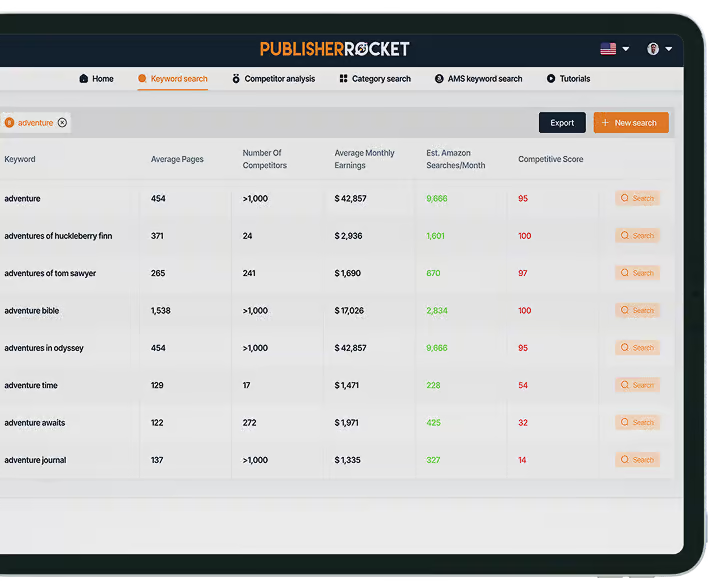
And the easiest way to do this is with Publisher Rocket. If you find a story idea that you like, you can vet it with Publisher Rocket, ensuring that the category isn't too competitive. Publisher Rocket can also tell you if there is a demand for the type of realistic fiction story you're going to write.
- Publisher Rocket's keyword search tool can help you determine what phrases and keywords Amazon shoppers are actually using when looking for realistic fiction books on Amazon.
- The Competition Analyzer helps you to see what other realistic fiction authors are doing and approximately how much they're making from their books.
- The AMS Keyword Search function can help you formulate the best Amazon Ad campaigns for your realistic fiction book.
- Lastly, the Category Search function helps you to choose the best categories when you publish your book on Amazon. This is very important for visibility!
This tool does the heavy lifting for you, searching through Amazon to bring you information on keywords, categories, and competition. Learn more about Publisher Rocket here.
Final Thoughts on Realistic Fiction Story Ideas
Realistic fiction usually works best when the idea feels familiar enough for readers to recognize, but specific enough that it doesn’t feel like something they’ve already read a dozen times. That’s why a simple prompt can be useful, not because it gives you the whole story, but because it gives you a place to start asking better questions about the character, the conflict, and what’s really at stake.
So if one of these realistic fiction story ideas gives you even a small spark, try writing a scene from it before you decide whether it’s worth keeping. You don’t need to know the full plot yet, and you definitely don’t need every character figured out before you begin. Sometimes the better material shows up only after you’ve spent a little time with the situation and let the people in it make a few messy, believable choices.
And if the first idea doesn’t go anywhere, pick another one, change the character, shift the setting, or make the central choice harder.
Good luck, and happy writing.