One of the smartest strategies an author can employ is building an email list as soon as possible.
(Especially if you intend on writing more than one book.)
But that begs the question…
What's the best email service for authors?
And the answer is complicated. Like most things, it depends.
How many subscribers do you have? How many do you hope to have? How many emails will you send each month? What's your budget?
Even when you have the answers to these questions, picking the right provider can be tricky.
See, email service platforms are smart…
They know it's a pain in the neck to switch from one service to another, so by grabbing you with a free or inexpensive account when you're small, they know the odds are great that they'll keep you as customers for life (even though it's no longer cost effective).
Trust me, I've switched services four times in my career. It's a pain.
That's why choosing the best email service from the get-go — one that'll serve your needs now but also down the road — is extremely important. It'll save you loads of time and money (and headache).
So, to help you choose the right email service, I've gone through and tested three well-known services for authors and stacked them side-by-side.
I'm happy to report that there is one specific email service that is the best fit for most authors.
Also, I created a free course to help you set up your account and get going with that particular email service (but more on that in a moment).
Let's jump right in.
Full Disclosure: I did use affiliate links in this article. Please know that if you end up using one of these and paying those companies, I will get a referral commission (which will go straight to my coffee fund and keep me writing and testing things like this). However, that doesn’t change my opinion of these products. I tried each of them personally, so be prepared for my unfettered opinion…
Why Only These 3 Email Services?
In my years of working online, I've personally used AWeber, Mailchimp, GetResponse, Kit, ActiveCampaign, Send Fox, and more.
There are probably hundreds of email services out there and more added every month.
So, it's simply implausible to test them all.
Therefore, in order to showcase the best grouping of author email services, I turned to author groups and the surveys completed by Kindlepreneur readers.
These three were the ones that came up again and again…
Side-By-Side Comparison of MailerLite, Kit, and Mailchimp
| Mailerlite | Kit | Mailchimp | |
|---|---|---|---|
| Free Account | |||
| Email Creation | |||
| Automation | |||
| Landing Pages | |||
| Forms | |||
| Ease of Use | |||
| Navigation | |||
Important Things to Note From the Email Service Comparison:
- Kit has the most generous free plan by subscriber count, with up to 10,000 active subscribers.
- MailerLite’s free plan is smaller than it used to be, but it still gives authors a useful way to test the platform.
- MailerLite remains one of the easier tools for beginners, while Kit is stronger for creators who want more advanced automations and monetization tools.
- Mailchimp’s free plan is now the weakest of the three, and its pricing still makes it hard to recommend for most authors.
Price Comparison of the Best Email Services for Authors
Pricing changes often, so check each provider’s pricing page before you sign up. But as of this update, here’s how the three services compare at common subscriber counts.
For MailerLite, this uses the Comfort plan unless the free plan applies. For Kit, this uses the free Newsletter plan until 10,000 subscribers, then the Creator plan. For Mailchimp, this uses the Essentials plan once you’re past the free tier.
| Mailerlite | Kit | Mailchimp | |
|---|---|---|---|
| 250 Subscribers # Email Sends | 2,500/mo | Unlimited | 500/mo or 250/day |
| 500 Subscribers # Email Sends | 5,000/mo | Unlimited | 5,000/mo |
| 1,000 Subscribers # Email Sends | 10,000/mo | Unlimited | 10,000/mo |
| 5,000 Subscribers # Email Sends | 50,000/mo | Unlimited | 50,000/mo |
| 10,000 Subscribers # Email Sends | 100,000/mo | Unlimited | 100,000/mo |
| 15,000 Subscribers # Email Sends | 150,000/mo | Unlimited | 150,000/mo |
| 25,000 Subscribers # Email Sends | 250,000/mo | Unlimited | 250,000/mo |
| 50,000 Subscribers # Email Sends | 500,000/mo | Unlimited | 500,000/mo |
| 100,000 Subscribers # Email Sends | 1,000,000/mo | Unlimited | 1,000,000/mo |
Important Things to Note From the Email Service Pricing Comparison:
- Kit has the most generous free plan, but as soon as you surpass 10k subscribers (or require features only their paid plans can provide), they become more expensive than MailerLite
- MailerLite's free plan isn't as good as Kit's, but as soon as you reach 10k subscribers (or upgrade to premium features), it costs less than Kit
- Compared to Kit and MailerLite, Mailchimp's pricing model sucks
Best Email Service for Authors (Ranked Worst to First)
- 3rd: Mailchimp
- 2nd: Kit (formerly ConvertKit)
- 1st: MailerLite
3rd Place: Mailchimp Review

I'll be honest…
Mailchimp has fallen behind the competition.
Don't get me wrong — it was and is one of the most well-known email service providers out there. It's been around since 2001 and its feature set has gotten better and better over the years.
The problem is its pricing model doesn't measure up to the “upstarts” that've popped over the years; namely, MailerLite and Kit (but also Beehiiv, GetResponse, and others).
Their “free” plan isn't nearly as generous as Kit or MailerLite. This wouldn't be a problem if Mailchimp was more affordable once the contact numbers (and feature sets) went up, but that's not the case. Mailchimp is more expensive than MailerLite and Kit once you get beyond the “free account” numbers.
So, who's it for then?
Probably big businesses who have loads of subscribers to email and/or who need enterprise level features.
Does that mean it'll work for indie authors?
It can, but bear in mind that most indie authors needs are pretty simple: the ability to automate a welcome sequence, deliver emails, manage their subscribers, occasionally tag them, have accurate reporting and remove inactive subscribers who don’t click or open.
In other words, Mailchimp might be overkill for authors.
But with that all said, let's check out what Mailchimp brings to the table:
- A free account with up to 250 contacts and 500 monthly email sends, with a daily send limit of 250
- Basic automation on the free plan, including a one-click automated welcome email. More advanced automation requires a paid plan.
- Landing pages with templates
- Forms that you can set up (not very easily though)
- Email campaign sending with a drag and drop email content builder
- Email scheduling
- Segmenting and tagging
- Social media posts
- Ad management
- Surveys
- Loads of integrations with other services
Mailchimp Summary

Overall, I found that Mailchimp offers some good services for authors but that it’s overpriced for what you get and it has some issues with contacts.
For example, you might have duplicate contacts. And when someone unsubscribes, you have to manually archive them or remove so you don’t pay for them being a part of your list.
Add in its price and underwhelming free tier compared to MailerLite and Kit, and Mailerchimp comes in a distant third.
(In fact, I may replace Mailchimp altogether in a future update to this article. I've heard some interesting things about Author Email and Beehiiv.)
Pros:
- Most authors and businesses are familiar with Mailchimp
- Easy-to-use email creation
- Tagging and segmentation are available
- Solid reports
- Large ecosystem of integrations
Cons:
- Free plan is now very limited compared with Kit and MailerLite
- You only get 250 contacts and 500 monthly sends on the free plan
- Pricing can climb quickly as your contact count grows
- Unsubscribed and non-subscribed contacts can still count toward your billing unless you archive or remove them
- More platform than most indie authors need
Pricing: Free Account (250 contacts and 500 monthly sends) // Essentials Plan — Starts at $13/month // Standard Plan — Starts at $20/month // Premium Plan — Starts at $350/month
2nd Place: Kit (Formerly ConvertKit) Review

Kit (formerly known as ConvertKit) is a super powerful email marketing service that’s geared toward businesses with multiple different revenue streams.
There are authors who use this service (I use it for Kindlepreneur and Publisher Rocket), but it’s not necessarily geared toward the indie author who's just starting out.
That said, Kit’s free Newsletter plan lets you have up to 10,000 active subscribers with unlimited email sends. That’s best-in-class by subscriber count, so it’s easy to check it out and see if it’s a fit.
Just know that the free plan includes 1 basic visual automation and 1 email sequence. If you need more automation power, you’ll need to upgrade.
Here are some of the features you can expect from Kit:
- Visual automations
- Signup forms and landing pages
- Unlimited email broadcasts on the free Newsletter plan
- One email sequence on the free Newsletter plan
- Subscriber tagging and segmentation
- Landing page and form templates
- Digital products, subscriptions, paid newsletters, and tip jars
- 100+ direct app integrations on paid plans
- Reporting and list growth analytics
- Support for free and paid users, with faster support on paid plans
Kit Summary

As you can see from the automation image above, Kit is fun to work with and really powerful.
That makes it a potential fit for creators with larger lists (like us at Kindlepreneur), authors with multiple products, and beginners who want to take advantage of the free Newsletter plan.
Let's look at some of the pros and cons of using the service for independent authors:
Pros
- Free Newsletter plan supports up to 10,000 active subscribers
- Strong automation tools on paid plans
- Great for authors with multiple products, reader segments, or monetization paths
- Landing pages and opt-in forms are easy to create
- Built-in tools for selling digital products, subscriptions, paid newsletters, and accepting tips
- Good support, with faster support on paid plans
Cons
- Paid plans can get expensive compared with MailerLite
- Free plan only includes 1 basic visual automation and 1 email sequence
- Subscriber-based organization relies on tags and segments, which may feel less intuitive for beginners
- Design flexibility may feel lighter than some drag-and-drop-heavy email tools
Pricing: Free Newsletter Plan (up to 10,000 active subscribers) // Creator Plan — Starts at $33/month when paid yearly for 1,000 subscribers // Pro Plan — Starts at $66/month when paid yearly for 1,000 subscribers
1st Place: MailerLite Review
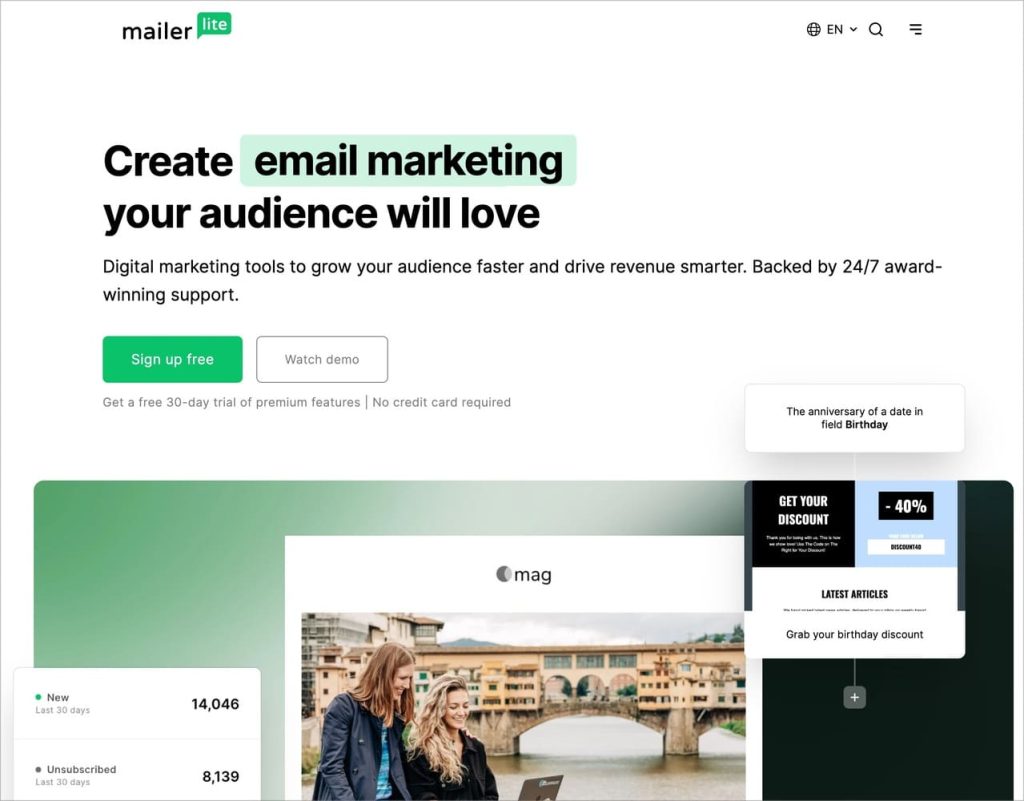
MailerLite is still my number one choice for many independent authors who are starting their mailing list.
The reason?
It’s simple, affordable, and gives authors a clean path from “I need to start an email list” to “I have a working signup form, welcome sequence, and newsletter.”
The free plan is not as generous as it used to be, but MailerLite is still one of the easiest tools for authors to learn.
Here are some of the features you can expect when using MailerLite:
- Free plan with up to 250 active subscribers and 2,500 monthly emails
- Visual automations
- Signup forms, embedded forms, pop-ups, and promotion pop-ups
- Landing pages and simple websites
- Drag-and-drop, Simple, and Custom HTML email editors
- Campaign A/B testing
- Email scheduling
- Templates for emails, forms, and landing pages
- Segmentation with groups and dynamic segments
- A clean, easy-to-use dashboard
- Tools to identify and remove inactive subscribers
You can check out my full MailerLite review here.
MailerLite Summary

I personally use Kit and even I am super excited about MailerLite’s offerings for authors.
I particularly enjoyed using the dashboard, which was super easy to navigate.
As you can see from the image, it’s simple to set up your automation sequence too. So, what are the pros and cons of our winning email service for authors?
Pros
- Easy for beginners to use
- Free plan is still useful for testing the platform
- Paid plans remain affordable compared with many alternatives
- Comfort starts at $12/month
- Power starts at $25/month
- Visual automations are easy to build
- Strong value for authors who want forms, landing pages, email campaigns, and automations in one place
- Groups and dynamic segments make it easy to organize subscribers
Cons
- Free plan is much smaller than it used to be
- Free plan caps you at 250 active subscribers and 2,500 monthly emails
- Free plan limits you to 3 active automations, 5 automation steps, 3 active forms, 1 landing page, and 1 website
- Not list-based, so you’ll need to get comfortable with groups and segments
- Some authors may outgrow the free plan quickly
Pricing: Free Account (250 active subscribers and 2,500 monthly emails) // Comfort Plan — Starts at $12/month // Power Plan — Starts at $25/month
Want to Dive a Bit Deeper? Free MailerLite for Authors Email Course

To help those who choose MailerLite, I created a free MailerLite email course.
While MailerLite does have an extensive list of tutorial videos, many of these go into specialized aspects and areas that don't serve most authors and can overwhelm you.
So, I created this course to help you get exactly what you need and get started in setting up your account the right way.
Final Thoughts
And that’s it!
Kindlepreneur’s top picks for email marketing services.
From my research, MailerLite is still the best email marketing service for many authors who want something simple, affordable, and easy to learn.
Kit is a close second, and it may be the better first choice if the 10,000-subscriber free plan matters more to you than MailerLite’s lower-cost paid plans.
Mailchimp is still a distant third for most indie authors.
But be sure to bookmark this article, though.
I'll likely update it again in the future (possibly replacing Mailchimp with one or many alternatives that are better). Save it so you don't miss out.
Cheers!