It’s a nightmare scenario for any writer…
You pour your heart into a book, only to have someone copy it without permission.
Yes, your copyright is automatically established the moment you put original words on the page. From the first draft forward, your work is legally protected.
But that doesn’t mean registration isn’t important. Officially registering your copyright makes your ownership easier to prove, especially if you ever need to enforce it in court.
(Ebook piracy, unfortunately, is still a real problem.)
That said, there’s a lot of confusion out there. Some authors skip registration entirely. Others go overboard, spending time and money on steps that aren’t necessary.
Let’s clear that up.
In this guide, we’ll walk through how to copyright your book the right way, in plain English and with no extra fluff. It’s all about protecting your work while avoiding costly mistakes.
What is a copyright?
A copyright is the legal right to control how a creative work is used. It gives the copyright holder the exclusive authority to reproduce, publish, perform, display, or distribute their work and to authorize others to do the same.
If you’re the author of an original book, you automatically own the copyright from the moment the work is created and fixed in a tangible form. You don’t need to register it for ownership to exist.
However, there are clear benefits to registering your copyright with the United States Copyright Office. Doing so creates a public record of your ownership and gives you stronger legal protections, including the right to seek statutory damages and attorney’s fees if you ever need to enforce your rights in court.
Copyright laws vary from country to country, but the U.S. maintains copyright agreements with many other nations. In most cases, those countries will honor copyright protections for U.S.-originated works. Still, enforcement can get complicated (especially across borders) so it’s smart to protect your work as thoroughly as possible.
How does copyright protection work?
Copyright is a form of intellectual property law that protects original works — including books, music, films, and other creative content — from being copied, distributed, or used without permission. It gives the creator legal control over how the work is used, shared, or adapted.
There are some exceptions under U.S. law, most notably fair use. Fair use allows limited use of copyrighted material without permission, as long as it's for specific purposes such as:
- Criticism or commentary
- Teaching or education
- Research or scholarship
- News reporting
- Parody or satire
It’s important to remember that copyright protects the expression of an idea, not the idea itself. To qualify for protection, the expression must be captured in a tangible form.
That could be a Word document, a handwritten manuscript, or even an audio recording, as long as it’s something you can save, print, or reproduce.
How much does it cost to copyright a book?
In most cases, registering a copyright for a book costs between $45 and $65, depending on which electronic application you use.
The U.S. Copyright Office offers these options:
- $45 – Single Application: one work, by a single author, same claimant, not made for hire
- $65 – Standard Application: all other electronic filings (for example, multiple authors, works made for hire, or multiple works)
- $125 – Paper filings (Forms PA, SR, TX, VA, SE)
Electronic filing is faster, more affordable, and easier to manage. For most authors registering a single book under their own name, the $45 Single Application is the right choice.
How can I copyright my book for free?
Technically, you already have.
As soon as you write original content and save it in a fixed format (whether on paper or in a digital file), you automatically own the copyright. There’s no cost, no form to fill out, and no need to take any additional steps to own the rights to your work.
However, if you want to officially register your copyright and gain added legal protection, you’ll need to pay the filing fee with the U.S. Copyright Office. For most authors, that’s $45.
You may have heard of something called a “poor man’s copyright.” This was the idea that you could mail a copy of your manuscript to yourself, keep the envelope sealed, and use the postmark as proof of ownership.
It sounds clever, but the U.S. Copyright Office specifically warns that copyright law provides no protection through a “poor man’s copyright.” Mailing a manuscript to yourself is not a substitute for registering it with the Copyright Office.
If you’re serious about protecting your work,register the work through the U.S. Copyright Office.
Is there international copyright protection?
Unfortunately, there is no such thing as international copyright protection that automatically protects an author's work worldwide. Protection against unauthorized use in a specific country depends on the particular laws of said country.
The Berne Convention is an international copyright agreement that now has 182 member countries. One of its core principles is that copyright protection generally cannot depend on formalities such as registration.
The United States is also a member of the Berne Convention, and copyright protection here is automatic. However, U.S. copyright registration still provides important additional benefits, particularly if you ever need to enforce your rights.
This article is mainly focused on the United States. For information about copyrights in other countries, see the links below. These links are provided as further reading, not as legal advice. I am not an expert in international copyright law.
- Canada Intellectual Property Office
- United Kingdom Intellectual Property Office
- European Union
- Australia
- South Africa
Here’s where you can get an ISBN (International Standard Book Number) in different countries:
Check out our article on Self-Publishing Hardcover Books to learn more about ISBNs. (You probably don’t need an ISBN if you’re publishing on Amazon Kindle instead of traditional publishing.)
Benefits to Copyrighting Your Book
There are more benefits to copyrighting your book than you may think.
Of course, you already own the copyright as soon as you write the book. But I’m talking more about the benefits of registering your copyright and making it as official as possible.
Here are 5 important benefits of registering a copyright for your book:
- Create a public record of your copyright claim. Registration places important information about the work, its author, and its copyright claimant in the Copyright Office’s public record.
- Create stronger evidence of validity. If you register before or within five years after first publication, the registration certificate can serve as prima facie evidence of the validity of the copyright and the facts stated in the certificate.
- Be able to sue over infringement of a U.S. work. For U.S. works, registration (or a refusal of registration by the Copyright Office) is generally required before you can file a copyright infringement lawsuit in federal court.
- Preserve eligibility for statutory damages and attorney’s fees. Timing matters here. Registering before infringement begins, or within three months after first publication, can preserve your ability to seek statutory damages and attorney’s fees.
- Create additional enforcement options. A registered copyright can also be recorded with U.S. Customs and Border Protection to help prevent infringing copies from being imported into the United States.
Why Copyright Registration Matters in the Age of AI
The Bartz v. Anthropic lawsuit gave authors a pretty dramatic example of why copyright registration can matter.
Three authors sued Anthropic after the company downloaded millions of books from pirate libraries while building a central library used in developing its Claude AI models.
Judge William Alsup ultimately treated two issues differently. He ruled that Anthropic’s use of the authors’ books for AI training qualified as fair use, but that ruling did not excuse Anthropic’s separate decision to acquire and keep pirated copies of books.
Those piracy claims eventually led to a $1.5 billion settlement covering more than 482,000 books, which received final judicial approval in July 2026.
Copyright registration played an important role in determining which works qualified for the settlement. The settlement allocates roughly $3,000 per covered book, although individual payments can depend on how ownership of a particular book is divided among authors, publishers, and other rightsholders.
About 91% of the covered books were claimed before the March 30, 2026 claim deadline.
It’s a good reminder that automatic copyright protection and copyright registration aren’t the same thing. You own your copyright without registering it, but registration can give you legal remedies and opportunities that you may not otherwise have.
When to Register Your Copyright
You can register a copyright before or after your book is published, but there are good reasons not to put it off.
For most authors, a practical time to register is when the manuscript is substantially finished. Registering an unpublished book can also make the deposit process easier because unpublished works can generally be submitted electronically.
If you publish before registering, pay particular attention to the three-month window after first publication. Registering within that period can preserve your eligibility for statutory damages and attorney’s fees for infringements that begin during those three months.
But don’t wait until you’ve completely registered your copyright to publish the book.
Processing times vary, but the U.S. Copyright Office’s latest figures show an average processing time of about 4.1 months across all claims. Electronic applications that don’t require correspondence averaged about 3.6 months, while applications with questions or problems generally took longer.
But don’t wait until your registration is complete to publish. Your work is protected the moment you write it, and you can start selling right away while the registration is pending.
To register a literary work, visit copyright.gov.
What to Do While Waiting For Your Copyright
While you wait for your copyright (which can sometimes take a while), you can also protect your book via blockchain in less than 60 seconds with Instant IP.
You can get a free Instant IP credit by clicking here.
Examples of Copyright for Books
Let’s look at specific examples of copyright notices for fiction, nonfiction, and memoirs.
You have my full permission to copy and paste any of these templates into your book or eBook and change the details as needed.
Fiction Copyright Example
© 2025 Jane Doe. All rights reserved.
This book is a work of fiction. Any names, characters, companies, organizations, places, events, locales, and incidents are either used in a fictitious manner or are fictional. Any resemblance to actual persons, living or dead, actual companies or organizations, or actual events is purely coincidental.
For rights and permissions, please contact:
Jane Doe
123 Main St.
Anywhere, State 12345
jane.doe@email.com
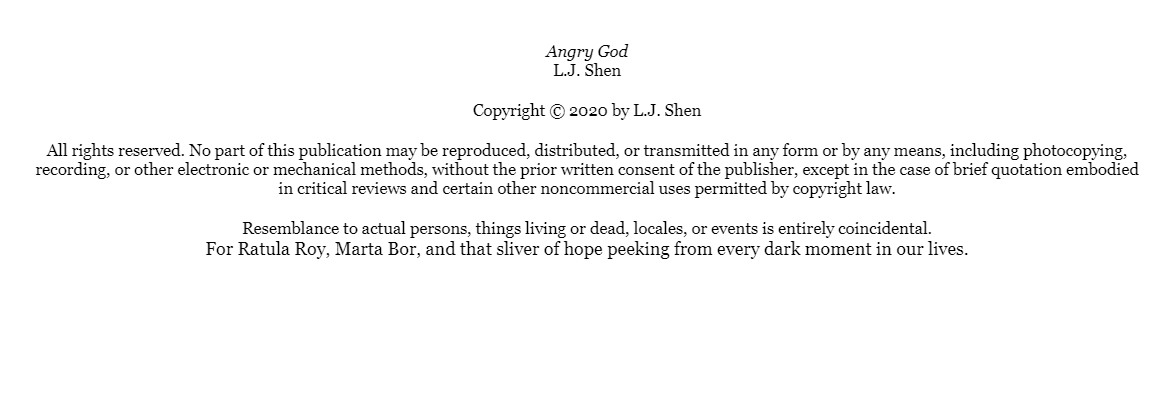
Here's a real-world example from L.J. Shen's Angry God:
Non-Fiction Copyright Example
© 2025 Jane Doe. All rights reserved. No portion of this book may be reproduced in any form without permission from the publisher, except as permitted by U.S. copyright law.
Every effort has been made by the author and publishing house to ensure that the information contained in this book was correct as of press time. The author and publishing house hereby disclaim and do not assume liability for any injury, loss, damage, or disruption caused by errors or omissions, regardless of whether any errors or omissions result from negligence, accident, or any other cause. Readers are encouraged to verify any information contained in this book prior to taking any action on the information.
For rights and permissions, please contact:
Jane Doe
123 Main St.
Anywhere, State 12345
jane.doe@email.com
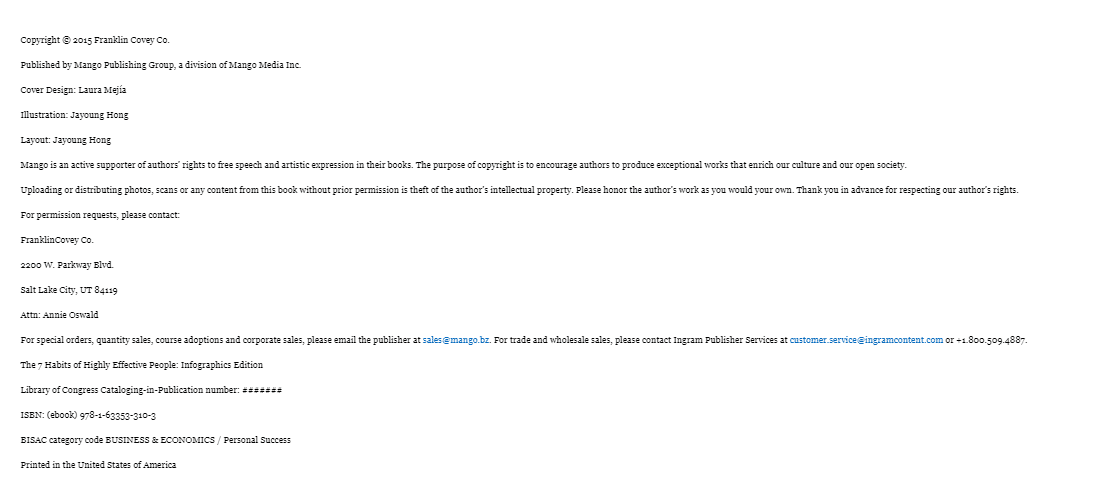
Here's a real-world example:
Memoir Copyright Example
Copyright © 2025 by Jane Doe. All rights reserved.
All rights reserved. No part of this work may be reproduced, stored in a retrieval system or transmitted in any form by any means, electronic, mechanical, photocopying, recording, or otherwise, without written permission of the publisher.
For rights and permissions, please contact:
Jane Doe
123 Main St.
Anywhere, State 12345
jane.doe@email.com
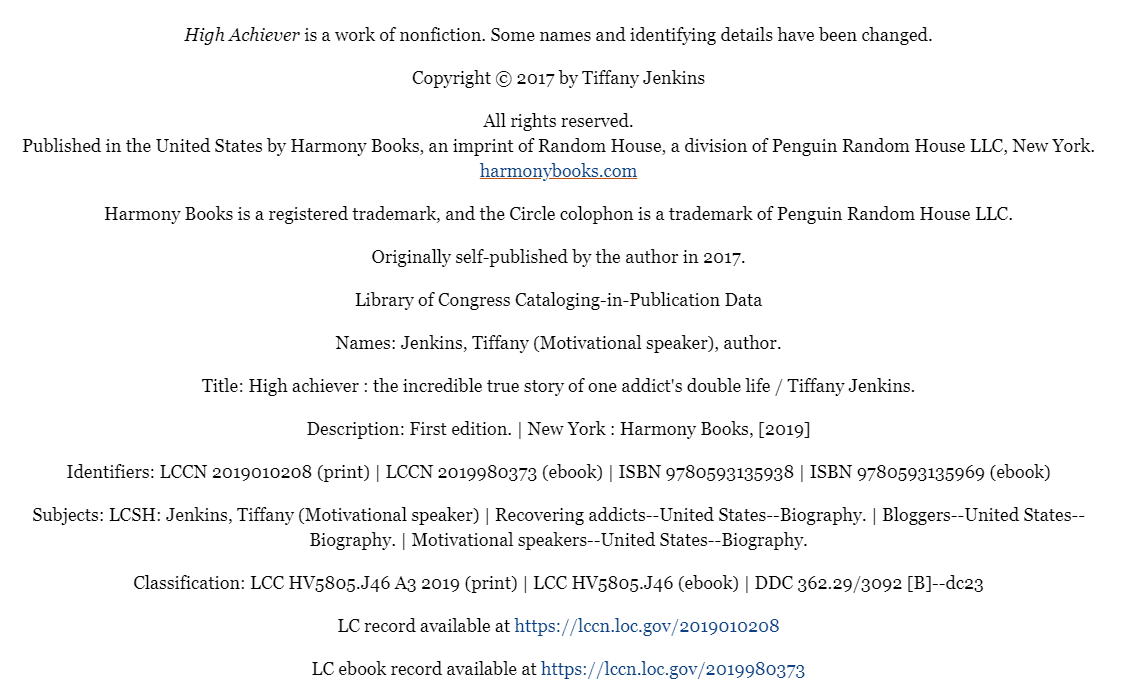
And here's a real-world example from Tiffany Jenkins' High Achiever:
How to Copyright a Book in 4 Steps
You can register a copyright for your book in 4 easy-to-understand steps:
- Create copyright rights
- Register a claim
- Include a copyright notice
- Format your copyright page
It’s worth noting that copyright exists automatically in original material you create and fix in a tangible form. Registration doesn’t create that copyright, but it gives you important additional legal benefits and creates a public record of your claim.
Step 1: Create Copyright Rights
The first step is simple: Create copyright rights. You’ll be glad to know that the copyright rights for your book are automatically created as you write it. That's right, automatically.
When your writing becomes “fixed in a tangible medium,” which is copyright legal jargon meaning written down — on paper, in a computer, on papyrus, or any other fixed form — you, as the author, have created the copyright rights to your work.
It's nice to have something in our legal system that functions automatically and without cost. Enjoy this before moving on to the next steps… which aren’t automatic and have a cost.
Step 2: Register a Claim
Next, you should register a copyright claim with the US Copyright Office. This is the most complicated part of the process, but I’ll simplify it as much as possible.
To register a claim for the copyright for your work:
- Go to the Electronic Copyright Office (or eCO) website.
- Login if you already have an account or register a new account.
- On the left side, under “Register a Work,” click “Standard Application.”
- Click “Start Registration” at the top.
- Follow the registration process for a new claim for a literary work.
- Pay the registration filing fee
- $45 for the Single Application (one work, one author, same claimant, not made for hire)
- $65 for the Standard Application (all other electronic filings)
- $125 for paper filing
- Submit deposit copies of your work either electronically or physically (by mail).
This is where the government returns to standard government ways with a process and a fee, but don't worry: The process is doable, and the price won't break the bank.
Electronic Registration for Copyright
When you register your copyright, you must submit a deposit copy of your book. Whether that copy can be uploaded electronically depends on how the book has been published.
If the book is unpublished or has been published only electronically, you can generally upload the deposit through eCO. If the book has already been published in physical form in the United States, you may instead need to mail the physical “best edition” required by the Library of Congress.
Check out these video tutorials on copyright.gov.
Are you allowed to register your book’s copyright online? You are allowed to register your copyright online, no matter what. You are allowed to upload an electronic copy of your copyrighted work if one or more of the following conditions is met:
- The work is unpublished.
- The work has been published only in electronic format.
- You are using the group registration options for unpublished works, serials, newspapers, newsletters, photographs, short online literary works, contributions to periodicals, or secure test items.
- The eCO agrees to accept electronic copies under a grant of special relief.
How can you digitally submit a copy of your copyrighted work? Here’s how to do it, according to instructions from copyright.gov:
- When payment is complete, you will see the “Payment Successful” screen.
- Click the “Continue” button on the upper right of the “Payment Successful” screen.
- Click the green “Select files to upload” button in the “Deposit Submission” table. A window with fields for browsing and selecting files to be uploaded should appear.
- Select the file(s) to be uploaded for the work being registered. As they are selected, the file names will be displayed under the green “Select Files to upload” button.
- After selecting all files for the work, click the blue “Start Upload” button.
- When all files have been uploaded for the work, click the green “Complete Your Submission” button.
- If you submitted multiple applications together, repeat these steps for each application to upload an electronic copy of the work(s).
Physical Registration for Copyright
You must send in copies of your book to the US Copyright Office if you’re registering your copyright. You may send in physical copies of your book, though this is not recommended.
According to copyright.gov, a physical deposit must be submitted by mail if either of the following is true:
- The book was published in or outside of the US before you submitted your copyright claim, and the book was published in a physical form, such as a paperback book, OR
- The book was published in the US before you submitted your copyright claim, and the book was published both in a physical and an electronic form.
Address copyright registrations for non-play literary works to:
Library of Congress
Copyright Office-TX
101 Independence Avenue, SE
Washington, DC 20559-6000
Step 3: Include a Copyright Notice
Next, you’ll probably want to include a copyright notice in your book.
For works published on or after March 1, 1989, a copyright notice is optional under U.S. law. However, the Copyright Office still recommends using one because it tells readers who claims the copyright and can provide additional legal benefits.
If you use a copyright notice, it generally contains three elements:
- The copyright symbol ©, (c), “Copyright,” or “Copr”
- Year of first publication (and year of newest publication, if different)
- The name of the copyright owner, or another recognizable designation for that owner
Here’s an example of a copyright notice:
© 2025 Jane Doe
According to the Copyright Office, placement of the copyright notice can be in any of the following locations in your book: (Source: U.S. Copyright Office)
- Title page
- Immediately after the title page
- Either side of the front cover
- Either side of the back cover
- The first page of the story proper
- The last page of the story proper
- Anywhere between the title page and the first page of the story proper, if there are no more than 10 pages between the front page and the first page of the main body of the work, and the notice is reproduced prominently and is set apart from the other matter on the page where it appears
- Any page between the last page of the story proper and the back cover, if there are no more than 10 pages between the last page of the main body of the work and the back page, and the notice is reproduced prominently and is set apart from the other matter on the page where it appears
Authors or publishers often dedicate a copyright page solely to display the copyright notice, rights reserved notice, and other information. The copyright page usually appears right after the title page as part of the front matter.
For more info about the front matter and back matter of your book, check out Kindlepreneur’s article on Parts of a Book.
You may want to add information near the copyright notice. For example, you can add your contact information (or publisher’s contact information) so that people seeking rights or permissions to excerpt your work can contact you.
Placing a copyright notice on your book makes any readers aware that copyright rights are claimed for this work. A copyright notice helps prevent a defendant in an infringement action from limiting liability based on an “innocent” infringement defense.
The copyright notice also identifies the year of first publication, which may be used to determine the term of copyright protection for works such as an anonymous work, a pseudonymous work, or a work made for hire.
Learn more about the elements of a copyright page.
Step 4: Format Your Copyright Page
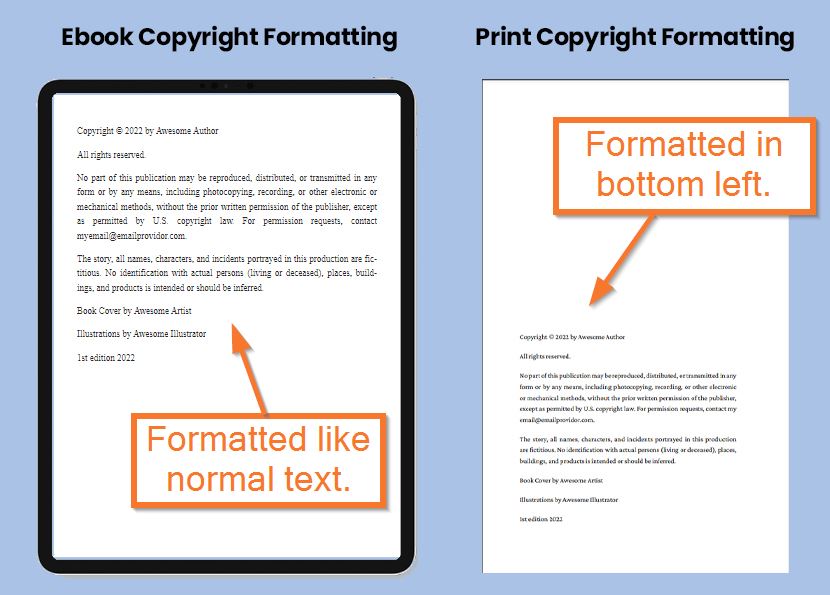
Finally, you can format the copyright page itself. There’s no legally required design or layout for a modern copyright page, but publishers tend to follow a few common conventions. Not all formatting software does this automatically, so be sure to double check (and I'll tell you our formatting software recommendation in a moment).
Common publishing conventions include:
- Come right after the Title page (basically it's the second thing you will ever see in a book).
- The text should be formatted to align on the bottom-left (for print). Some publishers will center it, but it should definitely float at the bottom of the page.
- Have a smaller font. Most copyright pages have a smaller font than the rest of the book.
If you're using Microsoft Word or Google Docs, you will need to format this page manually, which can be a pain. Thankfully, a program like Atticus automatically formats your copyright page for you, so you don't need to worry about it.
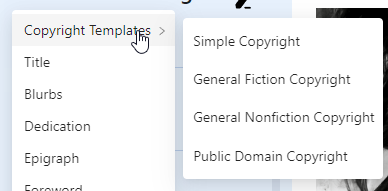
What's more, Atticus has multiple copyright templates built into the program! These templates include:
- A basic template
- A fiction template
- A non-fiction template
- A public domain template
- More coming soon
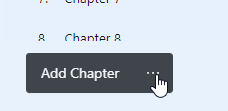
To use these templates, all you have to do is add a new element by going to the three dots next to Add Chapter.
Then scroll up to where it says Copyright Templates and select your desired template.
Once you have the template, you simply fill it in with your specific information and presto! You've got a solid copyright page.
Check out my article on how to create a copyright page.
Copyright Terms You Need to Know
To ensure you can gain the most out of your legitimately copyrighted book and know your rights, take note of these copyright terms:
- Copyright infringement
- Libelous writing
- Plagiarism
- Fair use
- Intellectual property
- Public domain work
Copyright Infringement
The act of using a person's copyrighted work without their permission, thus infringing upon their exclusive rights as the copyright holder.
Libelous Writing
To publish or broadcast, either in print or online, false information about an individual that will negatively impact their reputation. This is usually done by casting the individual in question in a negative light.
Plagiarism
Printing or presenting someone else's work or ideas as your own without their consent, or incorporating their ideas and work as part of your work without informing them or asking for consent, thus infringing upon their rights as the exclusive copyright holder.
Fair Use
Fair use is a legal doctrine that allows certain uses of copyrighted material without the copyright owner’s permission.
Courts consider four factors when determining whether a particular use is fair, including the purpose and character of the use, the nature of the copyrighted work, how much of the work was used, and the effect of the use on the potential market for the original.
Criticism, commentary, news reporting, teaching, scholarship, and research are examples of uses that may qualify for fair use, but no particular type or amount of copying is automatically fair.
For example, a book reviewer may be able to quote portions of your book without permission when those excerpts are reasonably used for criticism or commentary.
Intellectual Property
The intangible creations of human intellect, such as copyrights, patents, and trademarks. Thus, books are classed as intellectual property, whether printed or in eBook format.
Public Domain Work
A Public Domain Work is not protected by copyright, trademark, patent, or intellectual property laws. One can be used without permission or cost.
There are several criteria that a work must fall under to be considered public domain. You can view these criteria here.
Prefer to watch instead? Just hit play below. Otherwise, let’s jump into some frequently asked questions.

FAQs for Book Copyright
Do I have to register my copyright?
No, you don’t have to register your copyright rights for your book. You own the copyright the moment you write the words.
However, registering your copyright earns you several legal benefits. I generally recommend book authors register their copyright.
Do I have to renew my copyright?
No, you don’t have to renew your copyright. For works created on or after January 1, 1978, there is no renewal requirement.
How long does my copyright last?
For most works created on or after January 1, 1978, copyright lasts for the life of the author plus 70 years.
For anonymous works, pseudonymous works, and works made for hire, the term is generally 95 years from first publication or 120 years from creation, whichever expires first.
Older works follow different rules depending on when and how they were published. As of 2026, works published in the United States before January 1, 1931 are generally in the public domain because their copyright terms have expired.
What if I revise my book and release a new edition?
A new edition doesn’t automatically require a new copyright registration.
If you add substantial new copyrightable material, such as new chapters or significant new text, you can register the revised edition as a new derivative work. That registration protects the new material you added; the copyright in the earlier material remains covered separately.
Minor editorial changes, formatting changes, or spelling corrections generally aren’t enough to support a new registration.
What if I use material from another source in my book?
When using content from other sources in your book, this must be indicated in your copyright registration. If the material is from another writer or publisher, you should obtain written permission, which should be stored in case of ownership or permissions queries. If the material is from the public domain, no permission is needed, but it must be noted in the registration.
What if I hire a writer to write some or all of my books?
If you hire a ghostwriter, make sure your written contract clearly addresses copyright ownership.
Some commissioned works can qualify as “works made for hire,” but that term has a specific legal definition and simply calling something work for hire in a contract does not necessarily make it one.
Depending on the circumstances, the agreement may instead need to assign the ghostwriter’s copyright to you or your publishing company. Because the distinction affects ownership and copyright duration, this is an area where it’s worth having the contract reviewed by an attorney.
What if I use a free stock photo or purchase a photo?
When using a free stock photo or purchased image, ensure you understand the licensing requirements. You may need to purchase a standard or extended license for legal use. Some sites require credits for their images. Always verify the image is available for commercial use to avoid legal complications. For more information, refer to our detailed article on stock photos, licensing, and copyright.
What if I quote a famous person? Do I need to add that to my copyright?
Whether you need permission to quote someone depends on what you’re quoting, how much you use, and how you use it.
Some quotations may qualify as fair use, particularly when used for purposes such as criticism or commentary, but there is no automatic rule that makes a quote legal simply because it is short, properly attributed, or used positively.
If you’re using a substantial quotation, making the quote a major part of your book, or compiling a book built around other people’s copyrighted material, consider getting permission or legal advice.
What if I quote a song or its lyrics?
Song lyrics are copyrighted, so the safest approach is to obtain permission from the copyright owner before reproducing them in your book unless your particular use clearly qualifies for an exception such as fair use.
If permission is granted, follow any attribution or credit requirements in the license. Those credits are often placed on the copyright page or in a permissions section, but the required wording and placement depend on the permission you received.
Even a short lyric excerpt can raise copyright issues; there is no automatic “safe” number of words you can quote without permission.
Do I really need to register my copyright if protection is automatic?
Yes! While your book is automatically protected the moment you put it into fixed form, registration gives you legal leverage you can’t get otherwise.
The Bartz v. Anthropic lawsuit is a good example. Anthropic agreed to a $1.5 billion settlement over claims involving the millions of books it acquired from pirate libraries, and final approval was granted in July 2026.
Copyright-registration requirements played an important role in determining which works qualified for that settlement. More broadly, timely registration can determine whether you have access to remedies such as statutory damages and attorney’s fees if your own work is infringed.
Ready to Register Your Book Copyright?
We hope this article will help you register a copyright claim for your fantastic book. We understand how long it takes to write a book, and it would be a shame if you weren’t legally protected should the worst-case scenario happen.
Copyrights and the registration process can seem intimidating at first, but don’t fret.
If you can write a book, you have what it takes to protect that book.
Good luck.