Tropes get blamed for a lot.
If a story feels predictable, people call it tropey. If a character feels familiar, people call it unoriginal. If a plot goes exactly where readers expect it to go, someone will usually point at the trope and say, “There. That’s the problem.”
But tropes aren’t the problem. They're just familiar story patterns: the chosen one, enemies to lovers, the amateur sleuth, the haunted house, the ticking clock, the wise old mentor who clearly knows more than he’s saying and has apparently decided now is not the time to be helpful.
Writers use them because readers recognize them. And readers recognize them because, when they’re handled well, they work.
At Kindlepreneur, we spend a lot of time helping authors think through both sides of the equation: how to write books readers want, and how to position those books so readers can actually find them. Tropes sit right in the middle of that. They shape the story you’re telling, but they can also shape your book description, your keywords, your categories, your ads, and the way readers talk about your book.
So no, you don’t need to avoid tropes.
But you do need to understand what they’re promising your reader, then decide how to use that promise without handing them the exact same story they’ve read twelve times before.
That’s what this field guide is for, so let's break them down by genre.
Romance tropes
Romance goes first because, frankly, romance readers understand tropes better than almost anyone.
A lot of romance readers don’t just search by genre. They search by setup. They know whether they’re in the mood for enemies to lovers, fake dating, forced proximity, second chance romance, marriage of convenience, or the sort of billionaire story where nobody asks enough follow-up questions about where all that money came from.
And because romance is built around a central emotional promise, the trope often tells the reader what flavor of emotional journey they’re going to get.
Enemies to lovers
Characters start out opposed to each other, usually because of a real conflict, a misunderstanding, clashing values, professional rivalry, or one of them being spectacularly bad at first impressions.
This trope works because it creates instant tension. The danger is making the “enemy” part too thin. If they dislike each other for no believable reason, the story can feel manufactured. But when the conflict has real emotional weight, readers get to enjoy the slow turn from irritation to curiosity to attraction to, “Oh no, this is inconvenient.”
Friends to lovers
The characters already care about each other, but the relationship changes as one or both begin seeing the other differently.
This one works best when the friendship feels real before the romance takes over. If they’re only “friends” because the book says so, readers will feel it. Give them history, habits, private jokes, old wounds, and reasons they haven’t crossed that line yet.
Fake relationship
Characters pretend to be together for practical reasons, and then, because fiction is merciful and delightful, pretending becomes a problem.
This trope is popular because it lets the characters perform intimacy before they’re ready to admit they want it. Public affection, shared rooms, nosy relatives, awkward explanations, and “we need to make this look convincing” scenes all become pressure cookers.
Forced proximity
Characters are stuck together in a way that makes avoidance impossible.
Maybe they’re snowed in. Maybe they’re traveling together. Maybe they’re working on the same project. Maybe there is only one bed, because apparently the hotel industry exists solely to move romance plots forward.
The key is that the proximity should do more than put the characters in the same room. It should force honesty, conflict, vulnerability, or temptation.
Second chance romance
Two people had their chance before, lost it, and now have to decide whether the past is something they can overcome.
This trope works because the emotional baggage comes preloaded. The characters already know each other. They already have history. Which means the story can dig into regret, timing, forgiveness, and whether love can survive what happened the first time.
Marriage of convenience
Characters marry or agree to a marriage-like arrangement for reasons other than love.
Money, status, family pressure, inheritance, protection, immigration, political alliance, social convenience, there are plenty of ways to make this work. The fun comes from watching the practical arrangement become emotionally inconvenient.
Forbidden love
Two characters want each other, but something makes the relationship difficult or dangerous.
Family expectations, class differences, professional boundaries, rival groups, social rules, and personal loyalties can all make this trope work. The important thing is that the barrier should feel meaningful. If the only obstacle is “we probably shouldn’t,” readers may start yelling at the page.
Love triangle
One character is caught between two possible romantic partners.
This trope can create strong tension, but it can also wear readers out if the choice feels artificial. The best love triangles are not just about which person is hotter, nicer, richer, or more likely to own a dramatic coat. They represent different futures for the protagonist.
Fated mates
Common in paranormal romance and romantasy, this trope gives two characters a supernatural bond or destined connection.
Readers who love this trope usually want intensity. They want inevitability. They want the feeling that these two characters are being pulled together by something bigger than ordinary attraction. But the characters still need agency, because “fate made me do it” can get old very quickly.
Grumpy/sunshine
One character is closed off, cynical, cold, or emotionally allergic to joy. The other is warmer, more open, and generally less likely to hiss at daylight.
This works when both characters have depth. The grumpy one should not just be rude with cheekbones, and the sunshine one should not be a motivational poster with hair. Give them reasons for who they are, and the contrast can do a lot of emotional work.
Fantasy tropes
Fantasy readers also know their tropes well, even when they don’t call them tropes.
They recognize quests, chosen ones, magical schools, dark lords, ancient artifacts, secret heirs, taverns, prophecies, forbidden magic, and mentors who clearly know more than they’re saying, which is helpful for the plot and deeply irritating if you think about it too long.
Fantasy tropes work because they give readers a familiar doorway into an unfamiliar world.
The chosen one
A character is singled out by prophecy, destiny, bloodline, magic, or some ancient force that apparently has no respect for personal schedules.
This trope can still work, but it needs care. Readers have seen it a lot. The character’s choices still need to matter, and the story should not rely entirely on destiny to make the protagonist important.
The reluctant hero
The protagonist does not want the adventure, the crown, the mission, the power, the responsibility, or any of the nonsense that has just landed on their doorstep.
This is popular because reluctance makes the hero feel human. Most of us would not immediately volunteer to fight an immortal evil in a cursed forest with limited snacks. The key is making their eventual commitment feel earned.
The quest
Characters must travel to find, destroy, retrieve, deliver, or protect something important.
A quest gives fantasy a natural structure, but the journey needs more than distance. Every stop should change the situation, deepen the world, test the characters, or reveal something that matters later.
The mentor
An older, wiser, or more experienced figure guides the protagonist.
The mentor can teach, protect, challenge, or withhold just enough information to make readers suspicious. This trope becomes tired when the mentor only exists to explain the plot and then disappear at the convenient emotional moment. Give them their own agenda, regrets, blind spots, or limits.
Magical school
A school, academy, training ground, or institution teaches characters how to use magic, power, weapons, or supernatural abilities.
Readers love this trope because it combines discovery with structure. Classes, rival students, rules, forbidden areas, tests, and secret histories all give the story built-in momentum.
Forbidden magic
Certain magic is banned, feared, hidden, or considered too dangerous to use.
This trope creates instant tension because the character has to decide whether the power is worth the cost. And the cost needs to matter. If forbidden magic is just regular magic with better branding, the danger falls flat.
The lost heir
A character discovers they have royal, magical, divine, or otherwise important lineage.
This can be great fun, but it can also feel convenient if handled lazily. The stronger version usually asks what the lineage costs, not just what it gives.
Ancient artifacts
A ring, sword, book, crown, stone, amulet, or other powerful object drives the plot.
The artifact should do more than glow ominously and make everyone nervous. It should create choices, temptations, risks, or consequences that reveal character.
Found family
A group of characters who may not share blood become the emotional center of the story.
This trope works especially well in fantasy because the journey or conflict often forces characters into deep reliance on each other. Readers love watching a group of damaged, lonely, stubborn people slowly become the family none of them were looking for.
Good versus evil
A clear moral conflict drives the story.
This can feel classic and satisfying, but it can also become flat if the evil side is evil because the story needs someone to wear black and threaten villages. Even in a good-versus-evil framework, the conflict is usually stronger when characters have understandable motives, competing loyalties, or meaningful temptations.
Mystery tropes
Mystery readers want a puzzle.
They want clues. They want suspects. They want misdirection. They want to feel smart, then briefly foolish, then smart again when they realize the author was playing fair but not making it easy.
And because mystery is so structure-heavy, tropes are part of the experience.
The amateur sleuth
An ordinary person investigates a crime, usually because the crime lands uncomfortably close to their own life.
This trope is especially common in cozy mysteries, where the sleuth may be a baker, librarian, bookstore owner, innkeeper, teacher, or someone else whose job should not statistically involve this many dead bodies.
The grizzled detective
A professional investigator with a difficult past takes on the case.
This can be a police detective, private investigator, retired agent, or someone pulled back into the work they thought they had left behind. The trick is not making the haunted past feel like it came shrink-wrapped with the genre.
The red herring
A clue, suspect, or situation points readers in the wrong direction.
Red herrings are essential, but they need to be fair. Readers should look back and think, “I see why I believed that,” not “Oh, so the book just lied to me for 300 pages. Wonderful.”
The unlikable victim
The person who dies had plenty of enemies.
This gives you a large suspect pool and immediate motive, which is why it shows up so often. It also lets the story explore a community, family, workplace, or social circle full of people pretending they are much more shocked than they are.
The closed circle
A limited group of suspects is trapped or gathered in one place.
A mansion, train, island, hotel, cruise ship, office retreat, or small village can all work. The fun comes from containment. The killer is probably nearby, which makes every conversation feel a little less casual.
The secret from the past
An old crime, betrayal, relationship, or hidden truth drives the current mystery.
This trope works because it lets the present investigation peel back older layers. The danger is making the past more interesting than the present, so both timelines or revelations need to matter.
The dramatic reveal
The truth comes out in a final confrontation, confession, or explanation.
Mystery readers usually expect some kind of reveal, but they also want the clues to have been there. The ending should surprise them without making them feel cheated.
Thriller and suspense tropes
Thrillers are built around pressure.
Something bad is happening, about to happen, or already happened and is getting worse by the page. The reader is not just asking, “Who did it?” They’re asking, “How bad is this going to get, and can anyone stop it in time?”
The ticking clock
The protagonist has limited time to stop something terrible.
A bomb, deadline, kidnapping, disease, ransom, political plot, cyberattack, or disappearing witness can all create urgency. Just make sure the clock changes the character’s choices. If everyone behaves like they have unlimited time, the clock is decoration.
The framed protagonist
The main character is accused of a crime or conspiracy they did not commit.
This trope works because it strips away safety. The protagonist has to solve the problem while being hunted, doubted, or cut off from the systems that would normally help them.
The unreliable narrator
The narrator withholds, misunderstands, misremembers, or distorts the truth.
This can be powerful in psychological suspense, but it needs control. Readers are willing to be misled. They are less willing to be randomly tricked because the narrator suddenly forgot to mention the one thing that explains the entire book.
The conspiracy
The protagonist uncovers a hidden network of people, institutions, or forces working behind the scenes.
The appeal is scale. The danger is losing the personal stakes. A huge conspiracy only matters if we care about the person trapped inside it.
The stalker
Someone is watching, following, threatening, or manipulating the protagonist.
This trope can be terrifying because it invades ordinary life. Home, work, phone, email, family, routines, everything becomes vulnerable.
The twist ending
The story’s final turn changes how readers understand what came before.
A good twist feels surprising and inevitable at the same time. Which is annoying advice, I know, but it’s true. If the twist comes out of nowhere, readers feel tricked. If they see it coming from chapter three, they feel bored.
Science fiction tropes
Science fiction usually starts with a question.
What if technology went too far? What if society changed in this one specific way? What if humanity met something beyond itself? What if people could live forever, travel through time, build conscious machines, or ruin the universe with the confidence of a committee?
The best sci-fi tropes are not just gadgets. They create consequences.
Artificial intelligence
A machine, system, robot, or digital mind develops intelligence, autonomy, or influence.
This trope can explore control, consciousness, labor, ethics, power, and what counts as human. And yes, given the current world, readers bring a lot of opinions to this one.
Dystopian society
Here, a future or alternate society is built around oppression, surveillance, scarcity, control, or inequality.
This trope works when the world feels like a distorted version of something we already recognize. The stronger the “that could happen” feeling, the more unsettling it becomes.
Time travel
Characters move through time and create, prevent, or accidentally worsen events.
Time travel is fun because it creates instant complications. It also creates plot holes if you are not careful, because readers will absolutely ask why the character didn’t just go back three days earlier and solve the problem with a sandwich and a Post-it note.
First contact
Humanity encounters alien life for the first time.
This can be hopeful, terrifying, political, philosophical, or all of the above. The story usually becomes less about aliens in general and more about what contact reveals about humanity.
Space travel
Characters travel between planets, ships, colonies, stations, or galaxies.
Space gives you scale, danger, isolation, and plenty of ways for machinery to fail at the worst possible time. It can support adventure, horror, politics, romance, survival, or war.
Clones and engineered humans
Technology changes reproduction, identity, bodies, or the definition of personhood.
This trope works well when it asks uncomfortable questions. Who owns a body? What makes someone real? What happens when people are designed for a purpose they did not choose?
Post-apocalyptic survival
Civilization has collapsed, and characters are trying to survive what remains.
The appeal here is not just the wreckage. It’s watching people rebuild rules, communities, morality, and hope when the old world is gone.
Horror tropes
Horror readers know the patterns.
They know the basement is a bad idea. They know the antique doll should be left wherever it was found. They know the cheerful little town with one yearly festival is probably hiding something that requires candles and chanting.
And they keep reading anyway, because dread is part of the fun.
The haunted house
A house, building, hotel, mansion, or apartment carries something terrible inside it.
This trope works because homes are supposed to be safe. Once the safe place becomes the dangerous place, the character has nowhere easy to retreat.
The cursed object
An item brings evil, death, obsession, misfortune, or supernatural consequences.
The object can be a book, doll, box, necklace, painting, mirror, or anything else your characters should absolutely have left alone. The key is that possession changes the situation.
The monster
Something inhuman, partially human, formerly human, or deeply unpleasant is hunting people.
The monster can be literal or symbolic, but horror usually works best when the creature reveals something about fear, guilt, hunger, grief, power, or survival.
The isolated setting
Characters are trapped somewhere help cannot easily reach them.
A cabin, island, ship, storm, remote village, research station, or broken-down car can all create isolation. And isolation is useful because it removes easy solutions.
The traumatic past
Something buried in the past returns.
This can be personal trauma, family history, a town secret, an old crime, or a mistake the protagonist never really escaped. Horror loves the past because nothing says “healthy emotional processing” like a ghost in the hallway.
The final survivor
One character makes it to the end after everyone else is gone.
This trope can be satisfying, bleak, or subverted, depending on the story. It usually works best when survival costs something.
The evil next door
The monster is not a creature. It’s a person.
Neighbors, spouses, parents, children, teachers, doctors, religious leaders, and trusted community members can all become terrifying when the horror comes from ordinary life wearing a normal face.
Action and adventure tropes
Action and adventure stories are about momentum.
The character wants something, someone else wants it too, time is running out, danger keeps escalating, and nobody gets enough sleep.
The treasure hunt
Characters search for a valuable, hidden, lost, cursed, or historically important object.
Treasure hunts work because they give the story a clear external goal. The best ones also make the hunt reveal character, history, betrayal, or moral cost.
The MacGuffin
An object drives the plot because everyone wants it.
The MacGuffin can be a briefcase, weapon, map, relic, formula, file, or artifact. Readers may not care deeply about the object itself, but they care about what people will do to get it.
The ticking clock
The hero has limited time to stop the bad thing, find the thing, save the person, or survive the mission.
Adventure stories often need this because forward motion is the whole point. Give the character too much time, and suddenly everyone starts making sensible decisions. Terrible for pacing.
The double-cross
A trusted ally betrays the hero.
This works when the trust felt real before it broke. If the traitor was obviously suspicious from the moment they appeared, readers will spend half the book wondering why the protagonist is the only person who didn’t notice.
The impossible escape
The hero is trapped, captured, surrounded, or seemingly doomed, then finds a way out.
Readers like watching competent characters solve terrible problems under pressure. Just make sure the escape is clever enough to satisfy, not convenient enough to annoy.
The larger-than-life threat
The stakes involve a city, country, world, ancient order, or very large number of innocent people.
Big stakes can work, but they often need a personal anchor. Saving the world is fine. Saving the world and the one person the protagonist failed before is usually better.
Young adult tropes
YA is less a genre than a category, which means YA tropes can show up in fantasy, romance, dystopian fiction, contemporary fiction, mystery, horror, and pretty much everything else.
But the emotional center is usually the same: a young character figuring out who they are, what they believe, and where they belong.
The outsider
The protagonist feels different from the people around them.
This works because adolescence often feels like being the only person who didn’t get the instruction manual. The outsider trope can explore identity, belonging, class, power, family, and self-acceptance.
First love
A character experiences romantic love for the first time.
First love works in YA because everything feels bigger when it’s happening for the first time. The joy, confusion, embarrassment, intensity, and heartbreak all hit hard.
Found family
The protagonist builds a chosen support system outside their biological family.
This is common in YA because many young characters are trying to figure out who they trust apart from the adults and systems around them.
Absent or unreliable adults
Parents, teachers, leaders, or authority figures are missing, unhelpful, corrupt, distracted, or actively dangerous.
This trope lets young characters drive the story. If competent adults solve everything, the teen protagonist becomes a passenger, and nobody wants that.
Secret powers or hidden identity
The protagonist discovers something unusual about themselves.
This can be magical, royal, supernatural, genetic, political, or personal. The hidden truth gives the character an external problem that mirrors an internal one: “Who am I really?”
The rebellion
A young protagonist resists an unfair system.
This can show up in dystopian YA, fantasy, school stories, or contemporary fiction. The appeal comes from watching someone with limited power realize they still have choices.
Children’s book tropes
Children’s books often look simple from the outside, but good ones are usually very carefully built.
The tropes tend to be clear because young readers need stories they can follow emotionally. That does not mean the story has to be shallow. It just means the pattern has to be strong enough to carry the lesson, humor, adventure, or emotional turn.
Talking animals
Animals speak, think, solve problems, or behave like people.
This trope lets children engage with big ideas through characters that feel safe, funny, or magical. A talking bear can sometimes say what a human adult character cannot.
Learning to share
A character struggles with sharing, generosity, fairness, or selfishness.
This is common because it maps directly to the emotional world of young readers. The story turns a daily problem into something memorable.
The power of friendship
Characters succeed because they help each other.
Simple, yes, but also effective. Children’s stories often use friendship to teach cooperation, empathy, loyalty, and kindness.
Facing a fear
A child character confronts something scary or unfamiliar.
The fear can be the dark, school, a new sibling, a move, a mistake, or a monster under the bed that may or may not need better boundaries.
Trying three times
The protagonist fails, fails again, then succeeds.
This pattern gives children repetition, suspense, and a satisfying payoff. It also teaches perseverance without sounding like a poster in a school hallway.
The big imagination
A child’s imagination transforms ordinary life.
This trope works because children naturally blur the line between real and imagined play. It can make a small story feel grand without needing a complicated plot.
Historical fiction tropes
Historical fiction is shaped by time and place.
The setting is not just wallpaper. It changes what characters can do, what they believe, what they fear, who has power, and what choices are available to them.
Real events, fictional characters
A fictional protagonist lives through real historical events.
This gives readers the anchor of history while letting the author create a personal story inside it. The trick is keeping the character from feeling like they’re just wandering through a museum exhibit.
Historical figures as characters
Real people appear in the story.
This can add authenticity, but it can also backfire if the historical figure takes over or feels like a cameo inserted so the author can point and say, “Look who I researched.”
Dual timeline
One storyline takes place in the past and another in the present.
This works well when the timelines speak to each other. The modern story should not feel like it exists only to frame the more interesting historical one.
War and survival
Characters live through war, occupation, displacement, resistance, or recovery.
War provides high stakes, but the strongest stories often focus on the intimate costs: family, identity, moral compromise, grief, loyalty, and what survival does to a person.
Social constraints
Characters are boxed in by the rules of their era.
Class, gender, religion, race, law, family duty, and reputation can all create pressure. Historical fiction often works best when the conflict could not exist in quite the same way outside that time period.
Contemporary fiction tropes
Contemporary fiction can be harder to define because the stories are usually grounded in ordinary life.
The tropes tend to be less flashy. There may not be a dragon, a murder, a prophecy, or a cursed necklace making everyone’s week worse. Instead, the patterns often come from relationships, identity, family, loss, ambition, and personal change.
Family drama
A family conflict drives the story.
Inheritance, divorce, secrets, caregiving, estrangement, sibling rivalry, and old resentment all work here because families are basically unlimited renewable energy for fiction.
Coming of age
A character grows into a new understanding of themselves or the world.
This can happen to young characters, but adults come of age too. People do not magically become emotionally organized at 18, as anyone who has met people can confirm.
Return to hometown
A character comes back to the place they left.
This trope works because the setting carries emotional baggage. Old relationships, unfinished business, family expectations, and former versions of the protagonist all come waiting at the door.
A death in the family
A death forces characters to face grief, conflict, inheritance, secrets, or change.
This trope can be quiet, but it creates natural pressure because death rearranges relationships whether people are ready or not.
Reinvention
A character tries to change their life.
New career, new city, new relationship, new identity, new beginning. The story usually comes from the gap between who the character wants to become and what they have not dealt with yet.
Literary fiction tropes
Literary fiction is often more focused on voice, character, theme, and internal conflict than on a tightly engineered plot.
That does not mean literary fiction has no tropes. It just means the tropes usually show up in quieter ways.
The dysfunctional family
A family’s history, resentments, silences, or patterns shape the story.
This is common because family gives literary fiction a natural place to explore memory, identity, inheritance, regret, and all the things people say at dinner when they should have stopped talking ten minutes ago.
The small town
A contained community becomes the stage for the story.
Small towns are useful because everyone knows each other, or thinks they do. Secrets travel fast, reputations matter, and the setting can feel almost like a character.
The unresolved ending
The story ends without tying everything neatly together.
This can frustrate some readers, but in literary fiction it can also feel honest. Life does not always provide a final chapter where everyone explains their symbolism.
Childhood memories
The story looks back at childhood to understand the present.
Memory can be unreliable, selective, painful, or strangely ordinary. Literary fiction often uses childhood not as backstory trivia, but as the emotional source code for the adult character.
The interior journey
The biggest change happens inside the character.
There may be external events, but the real movement is emotional, psychological, or moral. The risk, of course, is writing a story where nothing seems to happen. The solution is not necessarily more plot. It is sharper pressure.
How tropes affect book sales
One thing that surprises a lot of authors is that tropes aren’t just part of the writing process. They play a big role in how readers find books in the first place.
When readers go looking for something new to read, they don’t always search by title or even by genre. A lot of the time, they’re searching for a specific kind of story they’re in the mood for.
You’ll see readers type things into Amazon like “enemies to lovers,” “found family,” or “twist ending,” because those phrases describe the kind of experience they want. And if your book lines up with one of those expectations, it has a much better chance of showing up in search results and getting clicked on.
Because of that, it’s often worth doing a little research before you get too far into writing or publishing.
Some tropes have large, active audiences behind them, while others are much more niche. And when you understand what readers are already searching for, it can help guide decisions around your plot, your positioning, your keywords, and even your cover.
For example, if you’re writing fantasy and you know your story includes magical creatures, it’s worth digging a little deeper than just using a broad phrase like that. When you look at the actual data, you’ll often find that certain creatures consistently perform better than others, whether that’s dragons, fae, or something more specific.
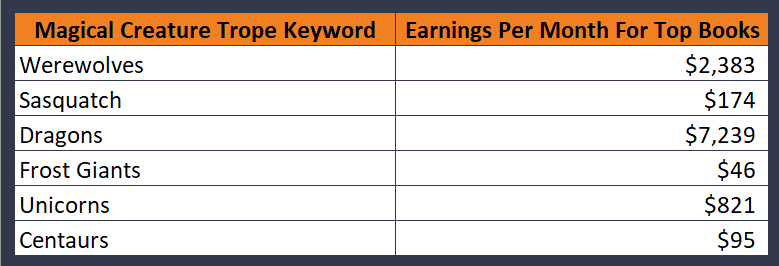
Data provided by Publisher Rocket
The same idea shows up clearly in romance.
If you look at trope-based keywords using a tool like Publisher Rocket, you’ll often see that some tropes are significantly more popular or competitive than others at any given time. One month, something like “marriage of convenience” might be performing better than “friends to lovers,” and that kind of insight can be useful when you’re deciding how to position your book.
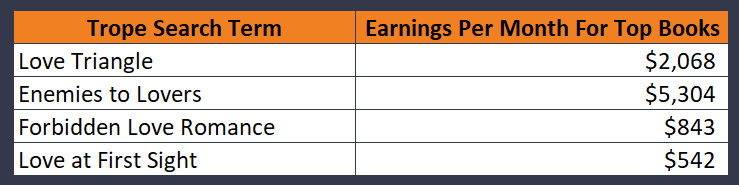
Data provided by Publisher Rocket
None of this means you should chase trends or force a trope into your story just because it’s popular. But it does mean that understanding how readers search can give you an advantage when it comes to discoverability.
Because at the end of the day, tropes don’t just shape the story you’re telling. They also shape how readers find that story in the first place.
A few final thoughts on book tropes
The more you read and write, the more you start seeing tropes everywhere. At first, this can feel a little discouraging, like you’ve accidentally discovered that every story is just wearing a slightly different hat.
But that’s not really the problem.
Stories have always shared patterns. Readers expect that. They like that. A romance reader who loves fake relationships is not furious when the book contains, you know, a fake relationship. A fantasy reader who picks up a magical school story is not offended when there are classes, rivalries, suspicious teachers, and at least one rule that exists mainly so someone can break it.
The real issue is whether the trope feels alive inside your story.
If it gives the reader something familiar to hold onto, great. If it helps you understand what kind of promise your book is making, even better. And if it gives readers another way to find and talk about your book, that’s worth paying attention to.