Home

Learn

Book Marketing

How to Change Your Kindle Keywords and Why You Should

by

Dave Chesson

Updated on Sep 30, 2025

Home

Learn

Book Marketing

How to Change Your Kindle Keywords and Why You Should

Did you know you can change your book’s keywords anytime you want?

In fact, it usually takes Amazon just 24 hours to reflect changes you make, and with the right keyword strategy, this can revive a book that hasn’t been getting consistent sales.

But, in order to do this effectively, you need to have a reliable process. There is actually a best-practice for how and when to change your book’s keywords. And if you don't follow it, you might accidentally hurt your book sales.

Bonus: Want to learn how to rank your Kindle book #1 on Amazon with our collection of time-tested tips and tricks? Download my free ebook now!
So, in this article, you will learn:
  1. What happens when you change keywords
  2. My process for how to change your keywords effectively
  3. Step-by-step instructions for actually changing your keywords

However, before we get into changing keywords, I think it’s really important that we first talk about how keywords work and how Amazon uses them. This, in turn, will help you to fully understand why this keyword changing strategy was built.

With that, let’s get to it!

What Happens When You Select Keywords

So, first things first, let’s discuss what happens when you select keywords for your book.

When you fill in your 7 kindle keyword boxes, you tell Amazon what words or phrases you want your book to show up for.

7 kindle keywords in Amazon KDP

Based on the experiment we performed in this article, using hundreds of books, we discovered the following:

  • Amazon uses all the different combinations of words in each box to create more keyword phrases for your book to show up for.
  • However, the more specific your actual phrase, normally the higher the initial rank you get.
  • Amazon also automatically creates pluralizations of the words and phrases in each box.
  • Words in the title and subtitle carry more weight than in the keyword box.

Based on this, I was able to create a video that shows you how to get the best out of those 7 KDP boxes. Using the information above and some more about category systems and such, if you follow this process, you can definitely show up for more keywords and rank better.

YouTube video

So, as an example, you may have entered a total of 17 words in these boxes. But using the different combinations and pluralizations, Amazon may index you for 210 phrases and words initially, and at different rankings for each.

So, if you follow the steps in the video, you will really set up your book for the best beginning.

But this is just the start. You see, when you publish your book, Amazon will start you with those 210 phrases (just keeping with the example above) and then will test your book over time to see if your book deserves to show up for those keyword phrases.

They want to know if your book converts well enough for those phrases because, after all, Amazon is all about those sales, right? If your book converts well, then Amazon will not only rank your book higher for those phrases, they will also start indexing your book for even more phrases and words. They will keep doing this until they finally see a point where there is diminishing returns and the book will sit until it otherwise proves different. Basically, they reward your book by showing it in more keywords.

Here is an example of what that looks like when your book converts well for those keywords:

keyword ranking conversions

However, if your book shows that it doesn’t convert well for those keywords and shoppers keep passing it by, your book’s rankings will decrease.

keyword rankings when conversions are poor

So, what makes a book fail at converting for keywords? Well, here are a few things:

  • Poor cover
  • Poorly written book description
  • Cover + title + subtitle doesn’t tell the shopper enough about the book
  • Poor reviews
  • Ranking for keywords that are not a good representation of your book
  • Choosing broad keywords that don’t truly fit

So, what does this mean for you?

If you select your keywords, and your book does well with them, Amazon will rank you for more and will help show up more often. If your book doesn’t do well, then your book’s ranking for those keywords will drop and ultimately, your book will disappear from those searches on Amazon.

So, what can we learn from this for changing our keywords?

So, When Should You Change Your Keywords?

If you haven’t made any sales or KU page reads, then you should change them and see if that can help get you back in the spotlight. I’d also recommend looking at the bullet points above and asking yourself why your original strategy didn't work. Was it because you used the wrong keywords or phrases that didn’t fit or get traffic? Was it because your book needs improvements? Diagnosing the problem can definitely help.

However, if you have a book that is doing well and getting organic sales, you still should think about changing them. Out of the 7 boxes, it might be one or two of them that are actually helping you the most while others are underperforming. Therefore, using the strategy I detail below, you can improve your optimization and grow your sales.

What Strategy Should You Use to Change?

Because, like I said above, there may be a keyword phrase or keyword box that is actually helping you beyond its original meaning.

That keyword phrase may have set Amazon on a path to show your book for other phrases that have been a major driving force for your organic sales.

Therefore, my general rule of thumb for changing keywords is to not change them all at the same time, but instead change only a couple at a time.

Here’s what you should do:

  1. Change your keywords in two of the boxes at a time.
  2. Save the two original keywords that were in the box in a separate sheet in case you need them later.
  3. Wait 5-7 days after changing your keywords to see whether you have an uptick in sales or not.
  4. If your sales go down, then put the original two back in and mark that those had an important effect. Then move on to another two boxes.
  5. If your sales go up, then mark those as beneficial keywords, and move on to another two boxes.
  6. Check to ensure you're in the same categories – this is because your keywords can affect which categories Amazon has you even (even if you selected certain ones in KDP). To check, you can use a tool like this one or if you have Publisher Rocket, you can use that.
For Books in a Series: Steps 4 & 5 are really important. Once you know which keyword phrases are the best for your book, you can use those again for the next book in a series. My recommendation is to use 3 to 4 of your best-proven keyword boxes on the other books in the series, but make the remaining boxes unique to that particular book. This is the best way to handle keywords in a series.

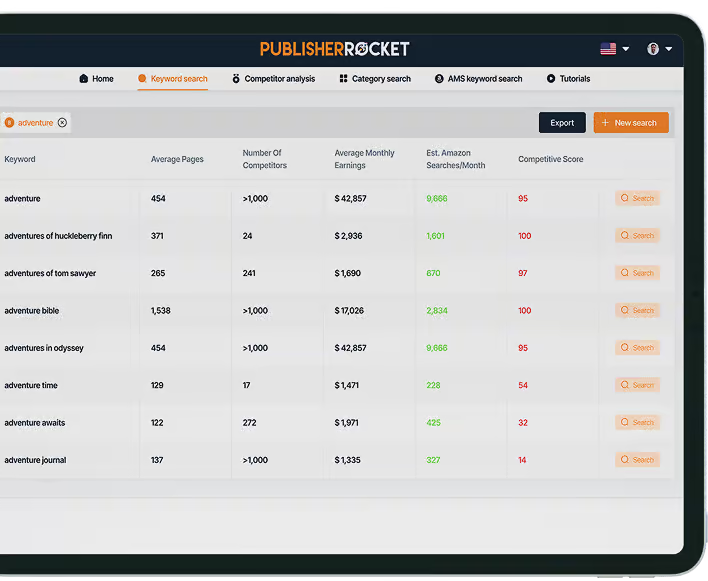
Also, when picking keywords, you should try using Rocket's new Category Keyword feature. Our system looks at some of the top category specific keywords books have used, and will show you. All you need to do is find your category or a potential category in the category feature, then click the “Keywords” button.

See Rocket in Action!

You'll see a list of great keywords to check out – these are not only good keywords, but these keywords have been seen as strong indicators to Amazon that you should be in that category.

But what happens now? What if you don’t see any sustained sales? Well, that's where my secret strategy comes in.

A Case Study: T.S. Paul Changing Keywords

A lot of times when you change your keywords you will see a bump in sales. The bump in sales happens because there’s some new life Amazon picks up on. They reindex you and they kind of give you a little bit more love just to see if you should be higher in the rankings.

So a lot of authors will change their keywords, and they’ll see a spike–a couple book sales or even 50+ depending on where you are in your author career. This spike is great, but you want to give it enough time to see where it actually settles. Because Amazon might have put you up there near the top but you only sold five books and the book below you was selling seven, so you’re naturally going to fall to where you should be.

So you want to give it enough time to see where you end up.

A great example of using this method well is how author T.S. Paul used it with his science-fiction books. As one of the first adopters of Publisher Rocket, he changed out his keywords and saw a massive bump in sales. In fact, it was a game-changer for him–and that’s part of the reason I had him on the podcast.

Take a listen below.

                                          

So you see, with the right keywords and strategy, you might end up selling more books and even becoming a bestseller.

Step-By-Step: How to Change Your Keywords

In case you don’t know how you can change your keywords, here is a step-by-step process for you:

Kindle keywords are the seven keywords you choose when you first upload your book in your KDP dashboard. You’ll find seven boxes below the “Publishing Rights” section as follows:

7 kindle keywords

It says optional in brackets next to “Your Keywords,” but if you want your books to be indexed and to be found by potential readers, you absolutely must fill in this section!

Here’s a step-by-step guide on changing your keywords:

  1. Navigate to your dashboard here.
  2. Enter your login in details and ensure you are on the Bookshelf tab.Amazon bookshelf tab
  1. Hover over the three dots next to your book and hit “Edit eBook details”.editing your keywords
  2. Scroll down to the seven kindle keyword boxes and change your keywords. 
  3. Hit “Save and Continue” and then “Publish” once you reach your pricing page. 

As I mentioned before, it will take about 24 hours for Amazon to change your keywords. After that, you’ll start seeing differences in how many books you sell, either more or less. Obviously, you’re aiming for more than less, right? And as I've mentioned, if the results aren't positive, you can change your keywords back to what they were before or try different keyword combinations.

My Recommendation for Changing Your Keywords

Changing your keywords is a process that you can do whenever you want, and if done right, it can either spark new life into your book’s sales or improve its already solid stance.

It can also provide you with valuable information on which keyword phrases helped to move the needle. This can improve your next book’s sales, whether in a series or just in the same genre or niche.

So, if you do decide to change your keywords, make sure to use the above process to systematically track and understand which keyword phrases move the needle for your book sales.

Cheers!
Share on:

[social_warfare ]

Share on:

Founder of Kindlepreneur and Creator of Publisher Rocket

Dave Chesson

Founder of Kindlepreneur and Creator of Publisher Rocket

Dave Chesson

Founder of Kindlepreneur and Creator of Publisher Rocket

Dave Chesson

Founder of Kindlepreneur and Creator of Publisher Rocket

Free Suite of Tools for Writers

Join 325k+ Who've Grabbed Our FREE Tools for Writers

We've built a collection of amazing resources. And they're yours (for free).

Download Now For Free

button-arrow

Share:

[social_warfare ]

Table of Contents

Authorpreneur Academy

Related Articles

Here are a few other Kindlepreneur articles we think you'll like.

free download

Amazon Kindle Rankings eBook

Learn how to rank your Kindle book #1 on Amazon with our collection of time tested tips and tricks.

Sell more books on Amazon

Publisher Rocket is our premium tool for finding keywords and categories to help you hit best-seller status faster and earn more money in book sales.

44 thoughts on “How to Change Your Kindle Keywords and Why You Should”

  1. Hello,
    I’m running an “Amazon marketing campaign”, and I was wondering what is a good “sells / clicks” rate. Currently, it is about 7%. Is this a good number ? Should I try to improve my book description ?

  2. Hi Dave,

    I run ams campaigns on my books. Would it be a good strategy, or not, to transfer the best converting ams keywords to my book keywords? Especially when there’s an unexpectedly effective keyword that I hadn’t considered for the book?

    • So long as the best converting keywords really fit your book, then absolutely. I’ve found some tertiary keywords that converted like crazy but really didn’t fit my book directly. Kind of like the example I showed working on Pat Flynn’s book “Will It Fly.” In that book about testing your business idea, we found that the word “Ivanka Trump” was huge. But obviously that would be a good 7 keyword.

  3. Dave, should I keep the same keywords for the ebook and print editions, or change them for each version?

  4. Hello Dave,
    Have you written about how to change categories, when amazon has put a book in a category that wasn’t even implied in the keywords entered prior to publication?
    The category isn’t totally off topic, but the book is related to childrens health and empowering children towards overcoming illness, so a children’s book. It was placed in alternative medicine.
    Kdp says change the keywords in the account, but how will that help if it is ignoring what was there to start?
    If you can point me towards a solution, it will be appreciated.
    Margaret

    • Yes. It’s in my Category article, but you can learn more about that here: https://www.youtube.com/watch?v=8wTThtack9I
      The key is, Amazon no longer uses keywords as an indication of what category to put you in. They only use the input you give them when you go to publish (this is that box where you select categories…however, they are actually BISACS and not amazon categories) or when you contact them to ask them to change or add your categories. Because the BISACs are not always directly connected to an Amazon categories (~4700 BISACs vs ~11,000+ Amazon Categories) there are sometimes some incongruencies.

  5. Thanks Dave … I used Publisher Rocket to find some niche keywords for my travel guides that were in generic categories, and last week one of my travel guides hit the #1 spot for Off the Beaten Path Travel … it’s relevant, but I hadn’t dug deep enough in the broader categories. Now I’m in the process of creating some case studies for all of my travel guides and nonfiction books to monitor the impact of making category and keyword changes.

    • That’s awesome Jay! We have a new update coming out on Rocket in a couple of weeks that will add to our Unleash the Categories feature – which I think will help authors even more. But it’s amazing how many Categories there are on Amazon – over 10,000! Anyway, that’s excellent and congrats!

  6. After running publisher rocket, I realize my keywords are sub-optimal at best. Should I delay the change until I have all my rebranding ready to go, or does that matter?

    (Context: I’ve been correcting tons of mistakes with my Amazon listing piecemeal, including changing categories — which made my already low sales crater). I am now thinking it might be best to make all the modifications (keywords, categories, cover redesign, maybe even some ads) all at the same time. Thoughts?

    • Usually best to do them all together. However, one thing to make sure is that, if you make changes like that, you may want to re-initiate another launch style showing new life to the book so it gains Amazon’s attention more so.

  7. Thank you for another great piece of content. I have a question. When the keywords are changed out, have you seen a need to also change the description on Amazon to include those keywords that were just added?

    • Not exactly. I’ve never really run into a situation where that altered the way I present the book description.

  8. Dave, currently I use the 7 keyword boxes plus the search results from Publisher Rocket for advertising campaigns. I was wondering if it is worthwhile to use the same keywords in advertising campaigns if they are already in the 7 keyword boxes? I am thinking that I am essentially paying for advertising keywords that are already being indexed, but wanted to get your thoughts.

    • I most definitely do. Sure, I’m trying to rank for them, but it doesn’t mean I’m ranking well. The ads could get my book to the top. So, definitely target them.

  9. Thanks, Dave. This is very helpful, and a systematic method for testing keywords. One question: does the order in which you enter the keywords have any bearing on how Amazon ranks the book, or is it relevance that’s the driver? Many thanks.

  10. Thanks for the info. Will certainly try changing keywords. However, I think my main problem is that I have no reviews on Amazon. I do have reviews for some of the same books on Smashwords and more sales there. Amazon makes it difficult to get reviews. I cannot afford to pay for reviews at this stage.

  11. What is the Formula for –“choosing the right or best Keywords”. What are some examples of this Choosing process?
    Do you use words from the title and or subtitle? Or do you use “Trigger words” such as –Free –Buy Now—Will not last long?

  12. Do we need to try those phrases we use in that 7 boxes by Amazon search before. Sometimes there is no result so I feel hesitate to use them.

    Thanks.

    • Yes, OR if you have Publisher Rocket, then you’ll know if those terms get searched for and by how many people.

  13. Hey Dave, thanks. This is a great systematic way of testing the keywords. I usually change all the keywords at the same time and have no idea which one works better. Also, using “3 to 4 of your best-proven keyword boxes on the other books in the series” is a good suggestion. I’ll try it. Thank you!

  14. This is great – many thanks. I’ve just initiated a first attempt and set up a record to track.

    I feel that my latest book confused the algos somewhat because I’m bridging two separate niches. I’m a bit reluctant to change the sales copy yet because I think it did well during the launch (hit #1 in 3 categories, even if only for 1.5 weeks).

    Any take on how categories might influence AMS ads? I’m getting some conversions on ads, but haven’t tapped any deep veins yet.

    Ultimately, I want to keep exploring bridging niches because I’ve made it work before… but I have to consider sunk cost fallacy against the fact that those other successes on Amazon were back between 2012-2014. A lot has changed since then – and always appreciate your site and videos for help with navigating those changes every time I work with Amazon. 🙂

    • Categories serve Amazon as an important validating point. For example, the keyword “dragon” may serve the book well if it’s in fantasy genre, but not in romance, even if ‘dragon’ is a part of its title.
      But if you put your dragon-romance book in some fantasy category, the keyword may get traction.

      It works also in the opposite direction. If you try to narrow down your audience with specific keywords and high bids, you’d better not confuse AMS with multiple various categories.

  15. That’s a useful and seldom mentioned strategy. Thank you for sharing. Keywords are so vital.

  16. I make a few sales on Amazon over several months and usually just get a notification that I have made sales, where do I get the information as to which books made the sales and which keywords were used to make the sale? I have 23 books on Amazon mainly teaching preschool children how to read; I mainly use KDPROCKET to choose my keywords. Thanks.

    • Amazon doesn’t offer the ability to know what keywords made the sales. But if you’d like to know which book made sales, you can check your KDP dashboard reports.

Comments are closed.

Interested in book marketing?

Join the Community

Join 325,000+ other authors who receive weekly emails from us to help them make more money selling books.

INTRODUCING: AUTHORPRENEUR ACADEMY

A Complete, Step-by-Step Course to Successful Self-Publishing

Join 1,500 (and counting) students who have learned our proven process for crafting, publishing, and marketing a book that stands out — without feeling overwhelmed.

Authorpreneur Academy